


SINGAPORE – Singapore has raised its concerns over the recent US trade probes during a meeting with US officials this week, said Deputy Prime Minister Gan Kim Yong.
Fresh from his ministerial trip to the US, DPM Gan, who is also the Minister for Trade and Industry (Trade), said on Aug 27 that he had discussed the Section 301 investigations with US Trade Representative Jamieson Greer.
Section 301 of the US Trade Act allows Washington to investigate and penalise foreign practices it deems unfair or harmful to US trade.
The US has imposed a 12.5 per cent tariff on some Singapore exports since July 24 after determining that Singapore has failed to enforce a ban on imports of goods produced with forced labour, which Singapore has denied.
Washington’s investigation into Singapore’s purported structural excess capacity in manufacturing is ongoing.
The US has also flagged Singapore as an “opportunistic target” for the rerouting of China-made goods to circumvent US tariffs, according to a separate White House report on global transhipment.
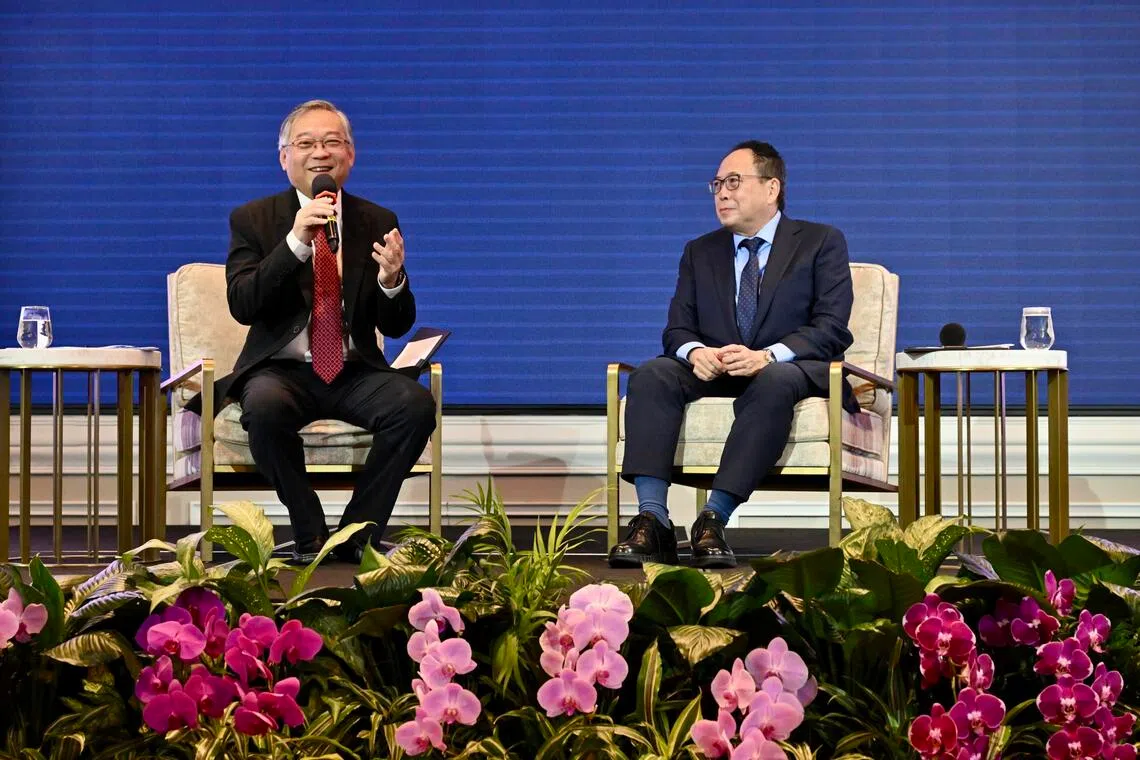
In a dialogue session at the Economic Society of Singapore’s 70th anniversary dinner, DPM Gan said he told Greer that Singapore does not use forced labour and “we frown upon forced labour”.
“They understand that Singapore doesn’t have forced labour, but they were concerned about Singapore allowing imports of products that are produced with forced labour and also trading with these products,” he said.
DPM Gan said he stressed that Singapore is a major trading hub, and that tackling forced-labour products in international trade requires international cooperation.
Both sides are discussing a “practical solution” that addresses US concerns while securing preferential tariff treatment for Singapore.
Rules of origin are also critical to shipping and trade, and Singapore does not support the use of its shipment hubs to bypass tariffs as it is “cheating”, DPM Gan stressed.
He cited the case of a Singapore-registered company which was charged here on Aug 14 for falsely declaring China-made mattresses as Singapore-origin goods to evade US import duties.
“We demonstrated to the US and the world that we take this very seriously,” he said, adding that Singapore has to uphold the credibility and trust that it has built up over the decades.
“It’s important for us to safeguard that trust by making sure that we are very stringent on the rules of origin… From time to time, we do need to take action so as to demonstrate our seriousness in enforcing the rules.”
The US is also investigating Singapore over what it describes as structural excess capacity in manufacturing, alleging that the Republic’s production capacity is untethered from domestic and global demand.
DPM Gan said he explained to Greer that the US allegations are untrue. Production in Singapore has to be at scale to be economical, but such volumes exceed what the small domestic market can absorb. The excess therefore has to be exported, resulting in a trade surplus.
“If we have excess capacity in Singapore, I’ll be dead. Because we are so scarce of resources, we employ our resources to the max. Sometimes we run our capacity to 120 per cent in order to meet our demands.”
He added: “I also reminded him that the US also has a trade surplus with Singapore.”
Aside from trade-related issues, DPM Gan said he also discussed opportunities for Singapore and the US to deepen cooperation, particularly as the two countries mark 60 years of bilateral ties in 2026.
With Singapore taking on the ASEAN chairmanship in 2027, he said he hopes the Republic and the region can work on more initiatives with the US. ASEAN and the US will mark 50 years of ties in 2027.
One potential area of collaboration is in AI governance.
In his opening speech at the event, DPM Gan also spoke about the impact of AI on jobs in Singapore.
Singapore’s AI strategy should not be limited to only a few sectors, and it must ensure that skilled trades and essential services continue to provide good job opportunities, he cautioned.
Good jobs are part of the economic strategy, and not simply a social outcome to be addressed after the strategy is decided.
Singapore would need to identify early roles that are potentially exposed to AI and create effective career bridges into work that “builds on existing skills, combining targeted training, guidance, job matching and actual placement”.
Therefore, companies should pay close attention to not only cost savings, but also job redesign, training and worker outcomes, to help people adapt before disruption turns into prolonged employment.
He acknowledged that advancements in AI will create new tasks and roles, but also lead to some existing ones to change, shrink or disappear.
This, however, is not likely to lead to immediate, economy-wide job losses, and there is no need to be alarmist, he stressed. But Singapore should not be complacent, and managing the transition well is critical.
Good jobs in an AI-led economy do not mean that everyone will and should be an AI engineer, DPM Gan noted. The strategy must encompass a broader range of jobs.
Many jobs in sectors such as allied health, care and early childhood education depend on “judgment, dexterity, trust and human interaction that technology can support but not easily replace”, he said.
Singapore should therefore focus not only on preserving these jobs but also on raising their productivity, improving their design, strengthening progression and supporting better wages.
“Productive work provides more than income. It gives people agency, dignity, social recognition and confidence that their effort will lead to progress and success,” DPM Gan said.
On a macroeconomic level, Singapore must continue to build on its strengths in reliability, security and strategic alignment as a trade and investment hub.
“A hub that is merely convenient or efficient can be bypassed for these considerations,” said DPM Gan. Singapore must move from just being open to being relevant.
The Republic’s role as a hub must also evolve from being a place through which goods, capital and data pass, to one where “these flows are decided, managed, financed, governed and translated into value”.
This ensures that a small economy like Singapore’s can create leverage in a more fragmented world by being useful to many other economies while being difficult to replace in a few key areas.
“We cannot do everything. We must concentrate on areas where we can build hard-to-replicate advantages, and become integral to companies’ supply chains and operations,” he said.
This would entail deepening Singapore’s capabilities in high-value manufacturing and trusted services, anchoring investments more firmly through partnerships with local enterprises and research institutions, and building up a strong base of local and global talent here.
DPM Gan pointed out that Singapore also cannot solely rely on its existing strengths to remain relevant. It must refresh itself by encouraging and supporting new firms and business models to emerge and grow here while also helping existing firms to restructure or pivot before their problems become entrenched.
He emphasised that Singapore should see its small economy as an advantage in its ability to adapt quickly, move early and adjust when global conditions change. “We must keep demonstrating the value Singapore creates for our partners too. A relationship is more durable when both sides have a tangible stake in its success.”

