


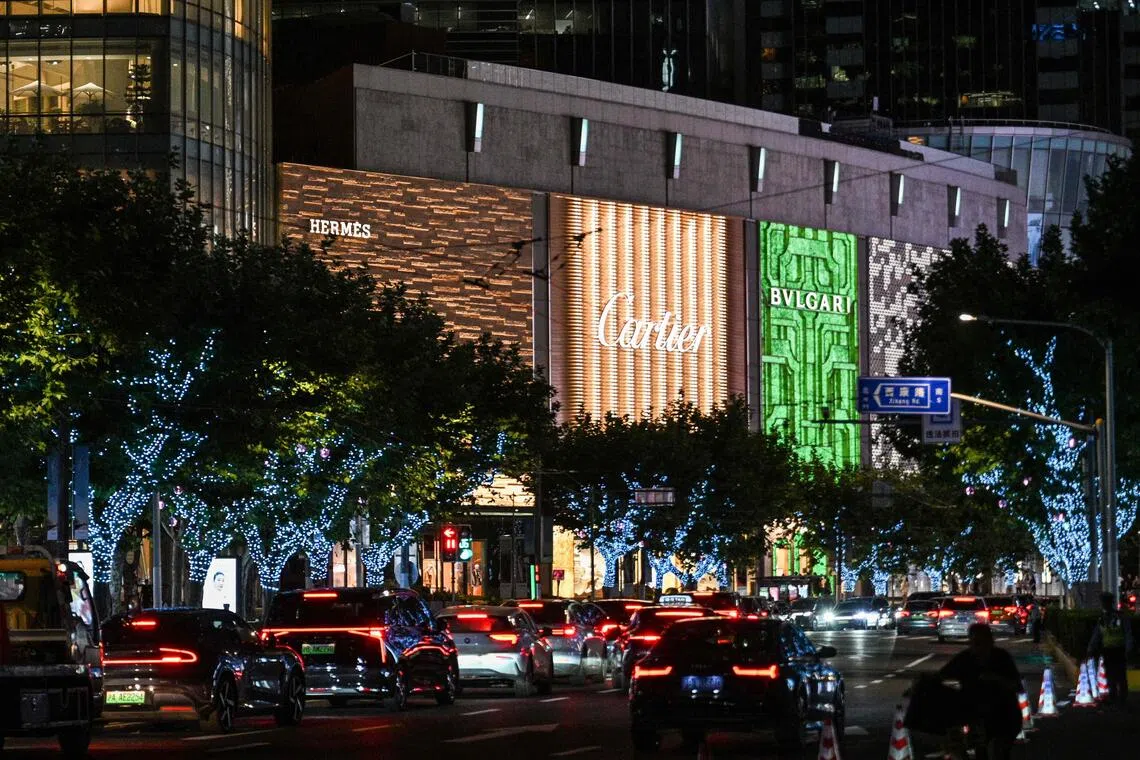
Europe’s biggest luxury firms are turning a little more positive on the crucial Chinese market, as a fragile spending recovery takes shape in the country.
Chinese household consumption is stabilising and even starting to rebound in some categories like high-end cosmetics, improving sentiment on China in the luxury sector, according to Bloomberg Intelligence analysts Simbarashe Gumbo and Laurent Douillet.
The market, whose health is essential to a broader luxury recovery, is still under significant pressure. Sales at the 25 biggest luxury labels in China dropped more than 10 per cent in July as the country tries to stem capital outflows and tax offshore wealth, dampening spending by its wealthiest citizens.
Earnings estimates now point to a pickup in performance as the year progresses. Gucci-owner Kering is expected to return to sales growth in the region that includes China by the fourth quarter of 2026, consensus shows. Growth in the region should accelerate for Hermes International, while declines are expected to slow down for jeweler Pandora.
For Kering, China is “the primary source of pressure across the portfolio, though trends improved notably through the quarter,” TD Cowen analyst Oliver Chen wrote in a note. The country is a “top strategic priority” for Kering, chief executive officer Luca de Meo said on the latest earnings call.
Trenchcoat maker Burberry Group reported a 9 per cent jump in retail sales in Greater China in the most recent quarter, supported by Gen Z demand.
“While the operating environment in China remains mixed, our actions are driving outperformance,” chief financial officer Kate Ferry said on the earnings call, citing new localised marketing campaigns including a documentary made in partnership with Chinese National Geography magazine.
“What we’re seeing in China is actually very positive,” chief executive officer Joshua Schulman said on the same call. “We’re very pleased to see our product and marketing continuing to resonate in one of our largest and most important markets.”
As for LVMH, the world’s largest luxury company, China “appears to be stabilising after several quarters of deterioration,” according to Chen. The company highlighted improving trends for cognac and beauty brand Sephora in the country in its latest earnings call.
Smaller players like Moncler are also well positioned. Citi analyst Thomas Chauvet increased his price target on the maker of luxury puffer jackets, saying that untapped market segments in the US and China create long-term growth opportunities for the firm.
Overall, “Richemont is benefiting from Hong Kong and Macau tourism, Kering is showing encouraging sequential improvement, LVMH continues to stabilise and Hermes remains the most consistent operator in the region,” Chen said.
This spending boost is primarily driven by high-net-worth consumers, following a K-shaped recovery, with the key debate centering around whether improving sentiment can broaden beyond affluent shoppers.
The tentative recovery in China will be key as the industry grapples with challenges on several fronts. Inflationary pressure is tightening discretionary budgets everywhere, while the war in the Middle East is hurting demand in shopping hubs like Dubai and restricting tourist flows to Europe.
“Without a more meaningful improvement in consumer confidence and stronger import flows into China, the path to reacceleration remains uncertain,” Deutsche Bank analyst Do-Hyun Yoo said. BLOOMBERG

