


SINGAPORE – Amid the rise of e-commerce, hyper-personalised service and the post-pandemic travel boom, hospitality has moved beyond one-size-fits-all.
Kung Teong Wah, cluster general manager for Parkroyal Collection Pickering and Parkroyal on Beach Road under the Pan Pacific Hotels Group, firmly believes that era is over.
Guests are so well travelled and diverse that even an order for a cup of coffee comes with its own distinct standards, he said.
“If you come from Australia, the expectation for your coffee is very different from someone who might be from Japan, India or Italy. Even the blend and the way the beans are extracted,” he said.
For guests who might want something comforting after a night out, Parkroyal Collection Pickering’s supper menu now offers a selection of hot porridge.
Kung added: “We are leaning into a lot more emotional intelligence to make guests feel pampered based on their needs. It’s no longer a standard operating procedure, it’s more cognitive.”
To that end, the hotel has flown in a UK-based trainer at a cost of about $100,000 to instruct 20 staff members on formal butler service, while also bringing in a professional storyteller to teach employees how to craft and share narratives.
Kung said: “We are leaning into a lot more emotional intelligence to make guests feel pampered based on their needs. It’s no longer a standard operating procedure, it’s more cognitive.”
Kung is also overseeing Parkroyal Collection Pickering’s ongoing upgrade of its lobby, bar, wellness floor, guest rooms, and urban farm and hydroponics facilities. With the room upgrades scheduled to wrap up in April 2027, the renovation follows the hotel’s October 2025 relaunch after a $3.7 million refurbishment of its event and function spaces.
Asked about the scale and speed of the upgrading works, Kung pointed to customer impatience – particularly among high-paying guests – as well as the cost of visiting Singapore.
“If we keep waiting, we’re going to not only lose business for this hotel, but also lose business for Singapore. We need to rejuvenate life and experience into hotels at a faster pace because the regional market is maturing and so much cheaper than us,” he said.
“It’s a matter of time before our competitors start to gobble up our business and make it less palatable for visitors to come to Singapore,” he said, adding that “guests are very impatient now because they are well educated and well informed through social media”.
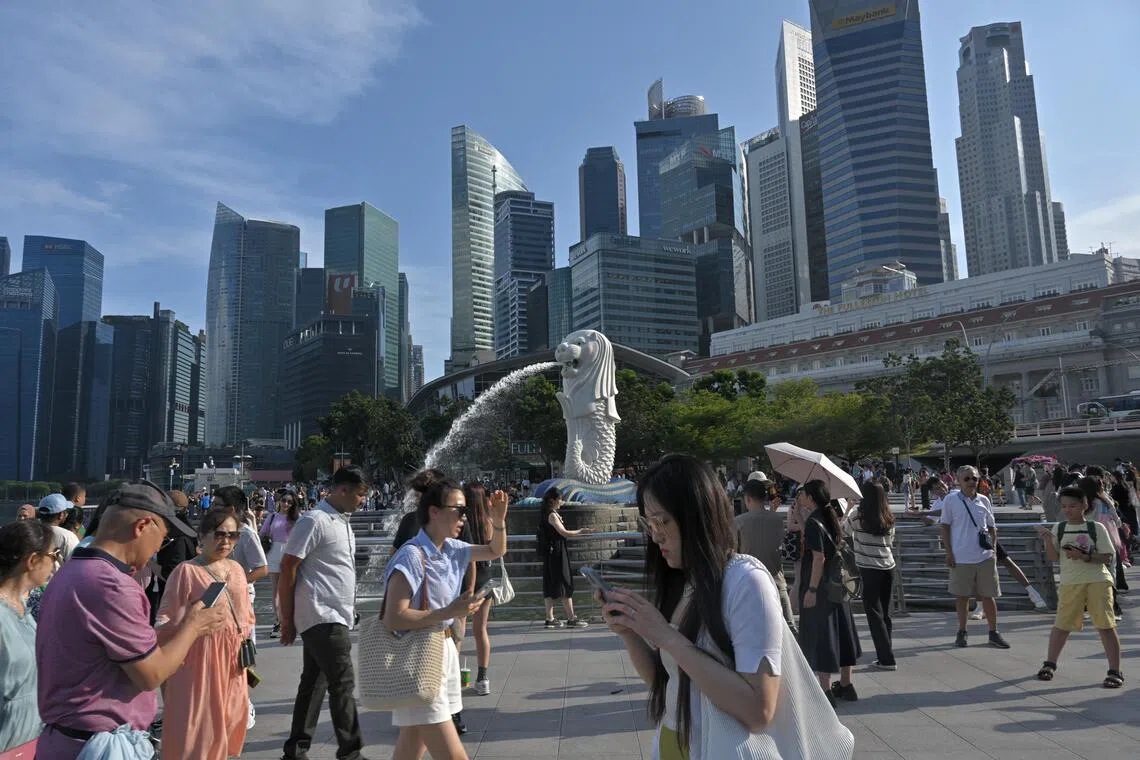
According to an Aug 17 report by BMI, a unit of global financial information services company Fitch Group, tourist arrivals in Singapore hit 1.63 million in July, 2.9 per cent lower than in July 2025.
From January to July 2026, total international arrivals was 9.8 million – a 1.9 per cent dip from the same period in 2025, and 11.7 per cent lower than pre-pandemic levels in 2019.
According to the Singapore Tourism Board (STB), mainland China remained Singapore’s largest source market for the January to July 2026 period, with arrivals rising 4 per cent to 1.9 million. This was followed by Indonesia at 1.3 million visitors, down 11 per cent, and Malaysia at 732,000 visitors, up 1 per cent.
STB noted that the increase in visitors from China was driven predominantly by families with children – who traditionally form the bulk of summer travellers from the market – bolstered by family-friendly offerings such as Disney Cruise Line’s Disney Adventure and Resorts World Sentosa’s Singapore Oceanarium.
Based on data from commercial real estate services and investment firm CBRE, the average daily rate in 2025 for a luxury five-star hotel in Tokyo was between US$630 and US$660 (S$801 and S$840). In London, it was between US$610 and US$640, and in Singapore, it was between US$440 and US$465.
Kung said: “As the Chinese saying goes, we need to si wei – think of the danger. We need to think about the crisis that is coming to us. If we are so content and don’t want to recreate, rejuvenate or reimagine our guest experience, we are probably in a very bad spot because it’s never cheap here in Singapore.”
To help offset the renovation costs, Parkroyal Collection Pickering had applied for the STB’s Hotel Rejuvenation Fund, which was launched in 2025 to help hotel owners and operators refurbish their properties to maintain the Republic’s position as a premier tourist destination.
The fund supports three key components: product enhancements that create differentiated guest experiences targeting specific segments and lifestyle trends; productivity improvements through adopting automation, technology and process redesign; and sustainability initiatives to reduce environmental impact.
Funds are disbursed on a reimbursement basis, subject to the hotel achieving agreed-upon project deliverables and milestones, as well as the actual qualifying costs incurred.
The projects are evaluated on four criteria: increased productivity per staff member; reduced carbon emissions; improvements in visitor satisfaction, total revenue or brand value; and the redesign of at least three job roles.
Due to strong industry interest, STB said it has extended support for the fund by a year.
Rachel Loh, STB’s executive director for hospitality and tourism talent, said the extension acknowledges that high costs and operational pressures – exacerbated by the Middle East crisis – can deter hotels from undertaking necessary upgrades to meet evolving guest expectations, emerging travel trends and the growing demand for sustainable practices.
“Upgraded hotel experiences help create a more vibrant and attractive Orchard Road, complementing broader efforts to breathe new life into the area,” she added.
Three other hotels have successfully applied for the grant. Jen Singapore Tanglin by Shangri-La is using the funds primarily for backend operations and implementing artificial intelligence to streamline work processes.
Days Inn by Wyndham Singapore Novena will introduce wellness-focused features – such as magnetic therapy mattress pads and a Hyrox-inspired fitness facility – to cater to business and medical travellers near the Novena hospital belt.
Meanwhile, Furama City Centre in Chinatown will centre its rejuvenation project on guest experience and operational sustainability.
On the technology front, the hotel in Eu Tong Sen Street will introduce smart room controls – such as auto-lighting in corridors and automated controls for curtains and air-conditioning – alongside AI-powered cleaning robots and energy-efficient air systems. Some rooms will also be converted into family-themed spaces.
Furama City Centre general manager Carol Yen said the upgrades will start in the third quarter of 2026 and be completed by end-2027.
She noted that the hotel aims to attract more families seeking affordable staycations with their young children, as well as older relatives who may not stay the night but will spend the day there for a meal.
Ananth Ramchandran, CBRE’s head of advisory and strategic transactions for hotels and hospitality, Asia, said these refurbishments matter for hotel operators’ bottom line and, by extension, the industry’s competitiveness as a whole.
“They upgrade more than just simple efficiency gains. They translate into fresher products, better service consistency and a stronger case for room rates that reflect the investment – which in turn lifts the overall visitor impression of the area, not just any one hotel,” he said.

