


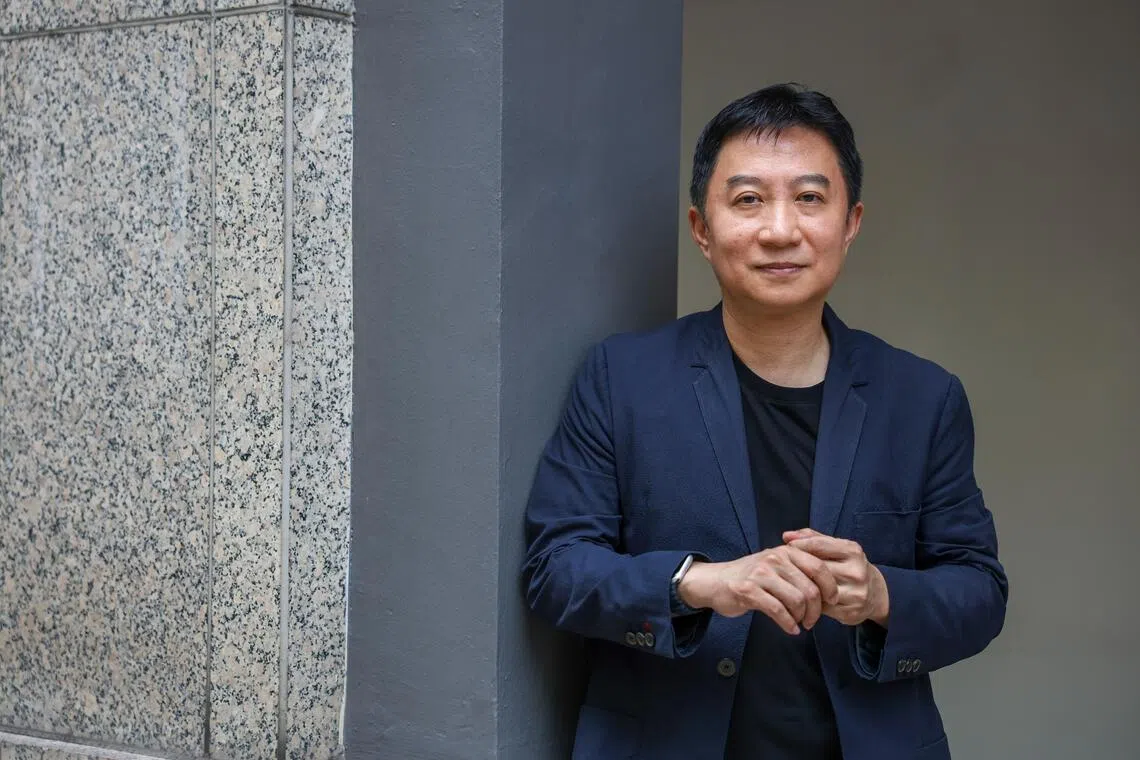
SINGAPORE – If you have booked a car on ride-hailing app Ryde, there is a slim chance that the company’s chief executive himself might have been in the driver’s seat.
Terence Zou has clocked over 700 rides since he founded the company in 2014, and he has had his fair share of interesting experiences with passengers.
He recalls being scolded by one because he could not find the correct drop-off point, as it was marked ambiguously on the map.
There have also been pleasant surprises. He reconnected with a former student who had helped him on a project when he was a lecturer at the National University of Singapore’s Business School about a decade earlier.
“You get to meet different people and see different aspects of life as a driver, and these are the experiences that make the driving experience a human one, more so than driving a car by yourself,” Zou told The Straits Times.
More importantly, being a driver on the platform gives him a better idea of how the app is working and benefiting its users.
The ‘human element’ of driving
For Zou, while Ryde is a technological product, the human element delivers customer service and remains integral to the customer experience.
“You can build relationships and pass leads, or even find out simple things like a good place to eat, just by having a conversation. That’s the human touch in day-to-day life, and that’s what makes the whole experience more real.”
While self-driving vehicles will be part of the future, Zou believes they will not be the only means of transportation available. Human drivers will still be here to stay.
This is something that an entirely automated ride-hailing service would not be able to offer. Passengers taking an autonomous vehicle (AV) to the airport would still have to carry their own luggage out of the car when they arrive, he chimes.
Singapore, a small city-state, has a private car population of around 500,00, and Zou estimates that around 0.5 per cent to 1 per cent could comprise AVs in the future.
“Rather than replacing human drivers, I see AVs complementing them.”
He envisions AVs being deployed in sectors where automation is especially beneficial, such as baggage transportation at airports or equipment transportation in industrial areas, where driving conditions may not be the most conducive. AVs could also be more effective in secluded areas for shuttling people from point to point.
Ryde is currently in talks with Singapore-based AV company MooVita and Chinese AV firm UISEE for potential collaborations.
Trials of commercial autonomous shuttle services are already underway in Punggol with the cars running on fixed routes, while on-demand rides are expected to launch in the coming months.
It is currently infeasible to operate a fully autonomous ride-hailing fleet. Zou said companies would not only need a minimum fleet size to make such services sustainable, but they would also require powerful servers to control the vehicles, which could be very expensive to maintain.
“I believe there is no AV company that is profitable at the moment,” Zou said. “When the computing power becomes cheaper, then perhaps we might be able to make the technological leap.”
There are also safety considerations. A server shutdown, for instance, could lead to a widespread malfunction of an entire fleet, and such considerations also impact insurance coverage.
Going public
Ryde started as a carpooling app a year after Grab and Uber had already established their presence in Singapore. Zou said the company focused on the carpooling concept, as it was a more environmentally friendly alternative to taxis than the two major ride-hailing platforms
It was only in 2018 that Ryde launched its own ride-hailing service, filling the gap that Uber had left behind when it exited Singapore that year. Gojek would enter the market a few months later.
While there are no publicly available figures on Ryde’s market share, a 2022 report by data and analytics firm Measurable AI, which tracked ride-hailing order volumes via e-receipts, showed that Ryde has around 6 per cent of Singapore’s ride-hailing market share.
With competition in the ride-hailing industry heating up, carpooling continued to be Ryde’s core business, which it highlighted in its prospectus when it launched its initial public offering on the New York Stock Exchange (NYSE) in 2024.
Zou said he had originally intended to list the company on the Catalist board of the Singapore Exchange, but market conditions were unfavourable at the time, with few companies going public.
Meanwhile, several Singapore companies had already listed in the US, attracted by higher valuations, liquidity and trading volumes. These included Grab, which went public on Nasdaq in 2021 through a merger with a special purpose acquisition company.
However, Ryde’s share price tanked a few months after its listing, plunging 80 per cent from a peak of US$22.49 to US$2.08, almost half of its IPO price of US$4. By the end of 2024, it was trading at just over US$0.50.
Analysts said the plunge was likely driven by momentum-based investors seeking to profit from price movements, and Ryde was more vulnerable to such movements due to lower liquidity and often less regulatory scrutiny over smaller companies on the NYSE.
Ryde was trading at US$0.97 on Aug 18, up more than 220 per cent from a year ago.
“We cannot control the stock price. But what we can do is to continue to do our best, and improve the product and our financial numbers,” Zou said. “Our focus remains on executing our business strategy and delivering long-term value to our stakeholders.”
A return to SGX could be on the cards too if conditions are right, he added.
Ryde has around 25,000 registered drivers on its platform. For the first quarter of 2026 ended March 31, it reported $3.8 million in revenue, up 38.6 per cent from a year ago. Net losses also narrowed from $3.6 million to $2.1 million.
More opportunities to grow
The ride-hailing and carpooling industry has room to grow further in Singapore with car ownership already starting to wane. In July, the number of private cars in Singapore fell to its lowest since 2019, while rental cars grew to over 97,000 units, making up 14.9 per cent of cars on the road.
According to Zou, modern lifestyle habits and rising costs mean that fewer Singaporeans see a need to own a car. Instead, on-demand car usage will rise as ride-hailing and carpooling have made commuting more efficient.
“The marginal cost of the next car should be passed on to someone who is sharing his car, not the next person driving alone.
But he conceded: “It’s a mindset shift, and that will take time.”
Singapore, where Ryde has operated for more than a decade, remains the company’s core market.
The firm said it will continue to focus on strengthening its position here while selectively pursuing overseas growth opportunities.
Ryde is now preparing for its overseas expansion, with Hong Kong as its first destination. It announced in April that it plans to acquire up to 50 taxi licences there and deploy up to 50 electric vehicles (EVs).
Hong Kong’s ride-hailing services like Uber had been operating in a grey area due to the lack of an official framework permitting private-hire cars to ferry passengers. But the government is implementing a new framework, with most of the new regulatory changes taking effect from Aug 3.
The government has already invited platforms to apply for operator licenses, and it will begin approving them in batches in late November.
This is a huge opportunity that Ryde could capitalise on, as the market is big enough for two to three players, Zou said. He pointed to Hong Kong’s similarities to Singapore in its demographics and high gross domestic product per capita as strong pull factors.
Ryde also signed a memorandum of understanding with VinaTaxi, a licensed taxi operator in Vietnam, to explore potential strategic collaboration opportunities there. These include the potential deployment of Ryde’s platform for VinaTaxi’s existing taxi fleet, the development of an electric motorcycle ride-hailing ecosystem, and the phased introduction of EVs.
Ryde will focus on “differentiated, niche services” in partnerships with local companies instead of trying to compete with Grab, which already has an established presence in the country, Zou said. This could include collaborating with airport transfer services, for instance.
Its business model will not change, even as it evolves its offerings to meet the demands of new markets, Zou stressed. It will focus on driver acquisition and engagement through competitive earnings opportunities and incentives, including maintaining its zero-commission policy for its drivers.
This allows them to keep their full fare earnings – breaking from the market practice in Singapore where dominant players charge a 5 to 10 per cent service fee on top of taking commissions from drivers.
“It is our core belief that happy drivers will give good services and that will lead to happy riders.”

