


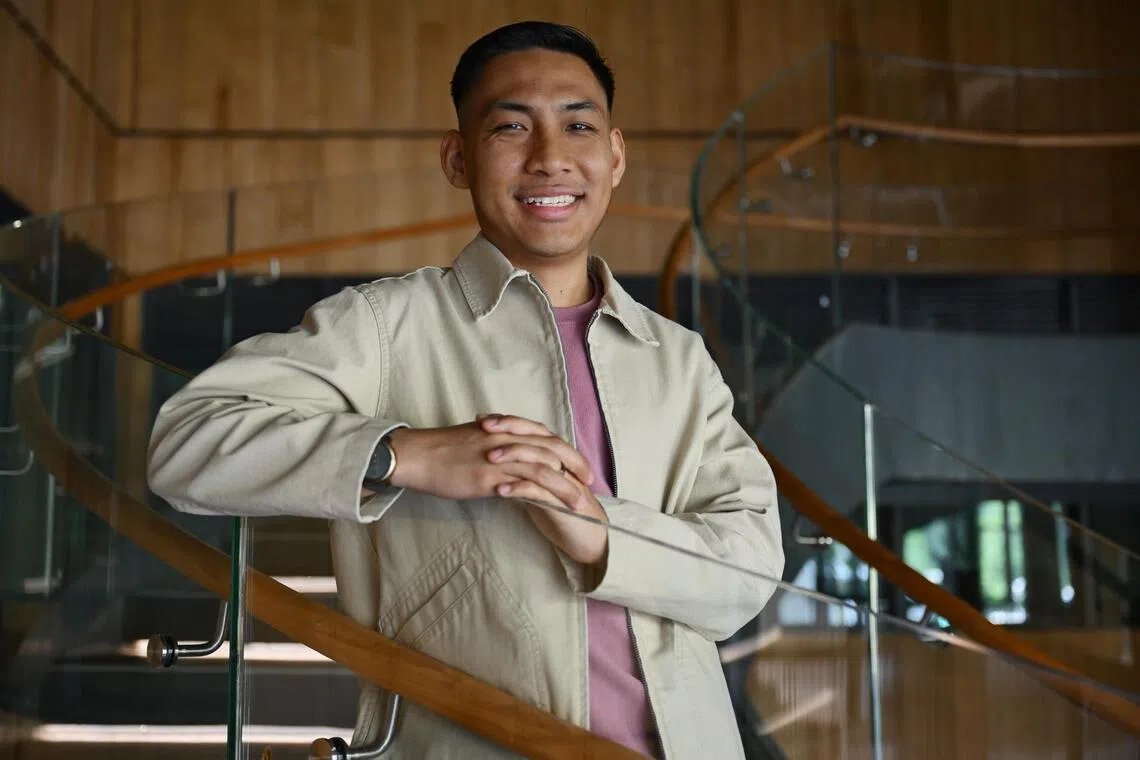
SINGAPORE – Muhammad Ridhwaan Radzi’s first lesson in investing came early in life at age 17, when he invested $1,000 in an Islamic fixed deposit with CIMB Bank.
His interest in Islamic finance deepened as he began creating content, conducting research and organising community events on the subject in Singapore in 2023.
“(I realised that) discussions around halal investing consistently drew the highest engagement, yet practical tools and access remained limited,” said Ridhwaan.
This led him to start building RizqX in his final year at Nanyang Technological University (NTU), where he was pursuing a business degree specialising in international trade and a minor in entrepreneurship. He graduated in 2023.
Ridhwaan, now 30, co-founded Rizqx with a partner he met during national service, who is now an Oxford PhD candidate specialising in AI and machine learning. Their investment platform is designed to give Muslims in South-east Asia access to halal, or syariah-compliant, investment opportunities that are often fragmented, under-publicised or difficult to evaluate.
While building RizqX, Ridhwaan and his team identified a major gap that is often overlooked in the investment journey for Muslims: the payment of zakat on investments.
Zakat is a compulsory wealth contribution in Islam that includes cash, gold, insurance-related savings and other assets, distributed to designated recipients, including the poor and needy.
“Many find it difficult to calculate zakat accurately across different investment assets, or to manage distribution in a transparent and structured way,” he said.
Zakat is typically 2.5 per cent of a person’s wealth if it reaches a minimum threshold, after it has been held for at least a year.
To address this gap, Ridhwaan and his team built a zakat calculation and distribution platform that allows users to calculate zakat across 16 different asset and investment categories, choose the calculation methodology they follow, and specify their preferred beneficiaries across multiple approved organisations.
“The idea received early support from NTU, went on to win a competition at NUS, and subsequently received backing from NUS as well,” said Ridhwaan.
RizqX was later accepted into Singapore Management University’s Institute of Innovation and Entrepreneurship incubation programme in 2025.
Today, he is the managing director of RizqX, which aims to close the loop between ethical investing and responsible wealth redistribution, while also dispelling the misconception that halal investing is narrow or limiting.
Do you invest in anything? If yes, what do you invest in and why?
Yes, I invest across a range of assets, including stocks, exchange-traded funds (ETFs) and property crowdfunding. My approach reflects my belief that halal investing is far more diverse than many people assume.
At its core, halal investing is about moral, interest-free growth. It goes beyond traditional stocks and mutual funds to include modern asset classes like property crowdfunding, global syariah-compliant ETFs, private equity, and venture capital.
What’s your approach when it comes to growing your money?
It can be summed up in three words: passion, purpose and process.
The passion comes from a long-standing interest in Islamic finance, which began during my formative years at Madrasah Aljunied Al-Islamiah, a full-time Islamic educational institution.
Over time, that interest evolved into a clear purpose: to contribute back to the community by making Islamic finance more accessible, practical and relevant in today’s context.
What was your first exposure to investing and what was your first investment?
My first exposure to investing came shortly after I learnt about Islamic finance and wanted to apply it in a practical way. I started simply by walking into a bank that offered Islamic banking products, in this case CIMB Bank, and placing $1,000 into an Islamic fixed deposit.
Because of how Islamic fixed deposits are structured, I received a modest upfront return of about 2.38 per cent, which could be withdrawn immediately.
While I would not consider this a true investment in the conventional sense, it helped me become comfortable with the idea of putting money to work in a way that aligned with my values.
My first proper investment came later, after I opened a brokerage account and invested in Sabana Industrial REIT, which at the time was Singapore’s first listed real estate investment trust structured to be syariah-compliant. That experience marked the beginning of my deeper engagement with investing.
What has been your biggest financial mistake?
My biggest financial mistake was investing $6,000 without doing sufficient due diligence. About $2,000 went into a business coaching platform that promised lifetime access and support. After the initial payment, the engagement quickly faded and I was eventually ghosted. The remaining $4,000 was invested in a peer-to-peer crowdfunding platform focused on Indonesia, which did not perform as expected.
Both decisions were driven more by optimism than discipline. They were painful lessons and even today, I still think about them. However, they fundamentally reshaped how I approach money.
I became far more cautious about unproven platforms, overly attractive promises, and investments that lack transparency or accountability.
In hindsight, those losses were expensive, but they forced me to develop a much stronger framework for risk, due diligence and patience.
What has been your best financial decision?
My best financial decision was investing in gold in 2023 when I was preparing for my wedding and needed to build up savings in a relatively disciplined way.
I had set a target of $15,000 but had only managed to save about $13,000. Instead of keeping everything in cash, I placed a portion into gold as a store of value.
As gold prices rose over that period, the value of my holdings increased and brought me close to my target amount. While the gains were not dramatic, they were meaningful in a practical sense, as they helped bridge a shortfall of nearly $2,000.
What was your first job?
A waiter at Swensen’s just after finishing my O levels in 2012.
What did you save up for as a child? Have your saving habits changed since?
As a child, I naturally gravitated towards saving even when there was no clear goal in mind.
One of my first memorable purchases was an Arsenal jersey that cost around $70 when I was 12, which felt significant at the time. My allowance was about $10 a week, and I remember putting most of that into a piggy bank and relying on the food my mother packed for school.
From school through university and into working life, I continued to prioritise saving and keeping everyday expenses low. I have always been comfortable keeping my day-to-day expenses modest, whether that means eating at home, bringing my own lunch, or choosing simple and affordable meals.
What was your most memorable encounter with money?
I started a regular savings plan while I was still in polytechnic. I committed $200 a month and, over time, managed to build it up to about $8,000. That experience was significant because it showed me, at a relatively young age, how consistency and discipline could compound into something meaningful. Unfortunately, I later liquidated that amount and reinvested it poorly – in what I mentioned were my worst financial mistakes.
Where’s home for you?
A four-room flat under the Sale of Balance Flats scheme in Tampines.
What do you drive?
I don’t drive a car at the moment but if I can afford it, I would go for a Ford Mustang as my personal ride and a Vellfire as a family car.
What does work-life balance mean to you?
To me, it does not mean a clean separation between work and rest because work, especially in the early stages of building a business, never truly ends.
At this phase, we are still focused on building momentum and chasing sales, and many processes have yet to be fully automated.
That said, I do not believe productivity is simply about working longer hours.
What would your perfect day look like?
A perfect day for me begins with a good night’s sleep, ideally turning in by 10pm. I wake up early for dawn prayers at around 4am, which sets the tone for the day, followed by a few hours of focused work while the mind is still clear and distractions are minimal.
After that, I exercise for about an hour before heading into the office. The rest of the day is spent on meetings, problem-solving and executing key tasks.
What would you do if you suddenly had a windfall of $1 million?
If I were to receive a $1 million windfall, my first priority would be to clear any outstanding debts, ideally just my housing loan. I would also set aside a portion to support my parents and my wife, as financial security for family comes first.
I would reinvest the remaining funds into the business. My focus would be on strengthening the foundations, building sustainable systems, and accelerating our long-term vision.
If you suddenly had only $100 to your name, what would you do?
I would concentrate on developing and monetising the skill of selling by leveraging skills I already have, such as building websites and landing pages on WordPress, and offering these services to contacts who run organisations and small businesses.

