


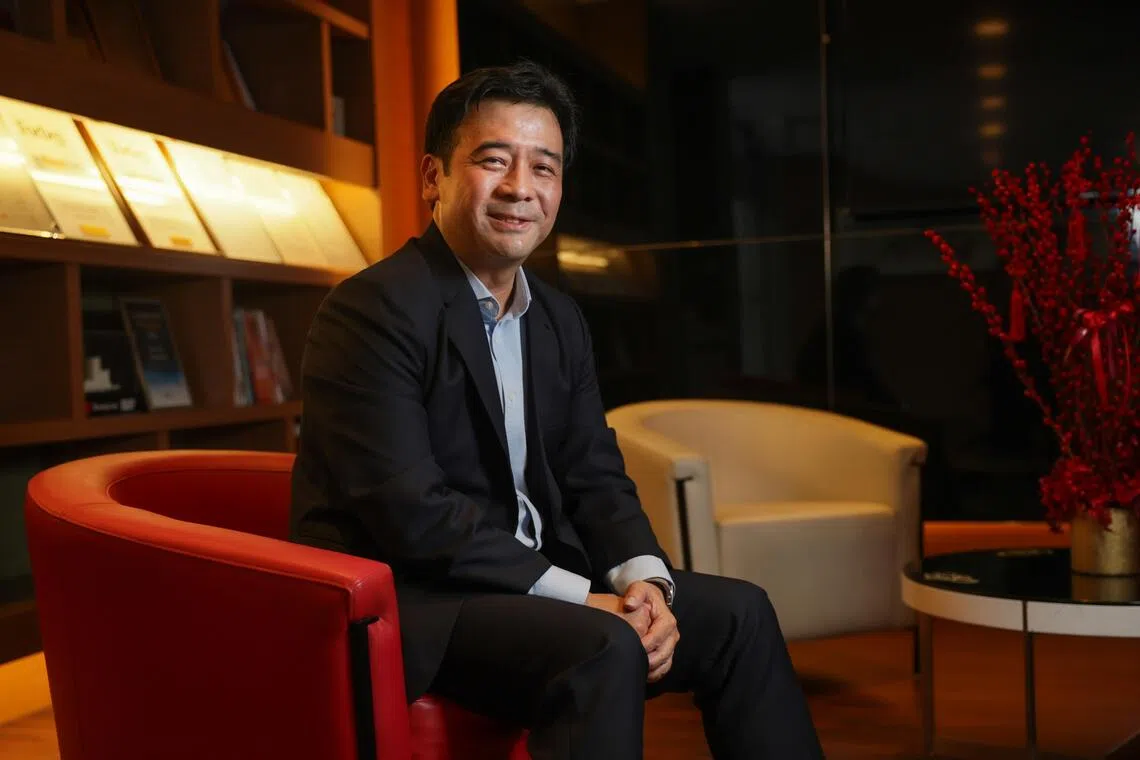
SINGAPORE – One of the construction sector’s biggest challenges is overcoming its outdated image among locals and younger Singaporeans, who may not realise how far it has evolved into a technology- and environment-driven business.
“For locals, the construction industry is still viewed as very backward, and we have an outdated image with the younger generation,” said Andy Lu, chief executive of home-grown property and construction firm Wee Hur.
“But the reality on the ground has changed. The construction sector has evolved a lot over the years. We are actually a technology business,” he told The Straits Times. “Instead of having to slog under the hot sun… where possible, we now use technology.”
In fact, construction is where those fresh out of polytechnics and universities can make their mark the most, Lu said.
Rather than entering an industry where technology is already well established, young people who join the construction sector have an opportunity to shape one that is ripe for change and already being transformed by new technologies.
“Construction is always ongoing, even if we do not have a lot of greenfield land in Singapore,” said Lu, referring to land that has not been built on before.
“There will also be a lot of redevelopment work to do as buildings grow old, and projects might be more complex, such as those involving underground highways and transport lines.”
More complex projects and new technologies are also prompting the construction industry to adopt more advanced solutions and digitalise its operations, Lu said.
For example, construction companies have started tapping robotics to support their work where possible, and now use artificial intelligence to augment their abilities.
Wee Hur also uses 360-degree cameras to track progress at its building sites and AI-powered cameras to flag safety breaches.
Its engineers now refer to digital plans on tablets instead of printed drawings.
Lu hopes these changes will help attract younger, tech-savvy workers to the sector.
“But it’s still a way off because what they perceive construction to be and what is happening on site is different. We still need to do a lot of work to sell the industry to the young population,” he said.
“We are just starting and there’s a lot of new technologies we are still trying to adapt to our use. We hope the younger generation can contribute with their familiarity with and passion for technology.”
He added that there are many opportunities for young graduates, across areas such as engineering, project management, quantity surveying, and workplace safety and health.
“We need more people to join the sector and contribute to its growth. But of course, we are competing against a lot of other, newer industries.”
Construction boom
Construction’s need for tech talent comes as the industry is booming, with work to be done across ports and airports, as well as data centres and Build-To-Order flats.
The sector was recently named by the Singapore Exchange as one of the best-performing on the stock market in the first half of 2026.
The construction sector grew more than 11 per cent in the first quarter of 2026, before growing a further 6 per cent the second quarter, advance estimates showed.
Lu, who has been with the Wee Hur group since 2006 and is responsible for the overall operation of the group’s construction arm, said the company, which started in 1980 and was listed in 2008, also sees many opportunities for further growth.
For one thing, Singapore will see big projects in the next few years such as the Long Island coastal reclamation, Changi Airport Terminal 5 and healthcare facilities due to the ageing population.
Housing projects will continue to ramp up as well.
“So in the next 10 years, we expect demand to still remain elevated,” Lu said.
The company’s own projects include an international school in Singapore – the Wycombe Abbey School in Hougang – and it is involved in the redevelopment of the former Hotel Miramar into DoubleTree by Hilton.
Besides construction, Wee Hur also runs a real estate development and investment arm.
In April, its private residential development Bartley Vue near Bartley MRT station obtained its temporary occupation permit and was 100 per cent sold.
Other fully sold residential projects in Singapore by Wee Hur include Parc Centros, Parc Botannia, Urban Residences and Villas @ Gilstead.
The sales launch of its Upper Thomson development with 596 units is targeted for the first half of 2027.
Wee Hur also has a fund management arm to recycle and redeploy capital.
The company saw a 47 per cent rise in revenue for its 2025 full-year results, reaching $295 million.
Adjusted net profit rose 130 per cent year on year to $106 million.
Grappling with challenges
As construction experiences a boom, sustainability within the industry is emerging as a key area of growth, and one that could appeal to young people who are passionate about the environment, said Lu.
This is vital, as future construction projects in land-scarce Singapore will need to be carefully looked at to ensure the work is done responsibly and does not have a negative impact on its surroundings.
To play its part, Wee Hur uses battery energy storage systems for its construction projects, instead of large generator sets to power cranes. These storage systems cut carbon emissions by up to 70 per cent.
Where possible, the company is also looking at using solar energy as an alternative and has installed solar panels at one of its construction site offices.
However, greener construction methods take time to develop and generally become cost-effective only when adopted on a larger scale, Lu said.
Besides trying to be more sustainable and hiring more talent, the construction sector also grapples with the rising costs of manpower and materials, especially with energy costs that have gone up due to volatile oil prices because of the US-Iran war.
“We try to plan ahead and secure contractors early so we have sufficient time to buffer against disruptions,” Lu said, adding that there have not been major delays or disruptions to Wee Hur’s projects.
The firm also entered the Hong Kong market in 2026 and bought a building in Kowloon to be turned into student accommodation. It already has a foothold in the student accommodation market in Australia.
“We are always on the lookout (for new markets), but it is never easy to start from scratch in a new country,” Lu said.
“At the same time, we also try to leverage our partnership with various partners who may be more familiar with the different markets.”

