


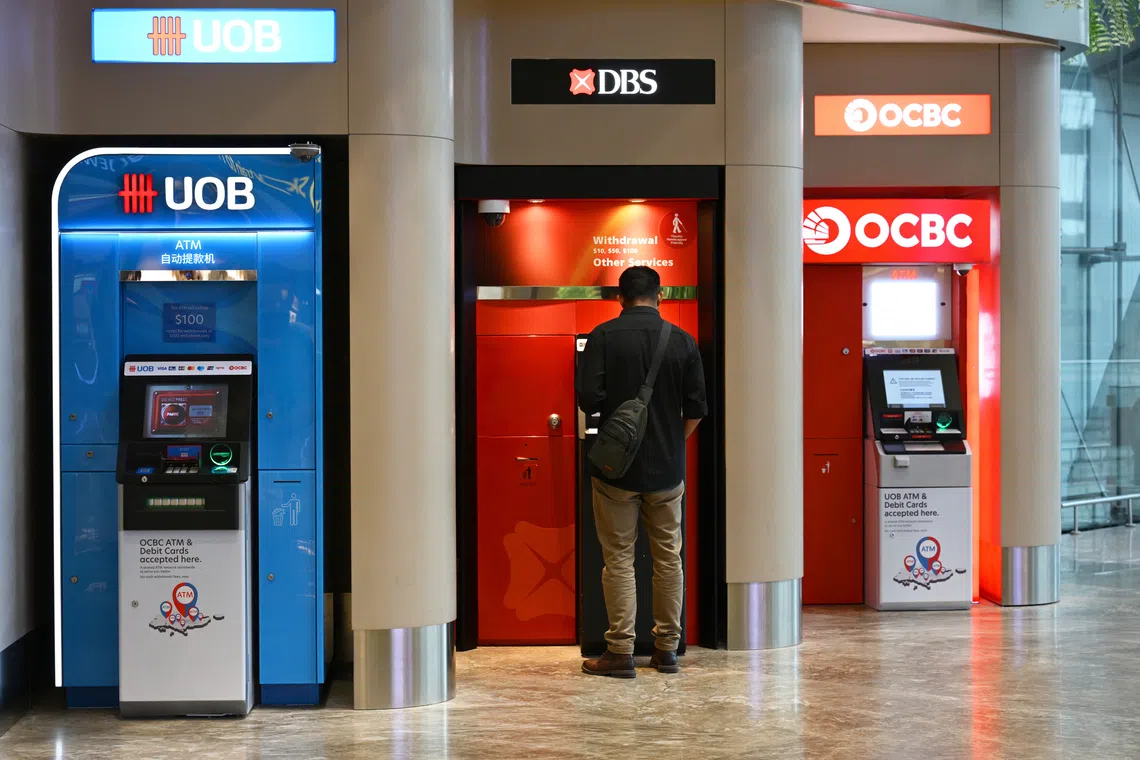
SINGAPORE – DBS and OCBC shares surged to record highs this week after the Singapore banks posted strong second-quarter results fuelled by their booming wealth management businesses, while UOB’s stock struggled to keep pace.
OCBC shares crossed the $30 mark for the first time and closed 3.94 per cent higher at $30.30 on Aug 7. DBS Bank closed 3.07 per cent higher at a fresh peak of $76.33. UOB, however, ended down 0.23 per cent at $43.30.
All three banks declared interim dividends.
DBS will pay shareholders 81 cents a share, comprising a 66-cent ordinary dividend and a 15-cent capital return dividend, after net profit rose 9 per cent to $3.08 billion in the quarter on record wealth-management income.
OCBC will pay a 47-cent dividend after its second-quarter profit jumped 22 per cent to $2.22 billion, while UOB will return 88 cents a share to shareholders as profit rose 10 per cent to $1.48 billion.
Macquarie Capital head of ASEAN equity research Jayden Vantarakis noted that the bank’s 8-basis-point quarter-on-quarter net interest margin decline was the largest among the three banks.
UOB’s new non-performing assets, or loans that turned problematic, hit $902 million in the second quarter, up 90 per cent year on year due to one real-estate account in Greater China. UOB noted that adequate provisions have been pre-emptively set aside to buffer against this exposure.
DBS and OCBC raised their 2026 financial targets, while UOB kept its guidance largely unchanged, except that it now expects low single-digit fee income growth, down from its previous forecast of high single-digit fee income growth.
Yen struggles to keep intervention gains
The Japanese yen struggled to hold onto its recent sharp gains from a joint US-Japan currency intervention.
The yen was around 157.80 per US dollar on Aug 7 after strengthening to 155.20 per US dollar on Aug 3, but remains stronger than a multi-decade low of about 164.
The yen weakened against the Singapore dollar over the week, with one Singapore dollar buying about 123.44 yen on Aug 7.
Several factors are weighing on the yen. Although the Bank of Japan has raised benchmark rates to their highest levels in decades, they remain low relative to those in the US and other major economies. That can encourage investors to borrow yen to invest in higher-yielding dollar assets, putting selling pressure on the Japanese currency.
Markets are also wary of Japan’s massive debt burden, which exceeds 200 per cent of GDP, while its persistent budget deficits have fuelled concerns. Such fiscal strains can undermine confidence in Japanese assets and weigh on the yen.
The Middle East conflict has also added pressure on the yen, with Japan heavily reliant on imported energy, and the region accounting for most of its oil supplies.
Vincent Chung, co-portfolio manager for diversified income bond strategy at T. Rowe Price, said that the market generally expects intervention to slow the yen’s decline rather than produce a sustained recovery.
For the yen to experience a more durable reversal, the Bank of Japan would likely need to bring forward its rate-hiking cycle, which could encourage Japanese investors to repatriate more overseas capital, said Chung in an Aug 5 note.
Alternatively, a broader macroeconomic catalyst would need to emerge, he added.
SpaceX, other AI stocks surge
Shares of SpaceX gained 20.5 per cent to close out a volatile week at US$133.11, as investors stepped back in to scoop up the shares following the expiration of an insider share lockup period that more than doubled the public trading float.
Over 900 million insider and employee shares were freed up for trading – the first in a series of restrictions scheduled to lift over the next few months.
While SpaceX’s IPO was the largest in US history, it kept a tight public float with fewer than 5 per cent of its shares available for open market trading.
The share price rebound followed an initial post-earnings slump, which saw SpaceX posting a net loss of US$541 million and AI infrastructure spending of US$15.8 billion for the second quarter of 2026.
Shares of AI stocks surged over the week too, as analysts remained upbeat about the sector’s longer-term prospects despite risk of near-term turbulence.
Nvidia shares rose 10.9 per cent over the week to US$223.96, Advanced Micro Devices gained 1.5 per cent to US$483.36 and Micron surged 6.41 per cent to US$877.57.
OCBC executive director for wealth advisory Afdhal Rahman highlighted that recent earnings from Amazon, the largest AI cloud hyperscaler, showed that demand for AI infrastructure and services remains robust.
He noted that AI adoption appears to be moving beyond experimentation and into real-world deployment, as enterprises increasingly use the technology to drive productivity gains and lower costs.
“Taken together, these trends suggest that while periods of volatility are inevitable as markets reassess valuations and earnings expectations, the structural drivers underpinning the AI theme remain largely intact,” he said.
Oil prices climb, gold jumps above US$4,300 an ounce
Brent crude oil climbed more than US$1 to settle at US$83.55 a barrel on Aug 7, driven by ongoing market uncertainty over negotiations to reopen the Strait of Hormuz.
Oil prices fell earlier in the week as signs of progress in negotiations raised hopes of a possible resolution to the Middle East conflict, which had entered its sixth month.
Meanwhile, gold prices surged above US$4,300 an ounce this week, after a weaker-than-expected US jobs report reduced expectations of a Federal Reserve rate hike in September.
Lower interest rates generally make gold more attractive because gold does not pay interest or dividends, reducing the opportunity cost of holding it relative to interest-bearing assets.
UBS said in an Aug 7 report that it expects gold prices to reach US$5,000 an ounce in the first half of 2027, driven by potential Fed rate cuts, a softer US dollar, and steady central bank demand.
However, the bank also said that the path to US$5,000 would not be smooth as near-term risks such as inflation or a more hawkish Fed rate path remain.
Other market movers
Yangzijiang Shipbuilding shares jumped 6.9 per cent to close at $4.20 on Aug 7 after the shipbuilder posted strong first-half earnings a day earlier.
Net profit for the period ended June 30 rose 28.4 per cent to 5.4 billion yuan ($1.02 billion).
This was mainly attributed to higher shipbuilding revenue from the progressive construction of vessels secured at higher contract prices and a favourable product mix which included ultra-large containerships and very large ethane carriers.
Shares of JustCo fell 1.6 per cent to close at 64 cents on Aug 7, well below its IPO price of 94 cents a share.
During its first results briefing on Aug 6 since listing on the SGX in May, Singapore’s largest co-working operator said it will pay out half of its net profit as dividends starting from financial year 2027 – signalling confidence in generating “meaningful” profits as its business expands.
For the six months ended June 30, net loss narrowed 52 per cent to US$839,000, from US$1.7 million a year ago.
DBS in July initiated coverage on JustCo with a “buy” recommendation and target price of $1.06 as it believes JustCo – with 50 centres across key APAC markets and approximately 35,000 workstations – is well-positioned to benefit from structural growth in flexible workspace demand across Asia-Pacific.
Shares of Singapore Exchange gained 0.2 per cent to close the week at $24.51 after it posted a nearly 25 per cent jump in adjusted net profit to $759.5 million for 2026.
It also has a pipeline of about 50 companies, including companies in sectors such as digital infrastructure, healthcare and consumer, keen to list on the exchange, it said on Aug 6.
The 21 new SGX listings it hosted had raised $4.1 billion in 2026, up from the six listings that raised $25.7 million the year before.
What to look out for next week
It will be a shorter trading week as the local bourse is closed on Aug 10 in observance of National Day.
Investors will be watching how the banks’ results continue to feed through into their share prices, dividend expectations and the broader Straits Times Index.
Singapore’s earnings season rolls on with a busy week ahead, with UOL and City Developments Limited among the companies due to report, alongside StarHub, Sembcorp, Wilmar International as well as China Aviation Oil and CNMC Goldmine.
The Ministry of Trade and Industry will release the full second-quarter economic survey on Aug 11, covering GDP, sector performance, sources of growth, inflation, employment and productivity. The advance estimate showed GDP grew 5.7 per cent year-on-year in the period, so investors will be looking for more details and any revisions.

