


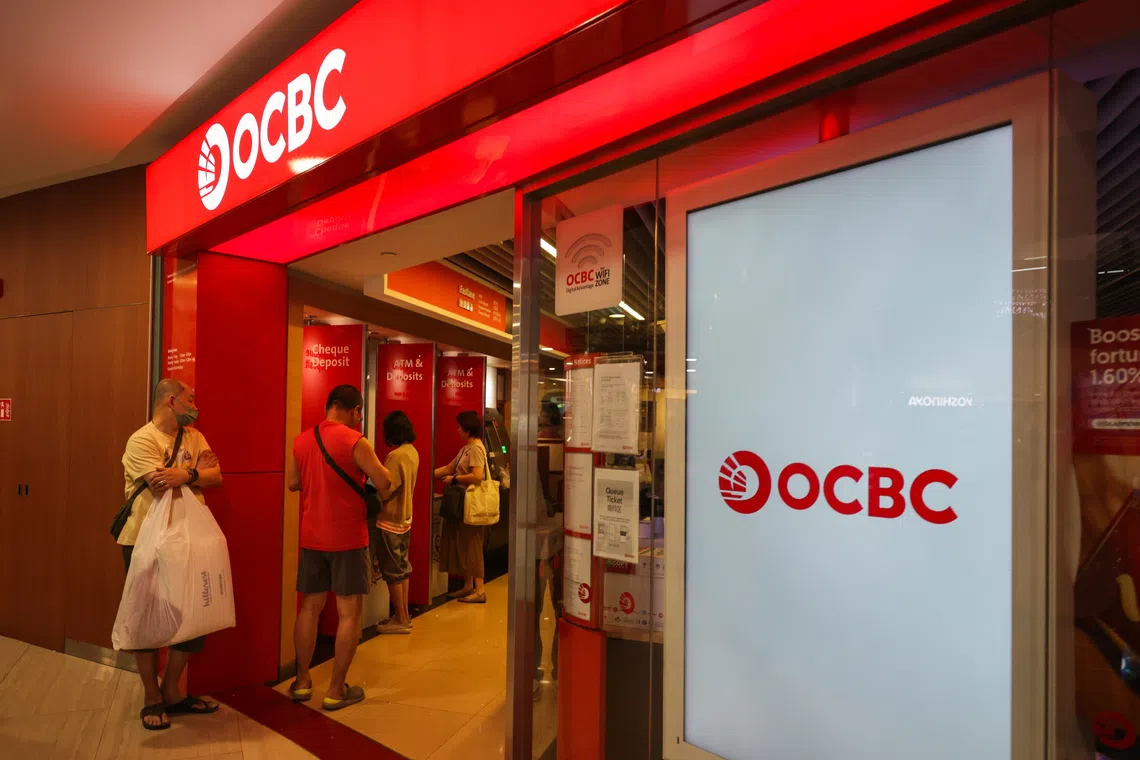
SINGAPORE – OCBC Bank’s net profit for the second quarter of 2026 grew 22 per cent as strong non-interest income led by wealth management cushioned the impact from lower interest rates.
Earnings for the quarter ended June 30 were $2.22 billion, up from $1.82 billion a year ago and beating analysts’ forecast of $1.91 billion in a Bloomberg poll.
The bank declared an interim dividend of 47 cents per share for the first half of the year, up from 41 cents a year ago.
The interim dividend payout will amount to an estimated $2.11 billion, or approximately 50 per cent of the group’s net profit after tax of $4.19 billion for the first half.
Net interest income at OCBC declined 1 per cent to $2.26 billion amid a lower interest-rate environment. Net interest margin fell to 1.70 per cent, 22 basis points below 1.92 per cent a year ago, but the impact was partly cushioned by a 12 per cent growth in average assets.
Non-interest income rose 51 per cent to $1.91 billion, driven by strong broad-based growth across fee, trading and insurance income. Fees were up 28 per cent, led by wealth management, trading income rose 85 per cent and insurance income jumped 68 per cent.
Total allowances of $156 million were higher than $114 million a year ago, mainly from higher allowances for impaired assets.
In a statement, OCBC group chief executive Tan Teck Long said that global conditions remain uncertain amid geopolitical tensions and elevated inflation risks, with much of the near-term outlook depending on the easing of Asia’s energy crunch brought about by the war in the Middle East.
Meanwhile, artificial intelligence and related technology sectors continue to register strong growth, he noted.
But the bank is well-positioned to navigate uncertainties and tap the growth sectors to deliver sustainable long-term value, with its strong capital, funding and liquidity position, as well as diversified income streams and disciplined risk management, he said.
OCBC updated its 2026 financial targets, including high-single-digit to low-double-digit loan growth, up from mid-single digits loan growth previously.
It also guided for total income to grow, up from previous expectations for stable-to-growing total income. The bank now expects a slight decline in net interest income, up from a slight-to-moderate decline previously. It still expects credit costs in the range of 20 to 25 basis points.
Singapore banks are expanding aggressively in the wealth space. OCBC in July said it will progressively launch what it says is South-east Asia’s first AI-native mobile banking app, introducing two virtual avatars that can engage customers around the clock with personalised wealth management insights.
To further support its wealth push, the bank will hire 600 additional relationship managers for its consumer banking business over the next three years.
UOB and OCBC reported second-quarter earnings on Aug 7, with DBS kicking off the season on Aug 6.
DBS declared 81 cents in dividends per share for the second quarter, as net profit for the period grew 9 per cent on record wealth management income.
DBS’s net profit came in at $3.08 billion, up from $2.82 billion in the year-ago period, surpassing analysts’ expectations of $2.87 billion.

