


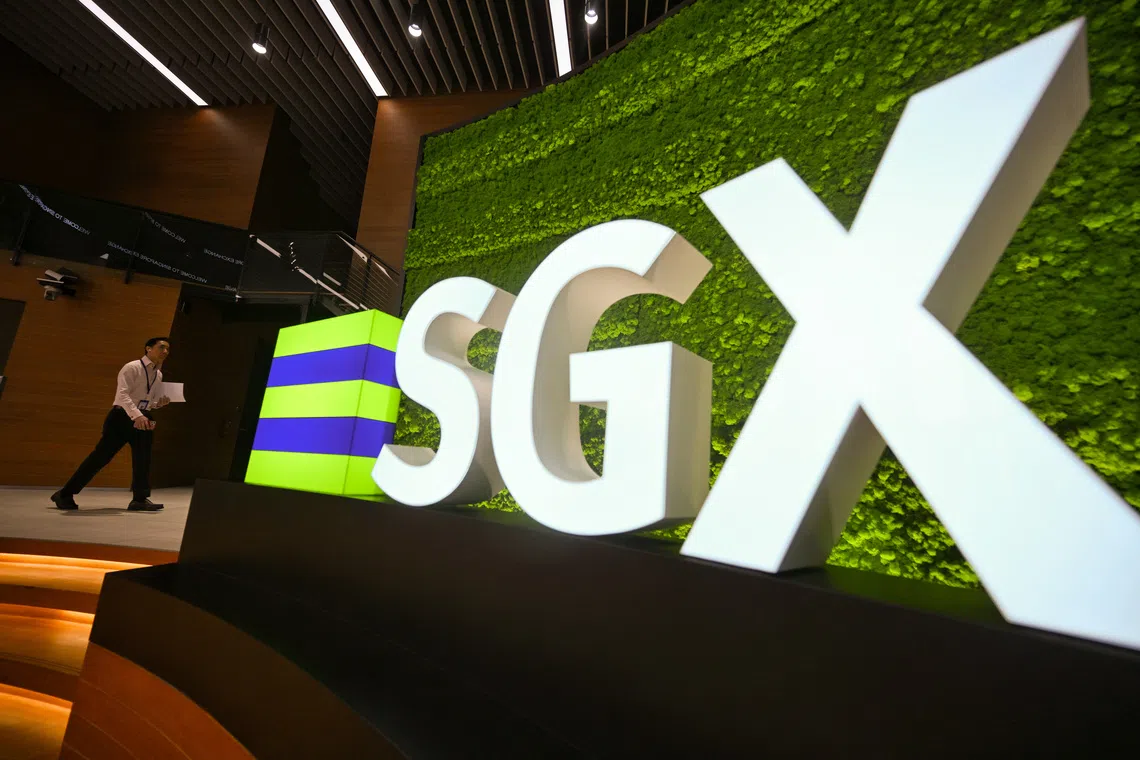
SINGAPORE – Efforts to revitalise the local stock market have borne fruit, with the Singapore Exchange seeing increased revenue and net profit in what it called an “exceptional” year for the bourse.
It also has a pipeline of some 50 companies keen to list on the exchange.
SGX reported a nearly 25 per cent increase in adjusted net profit for the 2026 financial year ended June 30. Net revenue also jumped 13.9 per cent, it said at its results briefing on Aug 6.
The 21 new SGX listings raised $4.1 billion in FY2026, up from the six listings that raised $25.7 million the year before.
The Singapore equities market gained momentum after efforts in 2025 to inject liquidity and grow investor interest.
The Monetary Authority of Singapore (MAS) set up the Equity Market Development Programme (EQDP), which provided grants to firms and individuals in the financial services sector to promote Singapore as a financial centre.
Other initiatives include the Value Unlock programme to help listed companies increase their valuations, and the Global Listing Board, which allows dual listings on the SGX and Nasdaq.
SGX Group chief executive Loh Boon Chye called 2026 an “exceptional year” for the stock market, marked by improving participation, liquidity and trading activity.
“Retail participation reached a five-year high, while institutional interest has broadened beyond the Straits Times Index (STI) constituents,” he noted.
Cash net revenue from equities also increased 28.1 per cent to $502.9 million, accounting for 34 per cent of total net revenue.
The securities daily average value also increased 34.9 per cent to $1.8 billion, while the total securities traded value increased 35.5 per cent to $455.7 billion.
Loh added that small- and mid-cap companies’ activity has also strengthened, with institutional inflows into this segment growing three times.
“This reflects the combined impact of better research coverage, stronger issuer engagement, and growing investor attention,” he said.
He noted that the listings pipeline is also strong, with interest from diverse sectors, including digital infrastructure, healthcare and consumer, real estate services, and real estate investment trusts.
SGX head of global sales and origination Pol De Win said around 50 companies are at various stages of engagement and preparation for listing.
These companies come from a diversity of sectors, he said. About a third of these companies are in the consumer and healthcare sectors, and another third are in tech, advanced manufacturing and digital infrastructure.
About a quarter are in real estate, and the rest are “fairly balanced across sectors”, he added.
Loh said he is also encouraged by the stronger institutional participation in initial public offerings (IPOs), including support from EQDP fund managers.
“Together, (with the) Value Unlock movement and other initiatives to grow demand and supply, we continue to work with the ecosystem to drive sustainable liquidity,” he said.
Loh added that SGX is also expanding the ways investors can access opportunities through initiatives such as the Global Listing Board, cross-listing of exchange-traded funds, and expanding the Singapore Depository Receipt to include US-listed stocks.
“These efforts are mutually reinforcing. Greater participation improves liquidity, which attracts higher quality listings, reinforces investors’ confidence and, in turn, drives deeper market engagement and creates a virtuous cycle,” Loh said.
De Win noted that the Global Listing Board is now live and fully operationally ready, and a number of companies have also started listing preparations, which SGX hopes will translate into actual listings.
But he said the “timing around these things is always tricky” as other factors like market circumstances also play a part in when companies list.
“The goal is for this board to attract more higher growth companies, and that is also reflected in the types of discussions that we are having with companies that are interested in this,” he added.
Besides equities, the other segments of SGX’s business also recorded growth in the 2026 financial year.
Net revenue from fixed income, currencies and commodities grew 17 per cent. The platform and others segment also saw net revenue grow 7 per cent.
SGX’s board of directors proposed a final quarterly dividend of 11.5 cents per share, up from 10.5 cents per share a year ago.
They also proposed a one-off additional dividend of 12.5 cents per share, both payable on Nov 10.
If approved, the total dividends for the 2026 financial year, including the additional dividend, will be 57 cents per share, higher than the 37.5 cents in 2025.
Loh said: “We enter the 2027 financial year from a position of strength.
“We will extend our franchise through strategic index partnerships and new ecosystems such as gold; unlock more value by bringing our listed and over-the-counter foreign exchange capabilities closer together; and use data more effectively to deepen client relationships and identify opportunities across our businesses.”

