


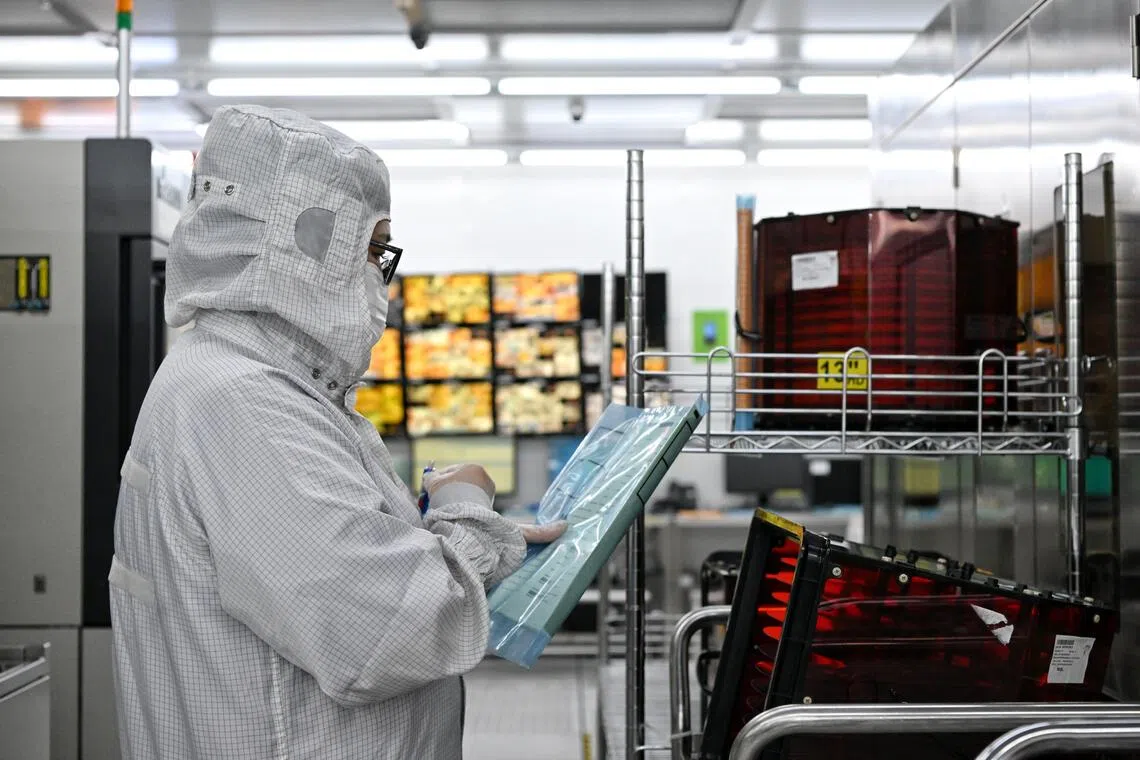
SINGAPORE – Factory activity here expanded in July for the 12th consecutive month, riding the wave of artificial intelligence-related demand.
This increase comes even as the continued tensions in the Middle East triggered a supply chain crisis.
Singapore’s purchasing managers’ index (PMI) – a barometer of the manufacturing industry’s overall health – inched up to 51.4 points in July, from 51.3 points in June.
A PMI reading above 50 indicates growth, while one below that signals contraction.
“The latest PMI readings indicate that Singapore’s manufacturing sector remains buoyed by the AI-driven semiconductor supercycle, which is driving robust order inflows and employment,” said Stephen Poh, executive director at the Singapore Institute of Purchasing and Materials Management, which compiles the monthly survey.
The survey noted on Aug 3 that the improvement in PMI was driven by stronger growth in new orders, new exports, input purchases and employment.
However, July’s factory output index posted a slower expansion of 50.8 points, down from June’s 51.1.
Meanwhile, the supplier deliveries index – standing at 47.8 points in July, down from 48.3 in June – contracted at a faster pace and for the seventh consecutive month, reflecting severely prolonged lead times and escalating supply chain constraints.
Poh said: “The collapse of the Middle East ceasefire has triggered a supply chain crisis, sending input prices soaring and severely crippling supplier delivery times.”
The US and Iran signed an interim ceasefire agreement in June that included points such as paving the way for the opening of the Strait of Hormuz – a vital global shipping channel for oil and gas.
However, this agreement collapsed when countries resumed strikes, with clashes over control in the Strait of Hormuz.
On Aug 3, US President Donald Trump called off further strikes and said talks with Iran are set to resume.
OCBC chief economist Selena Ling said the Middle East conflict “remains a bugbear” since the Strait of Hormuz continues to be a choke point that affects not only global energy prices, but also trade flows. This impacts petrochemical feedstock, transport logistics and insurance premiums, for instance.
UOB associate economist Jester Koh noted the re-escalation of the Middle East conflict in July led to a further deterioration in the supplier deliveries index, with lead times lengthening as cargo shipments were likely diverted from the Suez Canal or Bab el-Mandeb Strait route to the Cape of Good Hope.
The increase in the input prices index also reflects the resurgence in energy prices, which affects Brent crude oil, jet fuel and very low sulphur fuel oil for cargo vessels.
Still, the future business index remained in growth territory, which underscores manufacturers’ sustained confidence in business conditions, the survey said.
Electronics growth
The electronics sector, which accounts for 40 per cent of the Republic’s manufacturing output, saw its PMI rise by 0.2 point to 52.4 in July.
This indicates a faster pace of expansion and marks the 14th consecutive month of growth, the survey said.
The improvement was driven by stronger expansion in new orders, new exports, factory output, input purchases, and employment.
But the supplier deliveries index shrank at a faster rate, reflecting the severe supply chain disruptions and extended delivery lead times owing to geopolitical issues.
Meanwhile, imports, input prices, order backlog and future business posted stronger growth.
The finished goods index – dipping from 49.6 in June to 49.3 in July – decreased at a faster rate for the third consecutive month, suggesting that inventories continued to be rapidly drawn down in response to surging order demand, the survey said.
Ling noted: “This is translating to a situation that is led by a supply crunch rather than being limited by demand conditions.”
She added that anecdotally, it seems that the latest financial results reported by US companies suggest that revenues are surging.
These companies are also building AI infrastructure and prioritising high-performance compute architectures, which drives the demand for high-bandwidth memory chips and dynamic random-access memory chips.
These chips power anything from consumers watching shows on devices and playing online games, to businesses training complex machine-learning models.
It was recently reported that the four largest US hyperscalers – Amazon, Alphabet, Microsoft and Meta – are likely to spend more than US$700 billion (S$898 billion) on AI-related expenditure in 2026, supporting an unprecedented infrastructure build-out.
Koh agreed that Singapore’s strong electronics PMI readings reflect “sustained AI-related demand tailwinds” as major hyperscalers announced significant capital expenditure plans for 2026 and 2027.
He added that the demand for semiconductors is clearly outpacing supply.
“This should continue to keep electronics manufacturing supported in the months ahead, contingent on the ability of firms to ramp up production capacity,” he said.
Another challenge that Singapore is facing is the new 12.5 per cent tariff that Trump has imposed on a range of economies including Singapore.
However, Ling said she thinks the impact will be muted as it does not cover semiconductors, which is still a key engine of growth in the near term.
“Our forecast is for continued momentum for the third quarter of 2026,” she said, given the outperformance of the manufacturing sector in the first half of the year.
“The manufacturing sector should still see very resilient and robust growth for the whole of 2026.
“The current constraints are on the supply side in terms of intermediate inputs and components rather than a demand issue. So the PMIs may consolidate but would likely stay in expansion zone.”

