


SINGAPORE – Singaporeans can expect their spending power abroad to strengthen further after the Monetary Authority of Singapore (MAS) surprised markets this week by allowing the Singdollar to appreciate at a slightly faster pace to curb inflation.
The move marked the second consecutive monetary policy tightening since April, although MAS said the latest adjustment is smaller.
In its monetary policy statement on July 27, MAS said it expects higher global energy, food and other imported costs to feed more broadly into consumer prices domestically, keeping inflation elevated for the rest of the year before easing in 2027.
Singapore core inflation, which excludes accommodation and private transport, rose to 1.5 per cent in the second quarter of 2026, from 1.2 per cent in January and February before the Middle East conflict began. The cost of point-to-point transport and uncooked-food increased alongside surging fuel prices, while retail goods became more expensive due to higher import costs.
MAS said its April tightening, which enabled the Singdollar’s appreciation in recent quarters, had helped to curb inflation. However, it also noted that Singapore’s economy is expected to grow strongly in 2026, potentially adding to price pressures as demand outpaces the economy’s capacity to supply goods and services.
The central bank warned that inflation could rise faster than expected if energy prices spike again, as fuel reserves deplete and renewed Middle East supply disruptions send oil prices sharply higher.
Conversely, tighter financial conditions or weaker artificial intelligence (AI) investment could slow growth and reduce inflation.
For now, MAS expects global AI spending to remain strong, with capital spending by the five largest US technology companies now expected to nearly double from 2025, boosting demand for semiconductors, memory chips and other AI hardware.
While this should support Singapore’s technology sectors and economic growth in the second half of 2026, MAS also warned that AI investments are increasingly concentrated among a few companies and financed with greater borrowing.
Should earnings disappoint, a sharp market correction could curb AI spending and hurt technology-linked economies like Singapore through weaker exports, market turmoil and currency volatility.
Yen recovers against the Singdollar
The Japanese yen recovered ground against the Singdollar this week.
Every Singapore dollar bought 122.78 yen on Aug 2, down from around 126 yen earlier in the week.
International media reports point to the Japanese authorities intervening to support the currency by buying billions of yen in the market on July 30 and 31.
Separately, the Federal Reserve Bank of New York was also reported to have sold euros for yen on behalf of the US Treasury, sparking speculation of a coordinated effort to shore up the weakening yen.
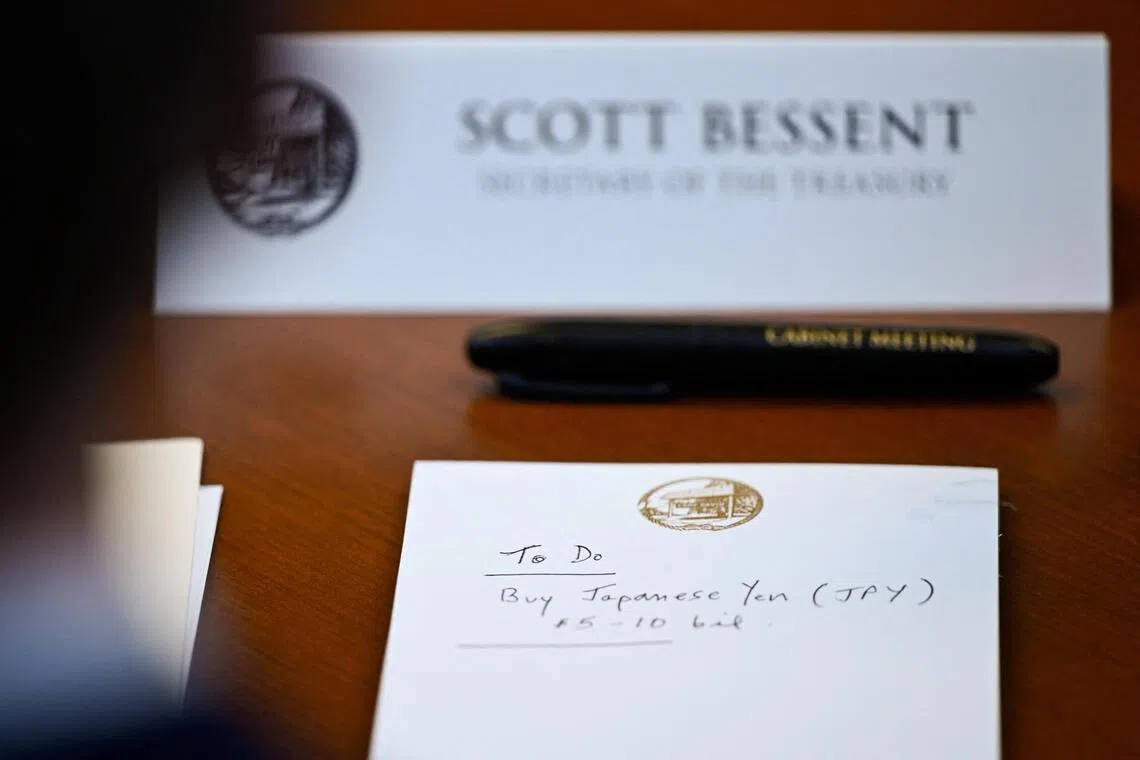
The move came after a July 31 Reuters photo of Treasury Secretary Scott Bessent’s notepad during a cabinet meeting at Camp David in Maryland showed the words “To Do,” followed by “Buy Japanese Yen (JPY) $5-10 bil.”
Japan and the US may unveil a policy as early as next week to address the yen’s weakness, Kyodo News reported on Aug 1, citing informed sources.
The US last directly supported the yen in 2011, coordinating with fellow Group of Seven nations to stabilise markets after Japan’s earthquake and tsunami disaster.
Sheng Siong considers adjusting prices
Meanwhile, ahead of the opening of the Johor Bahru-Singapore Rapid Transit System (RTS) Link in Jan 2027, Singapore-based supermarket operator Sheng Siong said this week that it may review its prices and product range to retain shoppers.
“We stand ready to adapt our pricing, promotions and product mix as necessary to remain competitive,” Sheng Siong chief executive Lim Hock Chee said in the company’s results statement on July 29.
Sheng Siong is expecting the RTS Link to intensify price competition between Johor and Singapore, particularly for selected packaged groceries and household products, but said the actual impact will depend on factors such as fares, travel time, exchange rates, relative pricing and consumer behaviour.
Singaporeans are projected to spend $1.05 billion more across the Causeway once the rail link opens, according to a joint study released on July 16 by the Singapore Business Federation, the Restaurant Association of Singapore and the Singapore Retailers Association.
The study also projected a 51 per cent annual increase in Singapore consumers crossing over to Johor Bahru in 2027, with groceries, pharmaceuticals and beauty products high on the list of categories Singaporeans spend on.
Landlords, local businesses raise the bar in the heartlands
Malls and businesses here are moving quickly to offer more options for consumers, particularly in the heartlands, before that happens.
Sheng Siong said it will continue expanding in Singapore, with three new stores in Hougang, Rivervale in Sengkang and Woodlands set to open between July and September.
The company is also awaiting the outcome of a Housing Board tender for another store, while two more tenders are expected to be called over the next six to 12 months.
Meanwhile, Frasers Centrepoint Trust this week provided updates revealing that renovations at Hougang Mall will be completed in September.
More than 98 per cent of the revamped space has been committed, with over 40 per cent of its units going to tenants new to the mall. They include FairPrice Finest, which is scheduled to open on Aug 1, and Decathlon.
FCT added that it brought in 69 tenants that were new to its malls in the nine months to June, including Japanese second-hand fashion retailer 2nd Street at Tiong Bahru Plaza, Korean restaurant O.BBa BBQ & Jjajang at Waterway Point, beauty retailer Well-Hey at NEX, and home-grown bedding brand Kapas at Tampines 1.
More new food and beverage brands like Grains & Co, Auntie Peng, Imperial Kungu Roti, Avocadoria Singapore, More Yogurt and Tofu G Gelato are to be expected at FCT’s malls in the coming months.
SIA announces new lounge, in-flight treats as fuel costs rise
Singapore Airlines shares recovered most of their losses following the carrier’s first-quarter results, after falling as low as $7.40 on July 29. The stock ended the week at $7.70, nearly 2 per cent higher than at the start of the week.
The airline posted a net loss of $76 million for the first quarter ended June 30, reversing a $186 million profit a year earlier, as soaring fuel costs and higher losses from its subsidiary Air India outweighed record revenue. The loss was despite revenue rising 19.3 per cent to a record $5.71 billion for the quarter.
SIA is meanwhile strengthening its partnership with Air India and will progressively introduce wider codeshare arrangements, better network connectivity and collaboration on loyalty programmes in 2026. Similar plans with Malaysia Airlines and Air China to expand its network and improve passenger connections are also in the works.
The carrier is also upgrading its passenger experience.
A new First Class SilverKris Lounge has opened at Changi Airport Terminal 2, while its lounges in Brisbane, Bangkok and Hong Kong have been refurbished. Further lounge upgrades at Changi and a new SilverKris Lounge in Melbourne will be introduced progressively in the current financial year.
SIA plans to unveil new long-haul cabin products, an upgraded KrisWorld entertainment system, refreshed in-flight meals and new amenity kits later in 2026. It will also progressively introduce Starlink satellite broadband across its aircraft from 2027.
Other market movers
Singapore-listed Hongkong Land said on July 30 that its Singapore Central Private Real Estate Fund would buy the Wheelock Place development on Singapore’s Orchard Road from Wharf Real Estate Investment for $1.1 billion.
The deal will give the fund ownership of the development, including Wheelock Place mall, marking the Hong Kong property developer’s first entry into Orchard Road as the authorities work to transform the shopping belt into a mixed-use lifestyle district with more attractions, public spaces, greenery and better-connected buildings.
Launched in February, the fund also holds stakes in prime commercial properties including Asia Square Tower 1 and One Raffles Link.
Shares of Hongkong Land closed July 31 at US$8.12, up more than 4 per cent through the week.
Another Singapore-listed property group, Indonesia’s OUE, said in bourse filing on July 31 that it is expecting to report a net loss for the first half of 2026, weighed down by losses and a potential impairment linked to its investment in China-based Gemdale Properties and Investment Corporation (GPI).
OUE, which owns 29.07 per cent of GPI, expects to record between $30 million and $50 million in losses from its equity-accounted investments, mainly due to the slowdown in China’s property market and weak economic conditions. This compares with a $46 million loss from such investments in the same period in 2025.
The group also expects to recognise an impairment loss of between $40 million and $60 million on its investment in GPI.
What to look out for next week
Shares of regional logistics solutions provider All-Link Air & Sea will begin trading on the Singapore Exchange mainboard on Aug 5.
The group is offering 37.9 million shares priced at 53 cents apiece, comprising 2.1 million public offer shares and 35.8 million placement shares. It expects to raise gross proceeds of around $20.1 million. The public offer will close on Aug 3.
All-Link’s listing will be closely watched as it comes after three other mainboard IPOs – JustCo, Foundation Healthcare and UI Boustead Reit – have come under scrutiny for trading below their IPO prices shortly after listing.
Source : https://www.straitstimes.com/business/singdollar-strengthens-yen-recovers-markets-this-week

