


SINGAPORE – Singapore sovereign wealth fund GIC’s 20-year annualised returns from its global portfolio fell to their lowest level since 2020 as geopolitical tensions, including the Middle East conflict and US tariffs, intensified market volatility and slashed investment returns.
For the 20-year period that ended on March 31, 2026, the annualised US-dollar nominal return of GIC’s portfolio was 5.6 per cent.
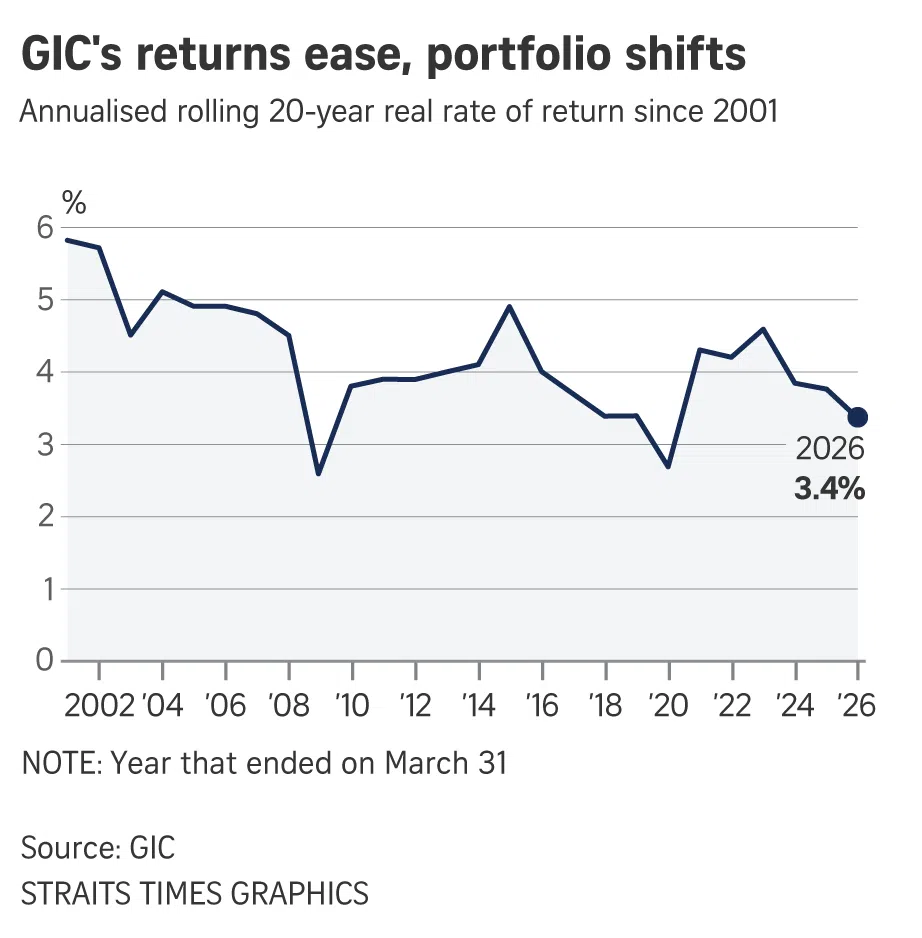
After adjusting for global inflation, the annualised real return for the same period came in at 3.4 per cent, said GIC, which manages the Republic’s foreign reserves. It takes a long-term investment horizon of 20 years.
The real return has fallen to its lowest level since recovering from the 2020 low of 2.7 per cent, after peaking at 4.6 per cent in 2023. The 20-year rolling nominal return came in at 4.6 per cent in 2020.
Annualised nominal returns were 3.6 per cent over the past five years, versus 6.2 per cent over the past 10 years.
GIC said it is refreshing its investment framework from 2026 to navigate a fundamentally changed world, where rising protectionism and intensifying competition for economic and technological advantage underscore a fractured global order and hinder economic growth.
Higher energy prices, tariffs and other protectionist measures are likely to keep inflation elevated and economic growth constrained worldwide.
GIC said the Iran war is a reminder of how quickly the global environment can change.
The outbreak of the war on Feb 28 triggered a surge in energy prices, upending market expectations at the start of the year for moderating inflation, stabilising interest rates and steady economic growth.
After a brief lull when the US and Iran agreed to a 60-day ceasefire on June 17, both sides resumed fighting on July 8, bringing oil and natural gas supplies through the Strait of Hormuz to a near halt. The renewed hostilities have sent oil prices to above US$95 a barrel, up from around US$70 at the start of July.
Meanwhile, President Donald Trump’s administration is likely to impose new tariffs under new pretexts, after the US Supreme Court declared the bulk of the levies he announced in 2025 to be illegal earlier in 2026.
While artificial intelligence remains an investment focus for the sovereign fund, gains from the technology have been uneven across industries and geographies, GIC noted.
Speaking at a media briefing on July 23, GIC chief executive Lim Chow Kiat said geopolitical fault lines are deepening, AI is redefining competitive advantage, and energy systems are straining under the competing pressures of AI-driven demand, security priorities and the climate transition.
“These constraints do not exist in isolation. Geopolitical fragmentation, limited fiscal flexibility, and bottlenecks in technology and energy reinforce one another as their impacts play out unevenly across markets,” he said.
For long-term investors like GIC, this widens the range of possible outcomes, making it harder to rely on any single view of the future, he added.
Lim noted that historically, geopolitical crises followed a familiar pattern: sharp, short-term disruption, followed by normalisation once the crisis passed – turning initial sell-offs into buying opportunities.
“Today, geopolitical risks are no longer episodic disruptions but structural changes, with more persistent and uneven market effects,” he said.
Countries are prioritising resilience and strategic autonomy, reshaping supply chains and capital flows in the process. In addition, investments in defence, industrial policy, export controls, and other forms of economic and financial statecraft are becoming the norm.
These shifts are colliding with physical constraints in computing power, critical minerals and energy.
The financial burden is falling on governments already facing high debt levels.
“Together, these dynamics are changing how markets price geopolitical risk. Rather than temporary dislocations, shocks now lead to more enduring and differentiated country risk premia, higher costs of capital, and greater divergence between winners and losers,” said Lim.
In response, GIC has enhanced diversification, not only across geographies and asset classes, but also across underlying sources of risk and return.
Hence, its regional exposure and asset mix changed over the last financial year.
Its portfolio exposure to the Americas – comprising North and Latin America – increased to 53 per cent from 49 per cent. Conversely, its exposure to the Asia-Pacific region declined to 22 per cent from 24 per cent.
In terms of asset mix, the share of equities in GIC’s portfolio rose to 56 per cent from 51 per cent over the year, while fixed income made up 22 per cent, down from 26 per cent.
GIC said it has diversified into assets with durable cash flows, low correlation to traditional markets, and structural demand that is less dependent on macro conditions, such as intellectual property rights and music royalties.
One such investment announced earlier in 2026 was the establishment of a multibillion-dollar investment partnership with Sony Music Group to acquire global music copyrights.
GIC has also built exposure to gold and inflation-resilient assets such as real estate.
Lim said its refreshed investment framework will be anchored by a new strategic portfolio that captures the underlying drivers of long-term returns, enabling nimbler and more flexible capital allocation.
“The GIC portfolio builds on this foundation, adding value to the strategic portfolio through bottom-up security selection and value creation. Portfolio construction will continue to be guided by the principles of diversification, granularity and agility.”
The GIC portfolio will aim to outperform the strategic portfolio over the long term within approved risk parameters through active investing to capture excess returns across market cycles.
Lim said GIC will continue to focus on active investing to “keep delivering good real returns for Singapore over the years ahead”.
He said that while global risks are significant, they also create opportunities for those who are prepared.
GIC will aim to go beyond broad return drivers and identify targeted investment opportunities across themes, sectors and assets with unique characteristics.
“The refreshed framework will improve our ability to fulfil our longstanding mandate: to preserve and enhance the international purchasing power of the reserves under our management.”

