


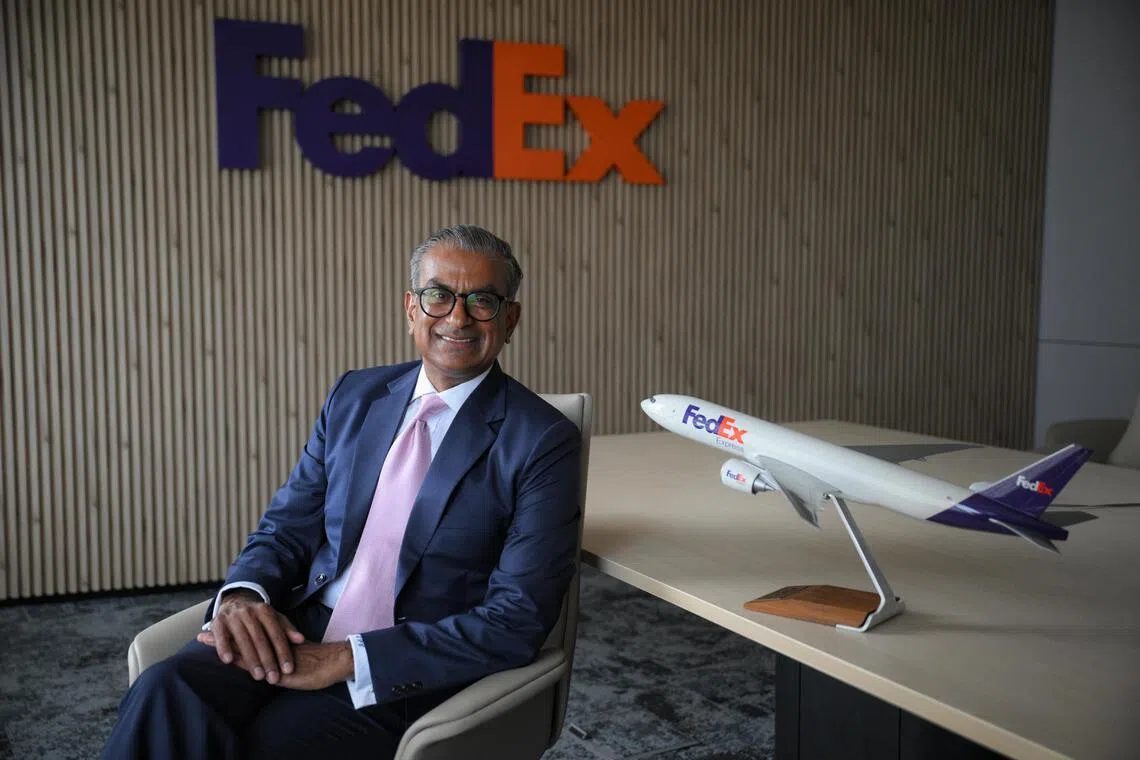
SINGAPORE – Getting packages delivered on time, without losing them, is no longer enough – it is just the bare minimum “table stakes” expected of any logistics industry player today, says FedEx’s Asia-Pacific president Salil Chari.
The bigger opportunity, he tells The Straits Times, is making supply chains smarter and simpler with more advanced technology, and helping customers navigate the disruptions now facing supply chains.
Geopolitical uncertainties over the past year have raised the need for more adaptable and robust supply chains, says Chari, who assumed his role at the multinational delivery and supply chain services company’s South-east Asia headquarters in Singapore in January.
This became a top priority when US President Donald Trump imposed tariffs on numerous countries in 2025 and suspended the de minimis rule, which had allowed shipments valued at US$800 (S$1,030) or less to enter the United States free of duties and taxes.
With every package now requiring clearance in the US, sending small parcels there has become much more expensive and unsustainable for many retailers, especially those in Asia, including China.
The ripple effects of this trade war have also spilt into Europe. In a bid to slow the rapid rise in imports from China, the European Union removed the €150 (S$221) de minimis duty exemption for imports from July 1, and low-value shipments are now subject to a €3 customs duty per item category.
These sudden and disruptive changes sent companies around the world scrambling to adapt and find alternative shipping routes. They also reshaped trade flows and how the logistics sector operated.
Adapting to a new trade reality
Retailers, who previously shipped their products directly to consumers, had to pivot to a business model in which companies sell to consumers through other businesses, to avoid ballooning their shipping costs. This typically involved engaging an intermediary, such as FedEx, to clear goods at wholesale prices.
They also needed their logistics partners to help them navigate tariffs and ensure compliance.
FedEx’s chatbot helped customers calculate shipping costs and stay updated on customs requirements, Chari says.
As trade within Asia and to Europe accelerated, FedEx added more flights between the continents and expanded intra-Asia routes, including from its Guangzhou hub to Penang and Bangkok.
Singapore will continue to play a major role in FedEx’s operations as its regional hub in the South Pacific, with around 60 weekly flights to and out of the Republic.
As companies look to multi-source in a fragmented global economy, South-east Asia is growing in importance as a manufacturing base. Singapore may lack the land space or manufacturing capacity of its neighbours, but its air and sea connectivity remains its biggest strength, says Chari.
“It’s not an either-or question. Singapore facilitates a lot of the movements in and out of the region from China and Europe, and it will be even more important as these regional trade flows increase.”
FedEx’s other hubs in the Asia-Pacific are in Osaka and Shanghai, and its regional offices in China, Japan and Australia.
The company declined to disclose figures for its Asia-Pacific business, but emphasised that the region has seen solid growth.
In its earnings call for its fourth quarter ended May 31, 2026, it noted “double-digit international export revenue growth on the Asia-Europe lane within Asia and US outbound lanes”.
Globally, international export package volumes rose for the second consecutive quarter, growing 5 per cent year on year, with strength in Asia being a key driver of FedEx’s international priority volume.
The Middle East conflict that began in February heightened the vulnerability of trade routes, with the blockade of the Strait of Hormuz shutting off a key shipping route.
In the early weeks of the conflict, when airports in the region were closed, FedEx rerouted flights via Europe before continuing on to their final destinations. Staying adaptable ensured that its supply chains continued to move in real time, even if manufacturers were unable to keep pace, says Chari.
Delivering value, powered by AI
Technology is another key component of FedEx’s operations, and it says it will be leaning heavily on artificial intelligence to “deliver value” by making its delivery operations smarter, more adaptable and easier to manage.
Chari notes that its AI-driven insights are still in their early stage of deployment, but have already helped customers make better-informed decisions.
For example, its AI models can give retail customers more accurate indicators to predict their business performance around the world. Customers can also make adjustments to their shipments using FedEx’s data to reduce their carbon footprint.
Another AI service, FedEx Surround, provides customers with near real-time data about their shipments, including predictive delay alerts due to weather changes. This is highly critical for healthcare sector customers, Chari says, where shipment delays could mean life or death if surgeries and medical treatments are affected.
It can also reduce unnecessary costs. He cites the example of how a hospital might be expecting a delivery of a spare part for its MRI machine, and the lack of visibility of an impending delay could affect the schedule of the technician waiting on-site to start repairs.
Physical AI is also being implemented in FedEx’s supply chains. Its cargo-handling facility in Changi Airport uses an AI-powered robotic arm to sort packages at a rate of 1,000 per hour – up to 5kg each time – with 98 per cent accuracy.
In July 2025, FedEx launched a partnership with Singapore-based robotics company QuikBot, which specialises in autonomous floor-to-floor deliveries, for its last-mile delivery.
With AI playing a more prominent role in FedEx’s operations, Chari says he foresees its workforce becoming more efficient and skilled at handling more complex tasks.
For instance, AI could help a customer service agent quickly sieve through thousands of tracking numbers from a customer’s shipment for potential problematic ones that the agent can focus on resolving.
Asked if AI’s efficiency could lead to workforce redundancies, Chari says it is difficult to predict job cuts. FedEx’s Asia-Pacific office employs more than 28,000 staff, with around 1,100 in Singapore.
“AI will be a big area of growth for us. As we grow, maybe we don’t need to hire as many people because we will be more productive,” says Chari.
He adds that FedEx would need to focus on keeping its logistical chains resilient in the face of new potential disruptions. This means strengthening network adaptability and predictability with AI, while standing out from the competition.
“There is always going to be the need for physical infrastructure and assets, and the network that we’ve built over the last 50 years is not easy to replicate. When you complement that with the data and AI, that combination is where I believe our differentiation is.”

