


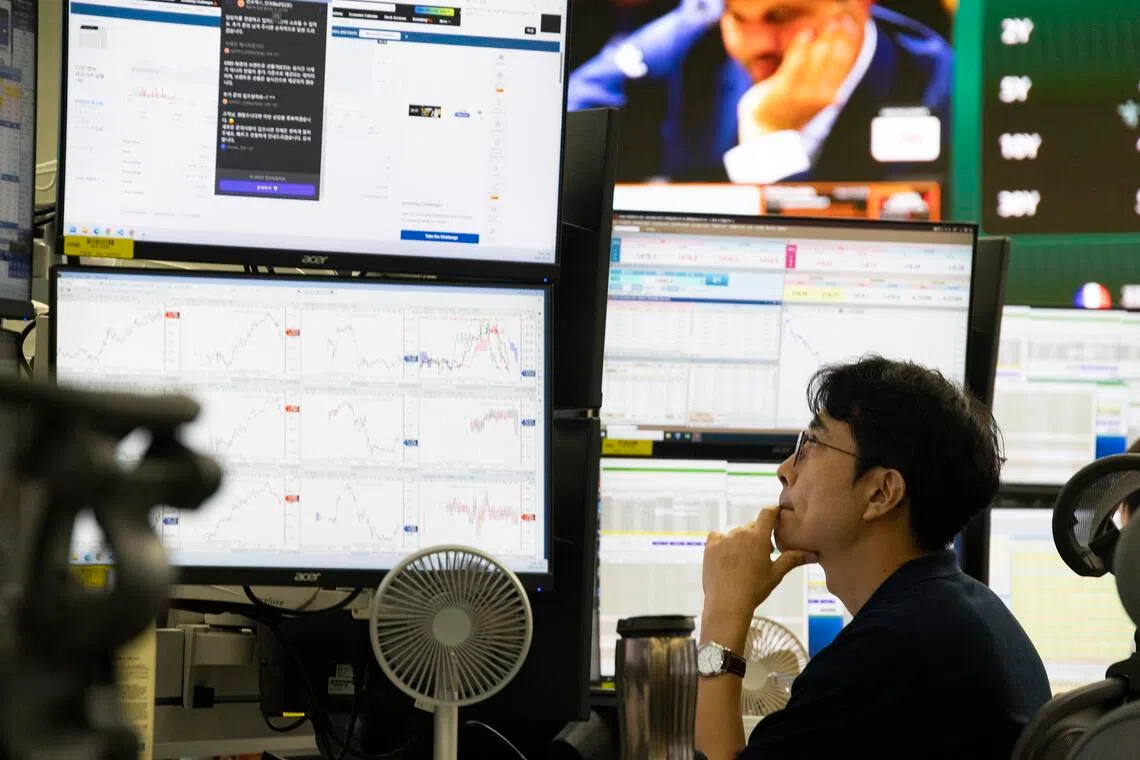
SEOUL – Investing in South Korea’s stock market has yielded huge returns in 2026, but it has been a wild ride.
Volatility on the benchmark Kospi Index has topped 60 per cent, almost double that of Japan’s Nikkei 225. It has even put the notoriously skittish cryptocurrency Bitcoin in the shade.
The gyrations have forced the Korea Exchange to trigger its “circuit breaker” mechanism, which puts a temporary halt on trading to prevent flash crashes and avoid investor panic, seven times in 2026 through mid-July. There was no such halt in 2025 and just one in 2024.
Here are some reasons for the unprecedented volatility in Korean stocks:
The Samsung-SK Hynix phenomenon
Two companies account for South Korea’s roller-coaster stock performance: Samsung Electronics and SK Hynix.
Their profits are exploding as they supply the memory chips required for the new generation of artificial intelligence systems. The AI boom has sent their stock prices up so far, so fast that they now account for more than 50 per cent of the Kospi. Listed affiliates of both companies take their share even higher.
As a result, funds tracking the Kospi index have effectively become a giant bet on AI. When the Kospi closed at a record high in late June, more than 650 of its 831 constituent stocks actually fell.
The valuations of AI-related companies are hostage to swings in investor sentiment.
Hundreds of billions of dollars are being poured into AI platforms and data centres in the hope that the technology’s transformative capabilities will yield vast profits.
For now, AI has not generated enough revenue from end-users to cover the cost of building it.
Leveraged ETFs
These investment funds are hugely popular in South Korea, and very risky. They use derivatives and debt to amplify the daily returns of an underlying index or asset – typically by a factor of two.
The sophistication and riskiness of leveraged ETFs mean that in most parts of the world, they are mostly bought by professional traders and investors.
In South Korea, they are actively embraced by individuals trading using their savings who often lack much formal training in finance.
South Korea’s leveraged-ETF boom has its roots in 2010, when Samsung Asset Management launched KODEX Leverage, a 2x KOSPI 200 product that the firm and South Korean media describe as Asia’s first leveraged ETF. For more than a decade, Korea’s leveraged-ETF market stayed mostly tied to broad indexes.
The country’s financial regulators recognised the risks when they tried to curb local investor demand for foreign leveraged ETFs in 2025.
But in 2026, they allowed the establishment of more than a dozen such products tracking Samsung and SK Hynix, 90 per cent of which are held by retail investors.
As concerns grew over their destabilising impact, South Korean authorities announced on July 16 that new listings of single-stock leveraged products would be temporarily halted.
Together with the two chipmaker stocks they track, the ETFs have recently been accounting for more than 70 per cent of daily traded value in the US$4 trillion (S$5 trillion) market, amplifying the price moves in the two underlying stocks.
As the AI trade loses momentum globally, these products have now fallen below their launch prices.
Retail investors
South Koreans have long dabbled in the stock market, but the AI frenzy focused on Samsung and SK Hynix has really got them excited.
Local individual investors have poured more than 100 trillion won (S$88 billion) into shares in the Kospi in 2026. Their money is helping to lower the companies’ cost of capital, supporting ambitious expansion plans.
But it has also added to the share price volatility.
The sellers have often been foreign investors – specifically, fund managers obliged to reduce their positions in Samsung and SK Hynix to ensure their share portfolios are not over-exposed to the two companies.
Foreigners have sold Kospi shares worth around US$108 billion in 2026, with SK Hynix seeing withdrawals of more than US$40 billion.
Institutional investors are more likely to stick with a company that is going through a rough patch, and have a clearer view of its fundamental value during waves of euphoria.
Retail traders in South Korea are often hungry for returns and willing to take risks. They are known locally as “ants” for their tendency to act in unison. When a stock falls, it can trigger a panicked stampede. When it rises, it can induce a wave of buying at inflated prices by small investors anxious not to miss out.
The boom in leveraged ETFs is only making things worse. Goldman Sachs Group strategists wrote in late June that assets invested in South Korean leveraged ETFs tracking indexes and single stocks had soared to over US$40 billion from US$5 billion at the start of 2026.
“Leveraged ETFs are the principal risk to monitor,” they wrote in a separate note dated July 5.
While the amount of margin debt – borrowing to buy stocks – has eased off in recent weeks from a June peak, it remains significantly above the level a year ago. When a stock market is propped up by borrowed money, it can increase the risk of panic selling when prices start to fall.
“Given that leverage was a meaningful driver of the 2Q rally in memory names, we remain cautious in calling the bottom,” said Gary Tan, a portfolio manager at Allspring Global Investments. BLOOMBERG

