


SINGAPORE – An influx of tourists from Johor Bahru is expected in Singapore once the Johor Bahru-Singapore RTS Link starts passenger service in January 2027, creating opportunities for local retailers and food and beverage (F&B) operators to capture the crowd and get them to loosen their purse strings.
Here are three broad areas where businesses and policymakers can help, as outlined by the Singapore Business Federation (SBF), the Restaurant Association of Singapore (RAS) and the Singapore Retailers Association (SRA).
1. Encourage Singaporeans to spend locally
The study, titled Impact Of RTS On Singapore Retail And F&B Sector and jointly commissioned by the SBF, RAS and SRA, found that Singaporeans spend the most on groceries in JB, followed by pharmaceuticals, dining and beauty.
To support domestic spending, the study suggests introducing time-bound consumption vouchers to boost local retail and F&B spending amid rising RTS Link-induced outbound expenditure, and partnering businesses and trade associations and chambers to amplify voucher impact and maximise local spending through promotions, loyalty programmes and shopping festivals.
As the Government already supports the local economy and retailers through the existing CDC voucher scheme, the call is to expand the eligibility and quantum of these vouchers to include more businesses affected by outbound spend, such as pharmacies, convenience stores and F&B operators.
A second broad suggestion is to review policy and enhance support for retail and F&B businesses, enabling them to offer unique products and services that help them stand out to consumers.
This can be done by adopting more flexible sourcing and accreditation frameworks to facilitate culinary innovation and cost competitiveness; reviewing regulatory barriers and policy frameworks to enable value-added services and enhance customer experience; and leveraging trade associations and chambers to facilitate pilot and experimental projects, as well as sector-wide collaboration.
2. Get tourists to stay longer and spend more
Big-name acts like American singers Taylor Swift and Lady Gaga, who performed in Singapore over several nights at the National Stadium in 2024 and 2025 respectively, drew huge regional crowds and generated billions in tourism spend.
Replicating such mega-events is ideal, and the suggestion is to leverage them by involving more retailers and F&B merchants outside the central region and in the heartlands.
To do this, the study recommended stronger inter-agency coordination and earlier information-sharing with retailers, mall operators and industry associations, alongside stronger support to develop Singapore-first product launches and destination-exclusive collections.
Another suggestion is to draw crowds beyond Kallang Basin and Marina Bay Sands – where the National Stadium and Sands Expo and Convention Centre are located – to the eastern and northern regions of Singapore.
SBF’s chief policy and operating officer Musa Fazal said the east of Singapore “benefits a little more than the other regions”, partly because it is anchored by Jewel and Changi Airport.
“How can we decentralise some of this? We think the Northern Gateway, for example, offers a significant opportunity to capture some of this RTS Link-enabled spending,” he said, referring to Woodlands and the northern part of Singapore.
“How can we add tourism, lifestyle and event infrastructure to the Northern Gateway to capture this? And how can we consider a more distributed event model, where major events are complemented by satellite activations outside the central region?”
There were also recommendations to expand Singapore’s night-time offerings beyond bars and clubs to include a broader mix of family-friendly, cultural, wellness and lifestyle experiences, and to build vibrant night-time precincts by supporting extended operating hours, improving transport connectivity and encouraging coordinated programming across retail, F&B and attractions to boost dwell time and visitor spending.
Also on the table was the idea of fostering a strong Singapore-JB consumer ecosystem through loyalty programmes and cross-border rewards, positioning Singapore and Johor Bahru as a “Twin Cities, One Destination” experience for both locals and tourists.
To encourage higher-value spending, the study suggested extending tourist tax refund eligibility to land checkpoint departures.
Kok Ping Soon, chief executive of SBF, said: “Instinctively, it’s about protecting your turf, right? The meat of this is what we can do to increase inbound spend. When we discussed the recommendations, we were quite uplifted – we talked about how we can do more mega events. The night-time economy got us quite excited. There’s a reason Singapore holds the F1 night race – we didn’t try an F1 day race, because the weather would kill us. Of course, F1 is just once a year, so how can we have more of such events in the night-time economy?”
3. Ease pressure on retailers and F&B operators
Labour and cost pressures are a perennial concern for business owners. To support them through the period when the RTS Link opens, the study recommended greater flexibility in foreign manpower policies, alongside targeted, time-bound manpower support such as S Pass levy reliefs and wage support.
Other ways to ease pressure on business owners include expanding access to affordable retail formats and subsidised commercial spaces to help them stay competitive, and prioritising RTS Link-related expansions within existing internationalisation schemes to support Singapore businesses growing across the Singapore-JB corridor.
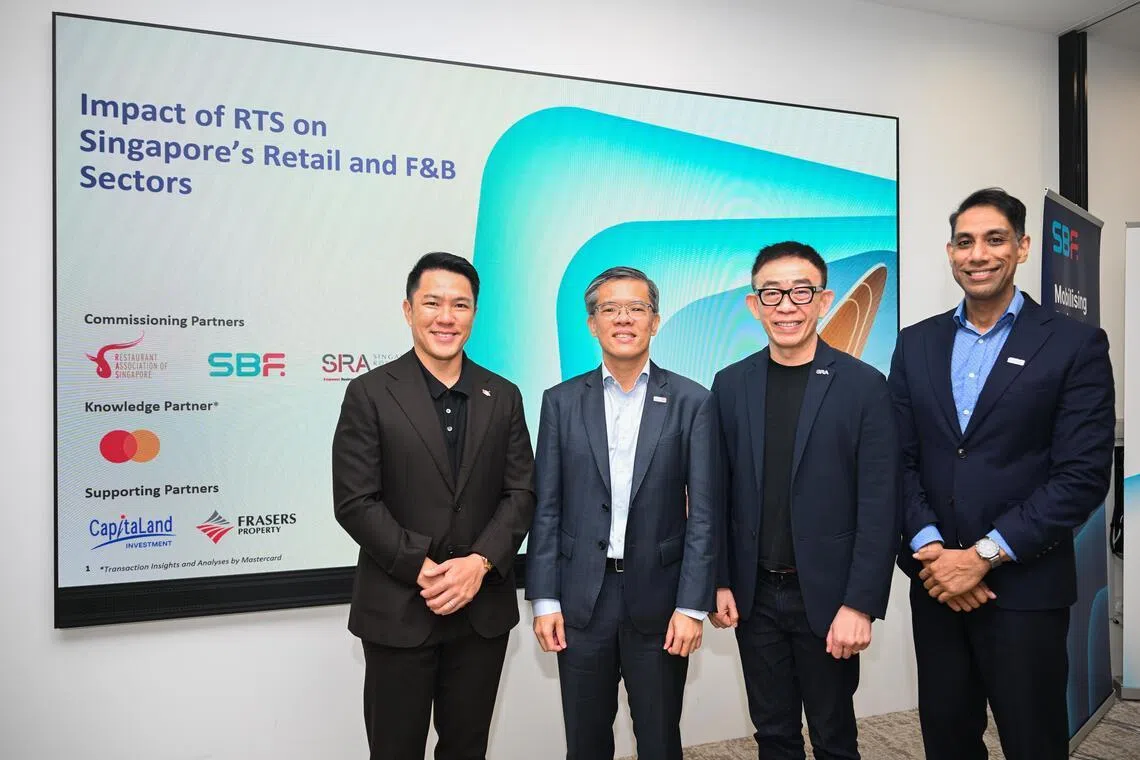
(From left) RAS president Benjamin Boh, SBF chief executive Kok Ping Soon, SRA president Ernie Koh and SBF chief policy and operating officer Musa Fazal at the SBF Center on July 16.
ST PHOTO: SHINTARO TAY
That could play out as a cross-border business facilitation framework, with streamlined approvals, faster regulatory processes and dedicated support for businesses operating across the RTS corridor.
Benjamin Boh, president of RAS, said: “The big players will always have more resources, while the small players have less. What has changed is that we now have a lot more solutions that help the smaller players. Government grants are one thing – but how do they innovate? How do they set up the right shop so they can operate well?”
On the retail property and landlord front, there were suggestions to introduce targeted, time-bound incentives – such as a temporary property tax relief during major upgrading works – to offset investment costs and minimise disruption, encouraging heartland retail malls to upgrade their assets.

