


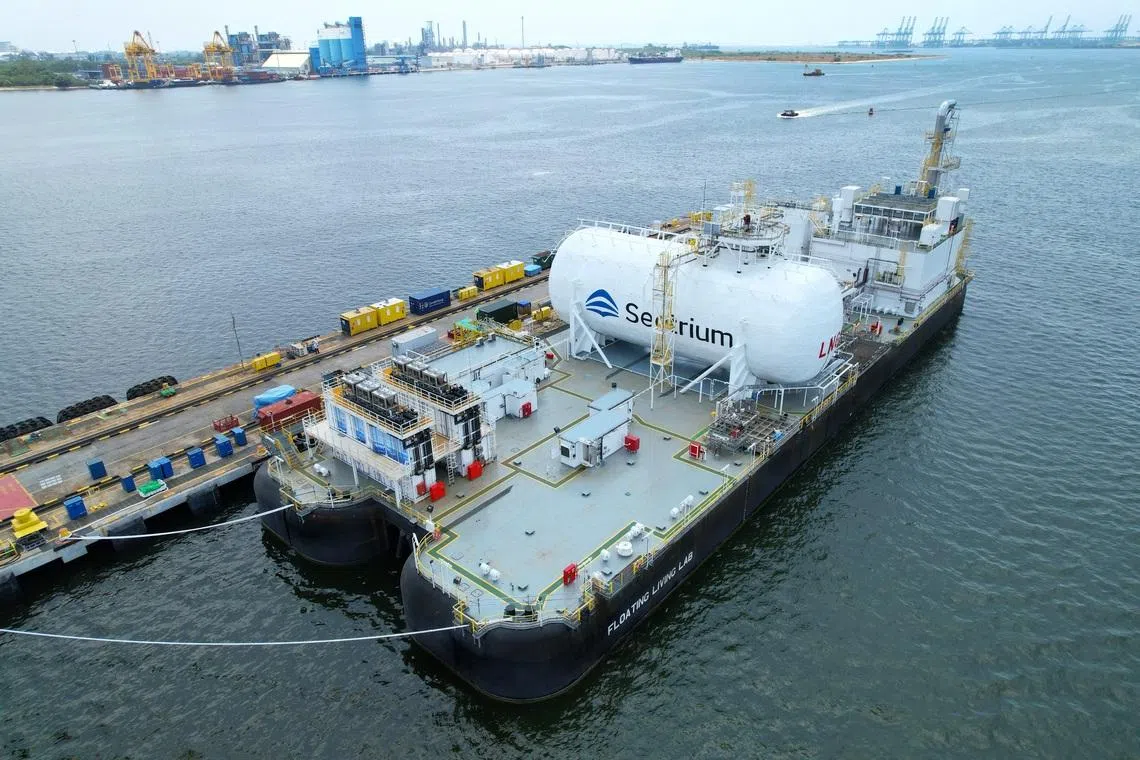
SINGAPORE – Singapore is trying out innovative ways of securing energy supply, with the latest attempt being the transfer of an electron from the world’s first remote-controlled floating lab to the national electricity grid.
This was carried out by offshore, marine and energy specialist Seatrium, which is listed on the Singapore Exchange (SGX).
Seatrium achieved this energy transfer from its floating living lab, which is located off its yard in Pioneer. The lab is the first remote-controlled floating platform for distributing energy resources in the world.
It was built in 2025 and was developed through a partnership between Seatrium and the Energy Market Authority that was announced in 2020.
The floating lab is controlled and monitored by a remote operations centre located about 1km away from the site, which helps to reduce the manpower required on the floating platform itself.
Minister-in-charge of Energy and Science and Technology Tan See Leng witnessed the transfer of the first electron from the platform to the electricity grid on July 3.
Seatrium Digital senior vice-president Lee Wey Lii told The Straits Times on July 10: “The first electron transfer validates that Seatrium has successfully developed a floating distributed energy resource platform that can support both on-land grid and marine energy needs.”
He added that this is particularly significant because Singapore’s electricity grid has stringent connection and export requirements.
“The milestone demonstrates that a marine-classed floating platform can meet the relevant regulatory and technical standards required to connect,” Lee said.
The platform works by having ships transfer liquefied natural gas (LNG) from vessel to vessel, until it reaches the floating lab.
The LNG is then consumed by the platform’s gas engines to generate electricity.
LNG is not considered a renewable energy source, but is seen as cleaner than other fossil fuels because it emits less carbon dioxide.
The generated electricity from the floating lab helps to power Seatrium’s Pioneer yard and meet its operational requirements.
Extra electricity is then exported to the Singapore power grid. Seatrium estimates that the excess electricity can meet the monthly energy needs of around 1,500 four-room HDB households.
Seatrium added in a media statement that the floating lab combines a stacked battery energy storage system with gas bunkering infrastructure. In this way, it can support new energy infrastructure and emerging business models.
“(This) positions Seatrium at the forefront of offshore energy as power demand in heavy consumer markets grows,” the company said.
Lee added that the floating lab also shows that it is viable to have floating energy infrastructure that complements land-based power systems, especially in a highly land-constrained environment like Singapore.
He noted that while the floating lab currently relies mainly on LNG-based energy generation, it can provide a platform for Seatrium to test and scale similar solutions using a broader lower-carbon energy mix.
“Combined with renewable energy generated at Pioneer Yard, this could help reduce the overall emissions intensity of the site over time,” he said.
“For Singapore, the platform demonstrates a more flexible approach to electrification and energy resilience, while creating the potential for distributed power solutions that can serve both grid and marine users.”
Energy resilience has grown in importance since the breakout of the US-Iran war, which effectively blockaded the Strait of Hormuz, the world’s most important energy shipping channel.
Lee added that this milestone also supports Singapore’s broader ambition to be a regional hub for energy transition solutions.
“While Singapore may face natural constraints in domestic energy generation, platforms such as the floating lab show how Singapore-based companies can develop and export advanced energy infrastructure, remote operations capabilities, and digital energy solutions to regional and global markets,” he said.
He also noted that while the lab is now piloted at a relatively small scale, it can potentially be scaled up with other greener energy mixes in the future.
The intention of the lab is also to test-bed new solutions, including the integration of storage and power conversion with remote capabilities within a single platform, he said.

