


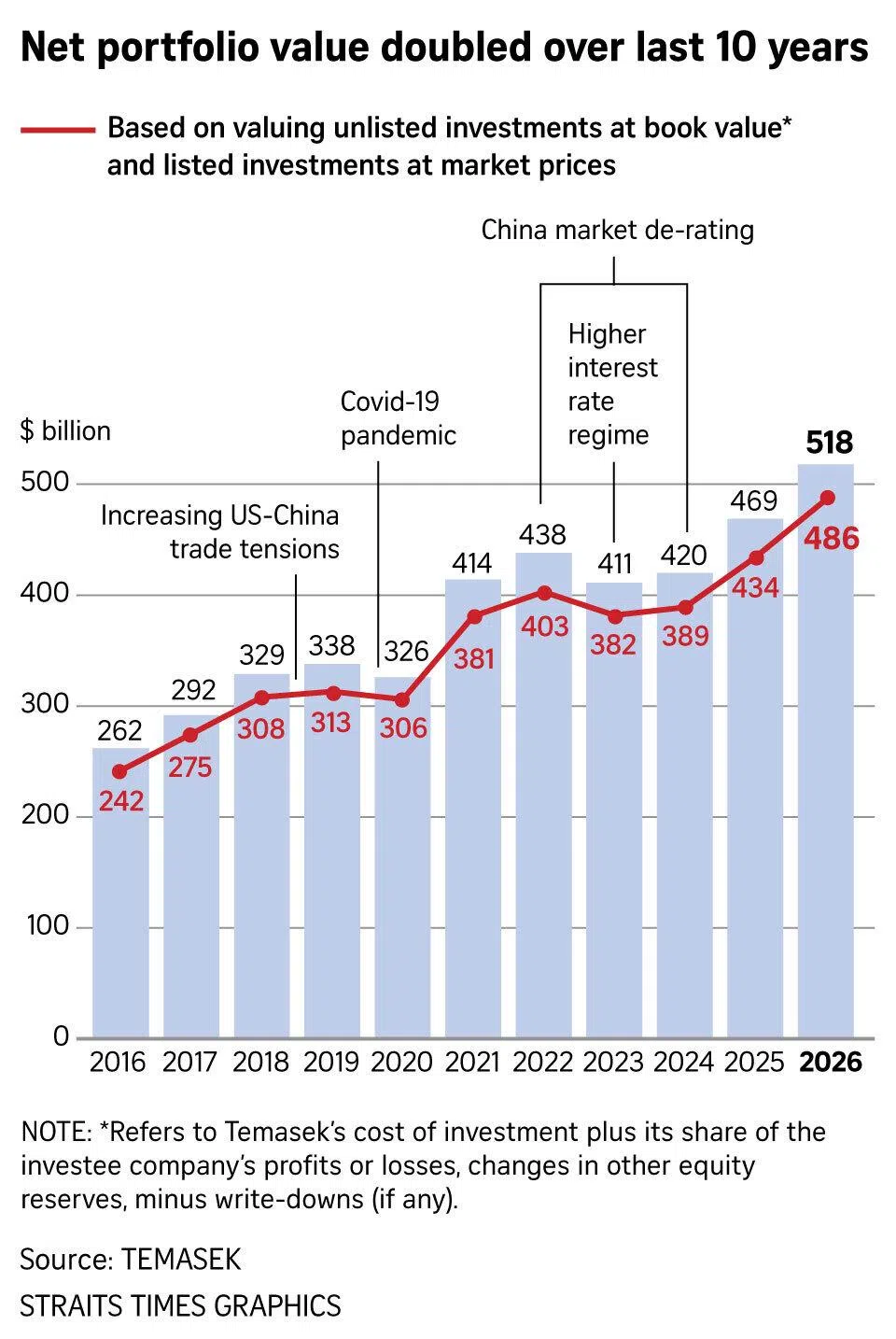
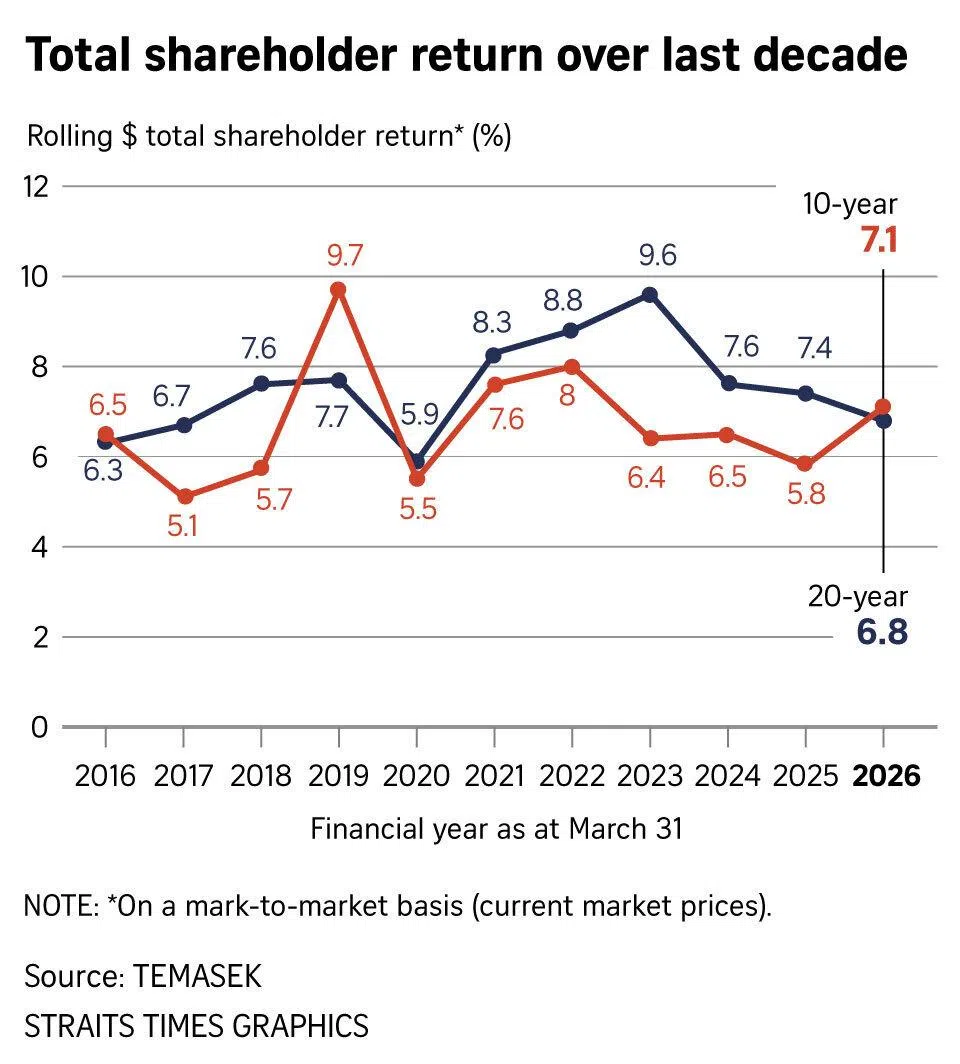
SINGAPORE – Temasek’s net portfolio value hit a new high of $518 billion in the financial year ended March 31, it reported on July 8. Singapore’s investment company said it continues to deliver resilient long-term returns, with a 20-year total shareholder return of 6.8 per cent.
This came despite the net portfolio value taking a 2 per cent hit due to the Middle East conflict, which started at the end of February.
Still, Temasek Global Investments president Nagi Hamiyeh said, Temasek does not have much direct exposure to the Middle East.
Around 12 per cent of its portfolio is exposed to the Europe, Middle East and Africa region, with most of it in Europe, he added.
While Temasek has some fund investments in the Middle East, the conflict has mainly affected Europe by disrupting energy supply chains, following the effective closure of the Strait of Hormuz, a vital global shipping channel for oil and gas.
Temasek Global Investments chief executive officer Chia Song Hwee said Temasek began looking more deeply into the Middle East market over the past two to three years, starting with fund investments.
“We believe that the underlying economic drivers are strong, and we also believe that it’s sustainable,” he said, adding that policy reform has been progressing quite well, although it has been disrupted by the US-Iran war.
“In the same vein, the war has created investment opportunities as infrastructure needs to be renewed, but more importantly, new infrastructure needs to be built to address the resiliency of the supply chain, including exports,” he said.
Temasek recently announced a partnership with L’IMAD, the sovereign wealth fund of the Abu Dhabi government, while its asset-management arm Seviora opened its first Middle East office in Abu Dhabi in 2025.
Overall, Temasek increased its net portfolio value by $49 billion in the last year, driven by strong performance from its Singapore-based portfolio companies, enabling it to cross $500 billion in its mark-to-market value. This refers to accounting for the value of an asset based on current market prices.
Temasek also delivered one-year total shareholder returns of 10.5 per cent. It added that in US dollar terms, this would be 14.8 per cent, due to the strong Singapore dollar against other foreign currencies.
In a recorded address to the media, Temasek’s chief executive Dilhan Pillay said he expects geopolitical shocks to persist, and it is important that Temasek builds a quality portfolio that can “bounce back” from such shocks and maintain resilient performance in the future.
He added that Temasek will identify opportunities where demand is underpinned by long-term structural trends and “where patient capital like Temasek’s can add value”.
During the financial year, Temasek invested $51 billion and divested $31 billion.
Its Singapore-based portfolio companies, which still make up 43 per cent of its portfolio, delivered an internal rate of return of 8.1 per cent over the last 10 years.
Temasek said it is an active owner of these companies and has partnered with them to unlock value. For instance, it invested in Singapore-headquartered data centre service provider ST Telemedia Global Data Centres in 2020, which was sold to local telco Singtel and US global investment firm KKR for $6.6 billion in 2026.
Growing Temasek’s global investments
Meanwhile, its global direct investments, which comprise public and private equity, make up 38 per cent of its portfolio and delivered an internal rate of return of 7.6 per cent over the last 10 years.
Temasek has invested in well-known companies from a wide range of sectors, such as AI companies Anthropic and OpenAI, as well as popular coffee chain Luckin Coffee from China.
Despite geopolitical risks and US dollar fluctuations, the United States remains the largest destination for Temasek’s capital in its global investment segment.
Its overall portfolio has 26 per cent exposure to the Americas, and this is set to continue.
Temasek International chief investment officer Rohit Sipahimalani said: “The US is an anchor for some of the biggest innovation that’s taking place today around AI, and the significant opportunities are going to be there.”
He added that the US market posted earnings growth of more than 20 per cent in the first quarter of 2026, and remains important to Temasek given the significant capital expenditure taking place there.
Temasek has been allocating about 50 per cent of its capital to the US every year, and it has been inching up as a share of the overall portfolio too, he noted.
Hence, despite issues around the US dollar, he said Temasek expects reasonable returns from the US.
Meanwhile, the overall percentage of Temasek’s portfolio in China has been steadily declining over the years. Its Chinese investments stand at 17 per cent, compared with 18 per cent in 2025 and down from 27 per cent in 2021.
Temasek said that its five-year total shareholder return of 4.6 per cent had been impacted by headwinds in China’s capital markets from 2021 to 2024.
It acknowledged that the softer Chinese market, as a result of a decline in domestic consumption, has made certain sectors, such as real estate, more challenging.
Chia said: “We need to recognise that those challenges are somewhat structural and, therefore, we can’t invest under the assumption that the situation will reverse itself.”
He added that despite the overall decline of China’s share in Temasek’s portfolio, the absolute dollar value continues to increase, growing by $10 billion over one year and by $24 billion over 10 years.
Temasek will continue to leverage the high level of innovation in China to identify new investment opportunities, he said. These include the renewable energy value chain, which Chia noted is one of China’s strengths, as well as AI-related infrastructure.
Certain consumer products in China, primarily those of local brands, are also seeing good growth, he added, as Chinese consumers are preferring to spend on experiences rather than goods, and are shifting away from foreign brands to local ones.
These include Luckin Coffee, which continues to open more stores amid a weaker consumer market. Temasek has invested in the coffee chain since 2019, through Centurium Capital, the Chinese brand’s controlling shareholder.
Temasek has a good track record of adapting to shifting trends in China, said Sipahimalani, and it is confident it will continue to find good opportunities in the market.
More growth in private credit business
Temasek aims to grow its private credit portfolio exposure from 2 per cent to 5 per cent over the next five years.
Private credit typically consists of loans offered by private lenders outside the traditional banking system, and are not publicly traded. Companies seek private lenders for acquisitions and business growth that traditional banks may not finance. Such loans include direct lending and asset-backed financing.
Temasek said it has been building its portfolio in private credit for more than a decade and will increase its investments there. It views private credit as an attractive asset class that offers returns at lower risk compared with private equity, while providing stable, recurring cash yield that contributes to its portfolio resilience.
This is while the private credit market in the US has come under pressure due to rising redemptions, with mounting losses in the first quarter of 2026.
Chia said the current crisis in the US is driven by liquidity and duration mismatches. He maintained his conviction in the strengths of private credit as an investment.
Temasek’s head of private equity capital solutions Alpin Mehta said that building a diversified credit portfolio across different sectors would strengthen Temasek’s portfolio resilience and reduce its risk exposure.
While the US remains its deepest and biggest market, Temasek has also invested in private credit opportunities in Europe and Asia.
Mehta cited digital infrastructure as a growing sector for corporate lending, along with real estate, which he said offers opportunities “for high-quality exposure”.

