For organisations large and small, connectivity is often taken for granted – until it stops working.
Payments cannot be processed. Video meetings keep freezing midway. Employees lose access to cloud-based files. AI applications take longer to respond. Even a brief disruption can quickly interrupt day-to-day operations, affecting productivity, customer service and sales.
As businesses become more reliant on digital tools, choosing a network service provider is no longer simply about comparing connectivity speeds or monthly fees, but rather whether the network can keep up with how businesses today operate.
Here are some questions businesses should consider when looking for a network service provider.
In March this year, a major outage lasted several hours, disrupting payment services, ride-hailing platforms and communications, and affecting business operations and revenue.
To reduce such risks, network resilience depends not only on backup systems but also on the physical routes that fibre infrastructure takes.
Singapore-based digital services provider SPTel has built its own fibre infrastructure alongside Singapore’s power network cables, instead of relying on the conventional telecommunications corridors. Because it does not depend on the same ducts and equipment rooms used by traditional telecom operators, it provides an alternative route for connectivity in the event of disruption.
While fibre routing provides one layer of network resilience, businesses also rely on devices that connect wirelessly through mobile networks. Payment terminals, vending machines and Internet of Things sensors, for instance, may depend on mobile networks to stay online.
Multi-Network M2M SIM solutions allow these devices to switch automatically between mobile networks if one becomes unavailable, helping businesses maintain core operations during disruptions. SPTel’s Multi-Network M2M SIM operates on this principle, enabling automatic switching across networks and data pooling across devices.
Smart engineering provider Recolte Technology relies on continuous connectivity to support the deployment of PowerAID™ and TrafficAID™ sensors as part of a smart street lighting initiative in Singapore. These sensors continuously collect multimodal real-time traffic movement data, energy consumption, dimming status and operational health data across the network, enabling engineers to evaluate how lighting could be adapted to changing traffic conditions and identify locations where road safety could be further enhanced.
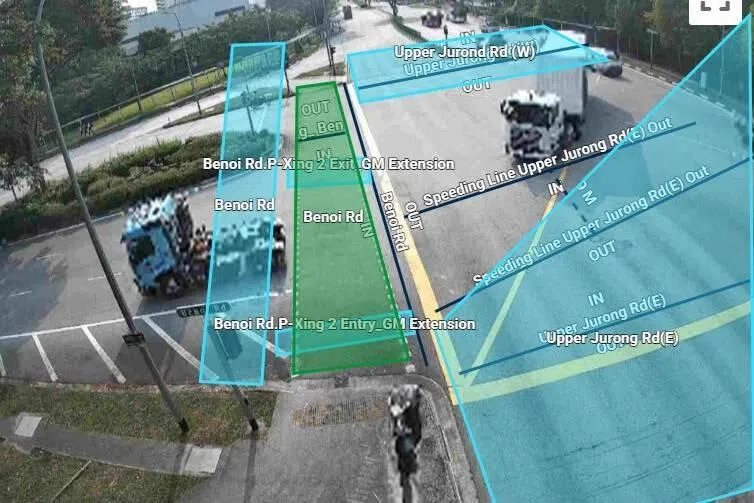
Recolte Technology deploys PowerAID™ and TrafficAID™ sensors that continuously collect multimodal real-time traffic movement, energy consumption and street lighting operational data to support lighting optimisation and AI-powered road safety analytics in Singapore.
PHOTO: RECOLTE
Because the sensors need to send data continuously, any network interruption could create gaps in the information being collected. SPTel’s Multi-Network M2M SIM helps reduce this risk by automatically switching to another available mobile network if one becomes unavailable, allowing data to continue flowing to the monitoring platform.
But staying connected is only part of the equation. As businesses use more AI applications, connected devices and other data-heavy services, they also need information to move quickly across the network. A stable connection that is not responsive can still hold back daily operations.
For example, a factory may use cameras to spot safety issues on the production floor, sensors to track how machines are performing or AI tools to answer customer queries. These systems work best when data can move quickly between devices, applications and employees. If there is a delay, decisions take longer and the tools and their applications become less efficient. That is why network performance is increasingly measured not just by whether a connection stays up, but by how quickly data can travel from one point to another.
SPTel’s fully digital network is designed to reduce the number of network hops data takes between locations, reducing latency for applications such as video surveillance and AI analytics. With a track record of island-wide latency of under 1ms – faster than most telcos – its network is designed to support businesses that depend on real-time applications and responsive AI workloads.
At the same time, the way businesses use digital tools has changed. AI applications and other data-heavy services may not need high bandwidth all the time, but they often require sudden bursts of capacity. Take, for example, during major sales events such as 11.11 or Black Friday, retailers often experience a surge in online shoppers. AI chatbots need to respond to many customer queries at the same time, while other AI systems update product recommendations in real time. These spikes in activity can create sudden bursts of demand on digital infrastructure. If network capacity cannot keep up, pages may load more slowly, AI tools may take longer to respond and businesses risk losing customers before a purchase is completed.
SPTel’s Bandwidth on Demand offering is designed to address these sudden spikes in network usage. Businesses can increase their bandwidth when needed, for as short as an hour, with the upgrade implemented within two minutes. This helps AI-powered services and other data-heavy applications continue running smoothly even during periods of intense demand.
As businesses depend more heavily on digital tools, cybersecurity becomes essential to keeping operations running, protecting customer data and maintaining trust. Every internet connection is a potential entry point for cyberattacks.
Instead of asking businesses to add cybersecurity tools only after their internet service is set up, SPTel builds basic protection into the connection itself. Its clean pipe network, for instance, comes with distributed denial-of-service (DDoS) attack detection as a default.
A DDoS attack happens when a website or online service is flooded with traffic to overwhelm it and force it offline. Built-in detection helps identify such attacks early, so they can be looked into and managed more quickly.
SPTel customers receive alerts when such threats are detected, allowing them to respond faster. They can also activate DDoS mitigation on demand, even without a prior DDoS protection plan. This helps businesses reduce the disruption and damage caused by such attacks.
With digital tools placing higher demands on standard infrastructure, choosing the right corporate connectivity solution is a critical business decision. Find out how SPTel’s network features can support your business requirements here.
$98 per month (24-month contract)
Includes:
– 500Mbps + free 300Mbps speed boost
– Free Wi-Fi 7 dual-band router
– Free DDoS attack detection (worth $1,272 per year)
– Bandwidth on Demand: Scale up to 1Gbps in two minutes via a self-service portal
– One-time charge waiver (worth $817.50)
$356 per month (24-month contract)
Includes:
– 100Mbps + free 100Mbps speed boost
– Enterprise Internet 200Mbps
-
Free Bandwidth Utilisation Dashboard
-
Supports scalable bandwidth up to port size
-
Service level agreement 99.95 per cent
-
Enterprise-grade router rental
– DDoS Protect Enterprise 200Mbps
-
Network-based DDoS attack detection
-
Application-layer DDoS attack detection
-
Automatic/initiated DDoS attack mitigation
-
SIEM dashboard login (two accounts)
$113 per month for 10 SIM Cards (12-month contract)
Includes:
– 10 physical SIM Cards (500MB per SIM)
– 5GB Data pooling
– 4G/5G speed
– Management portal
Customers who sign up for these plans will also enjoy:
-
A chance to win a three-day, two-night staycation for two during the Singapore Night Race weekend from Oct 10 to 12, 2026 (worth $5,000)
-
Reward of up to $250 vouchers (fuel or ride-hailing), while stocks last
The promotion ends on Sept 20, 2026. Visit the SPTel website for more details.