


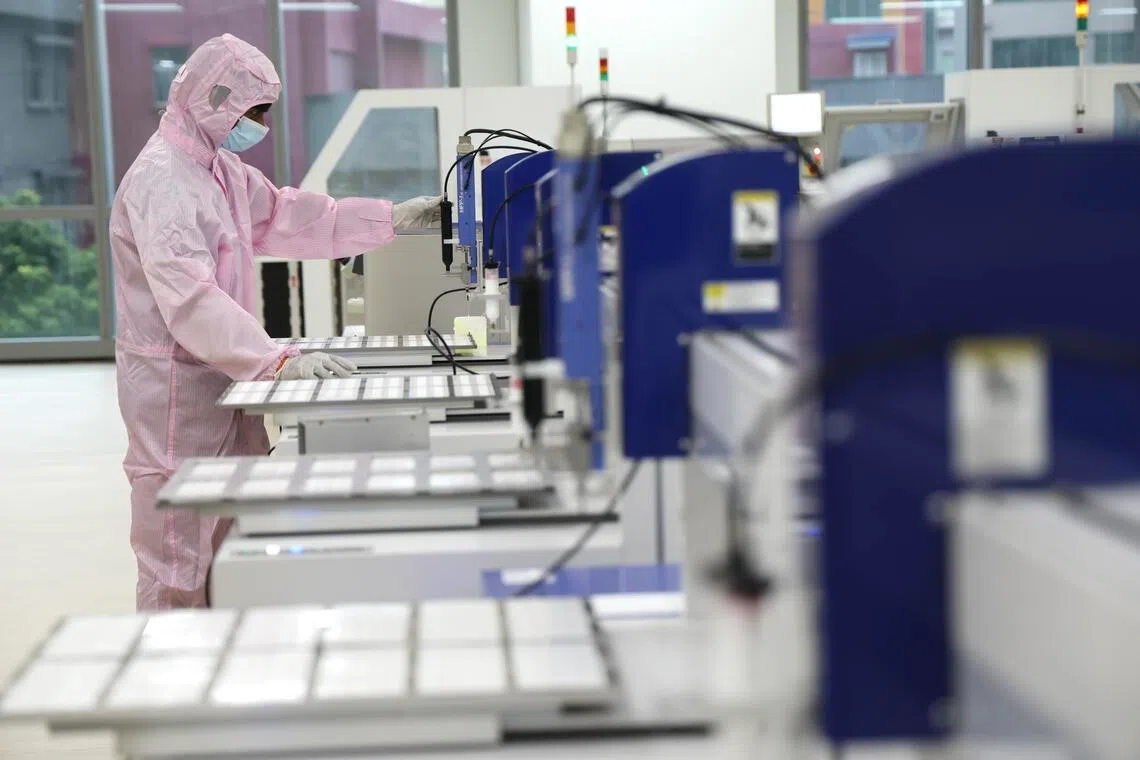
SINGAPORE – Manufacturers continued to benefit from artificial intelligence demand in June, as orders for semiconductors fuelled an expansion in factory activity here for the 11th month straight.
This is despite continued pressure on supply chains due to instability in the Middle East, with a recent round of indirect talks between Iran and the US ending with no real breakthrough.
Singapore’s purchasing managers’ index (PMI) – a barometer of the manufacturing industry’s overall health – hit its highest reading since November 2018 in June.
It rose to 51.3 points from 51 points in May, buoyed by stronger growth in new orders, new exports, factory output, input purchases and employment.
A PMI reading above 50 indicates growth, while one below that signals contraction.
The electronics sector, which accounts for 40 per cent of Singapore’s manufacturing output, recorded a PMI of 52.2 points in its 13th consecutive month of expansion.
“Singapore’s manufacturing sector continues to benefit from the AI-driven semiconductor super-cycle, which is supporting robust production, strong order inflows and rising order backlogs while reducing finished goods inventories,” said Stephen Poh, executive director at the Singapore Institute of Purchasing and Materials Management, which compiles the monthly survey.
Supplier deliveries contracted at a faster pace and for the sixth straight month, pointing to longer lead times and persistent supply chain constraints, which Poh attributed to the ongoing tensions in the Middle East.
DBS senior economist Chua Han Teng noted that the electronics supplier deliveries sub-index also remained in contraction.
He said the de-escalation of US-Iran tensions, which began with an interim peace deal, will take time to filter into global supply chains.
Negotiations between the US and Iran over maritime traffic in the Strait of Hormuz are expected to continue later in July.
The critical waterway, through which around a fifth of the world’s oil and gas supplies are usually transported, was effectively shut for months following the outbreak of the Iran war on Feb 28.
“Confidence in transiting the Strait of Hormuz is taking time to recover,” Chua said. “Consequently, flows of critical input supplies from the Middle East, including oil and gas, will also gradually normalise to pre-war levels in possibly months.”
UOB senior economist Alvin Liew said the easing of the input prices sub-index from 51.6 points in May to 50.8 points in June likely reflects “easing in energy- and fuel-related costs and other input costs as the Middle East conflict achieved some level of de-escalation”.
“However, the input prices sub-index for electronics continued to rise, along with a higher imports index, suggesting continued strong underlying demand for electronics,” he said.
The future business index remained in expansion territory for the eighth consecutive month, pointing to confidence among manufacturers in the current economic environment.
Brian Lee, economist at Maybank Securities Singapore, expects strong electronics and manufacturing growth to continue in the second half of 2026, driven by AI demand.
“America’s five largest hyper-scalers are planning to raise capital expenditure (capex) by a robust 77 per cent year on year. This will supercharge demand for semiconductors and server-related products,” Lee said.
“Higher China capex spending is likely to add another layer of demand for Singapore’s exports and manufacturing,” he added.
The demand for semiconductors, computers and other AI-related products helped to return China’s factory activity to expansion in June.
Chinese manufacturers also benefited from strong export orders, including from customers which front-loaded orders to get ahead of new US Section 301 tariffs that take effect in late July.
The country’s official manufacturing PMI rose to 50.3 points in June from 50 points in May.
Elsewhere, private surveys showed that factory activity ticked up in the Philippines, while in South Korea it expanded at a slower pace as export demand fell.

