


Soggy bread. Melted ice cream, refrozen. Temperature lapses at Jurong Cold Store (JCS) once meant losing between four and five pallets – up to 5 tonnes – of food.
According to the home-grown cold chain logistics company, it has eliminated food wastage entirely, after adopting a Singapore Standard (SS) governing the handling, storage, and transportation of chilled and frozen food.
Belinda Lee, who co-founded JCS with her husband Lee Weng Wah in 1998, says: “We used to have at least 5 per cent wastage a year. Any wastage, for us, is a problem.”
For a cold chain logistics operator, wastage was not just about lost product – there were also disposal costs to pay, and it could also mean losing customer confidence in its reliability.
Introduced in 2020, SS 668 sets out requirements for the temperature control, handling, storage and transportation of chilled and frozen food.
For JCS, adopting the standard in 2021 with support from Enterprise Singapore (EnterpriseSG) through the Enterprise Development Grant meant rethinking every step of the cold chain – from the moment a container arrived at the loading bay and how goods were transported between cold rooms and warmer environments, to warehouse storage practices and last-mile delivery schedules to restaurants and supermarkets.
“Now, we never have to throw anything away,” says Lee, who currently serves as a director at JCS.
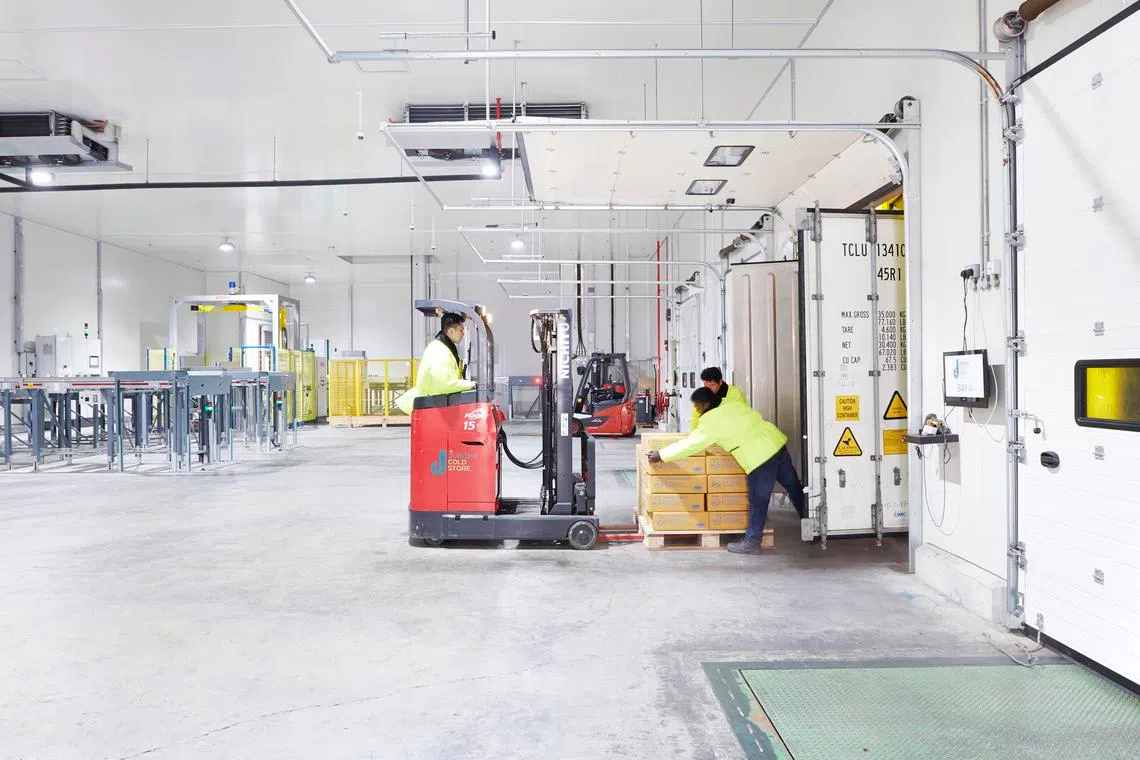
Inside the goods receiving zone, or anteroom, at Jurong Cold Store, where Singapore Standard (SS) 668 limits transfer times for chilled and frozen goods to just 30 minutes..
PHOTO: JURONG COLD STORE
To Lee, SS 668 put into writing what she had always known – that controlling temperature and timing at every stage was the difference between food that arrived fresh and food that did not.
In the heat, bacteria multiply rapidly the moment cold chain discipline slips – a pallet left too long in a loading bay, a truck that had not been pre-cooled before loading, a transfer that took more than 30 minutes.
For JCS, which operates a high-density fully automated cold storage facility capable of handling 15,000 pallets, SS 668 gave the team a clear framework to follow.
“If you’re not carefully controlling, and monitoring the temperature and the timing at every stage, bacteria will grow quickly and spoil the food,” says Lee.
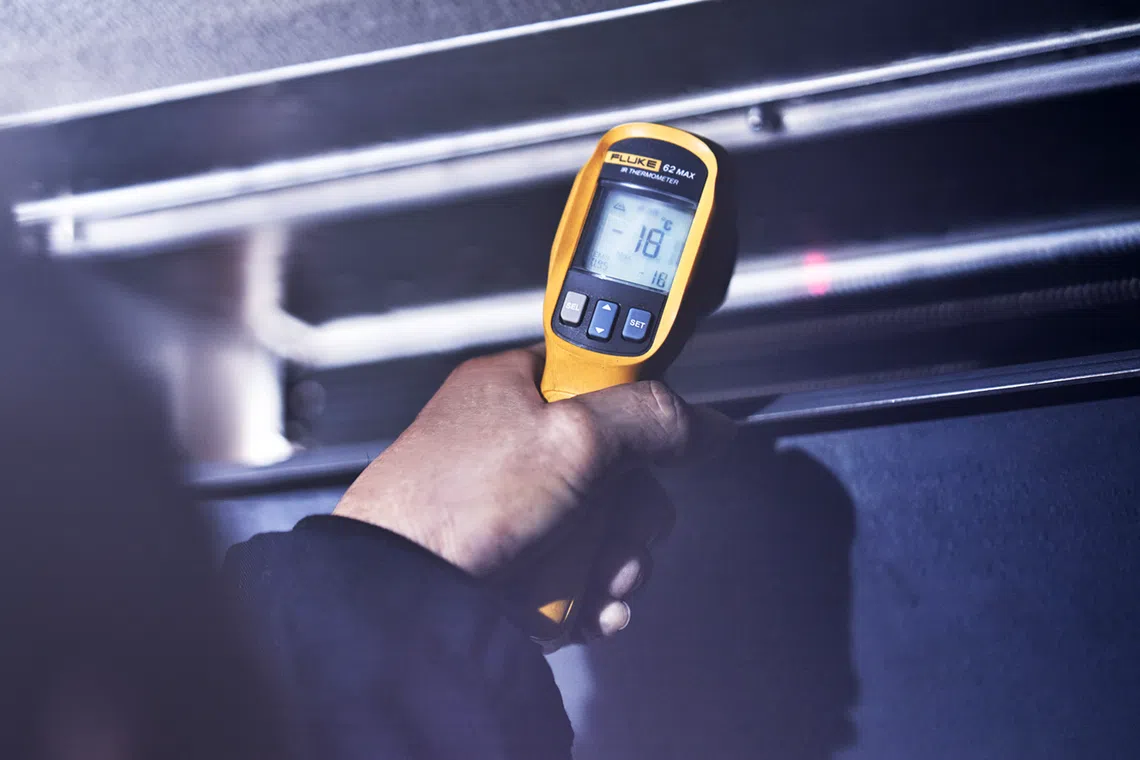
A staff member checks that temperatures hold at minus 18 deg C in delivery trucks – a requirement Jurong Cold Store enforces across its operations since adopting SS 668.
PHOTO: SPH MEDIA
SS 668 is one of many standards developed under the Singapore Standards Council, which EnterpriseSG oversees. The council brings together industry players, regulators and academics to translate ground-level expertise into practical frameworks that businesses can follow.
Choy Sauw Kook, director-general for quality and excellence at EnterpriseSG says: “Besides encouraging companies to adopt standards, we invest significant effort in continuously reviewing existing standards and identifying emerging areas where new standards are required. This contributes to a robust ecosystem that supports business growth.”
While JCS’ operations had already met temperature control best practices before adopting the standard, SS 668 pushed the company to strengthen other processes along its delivery fleet and cold rooms.
It introduced sensors and data recording systems, tightened handling times at transfer points and strictly monitored how long goods spent moving between cold rooms and warmer environments.
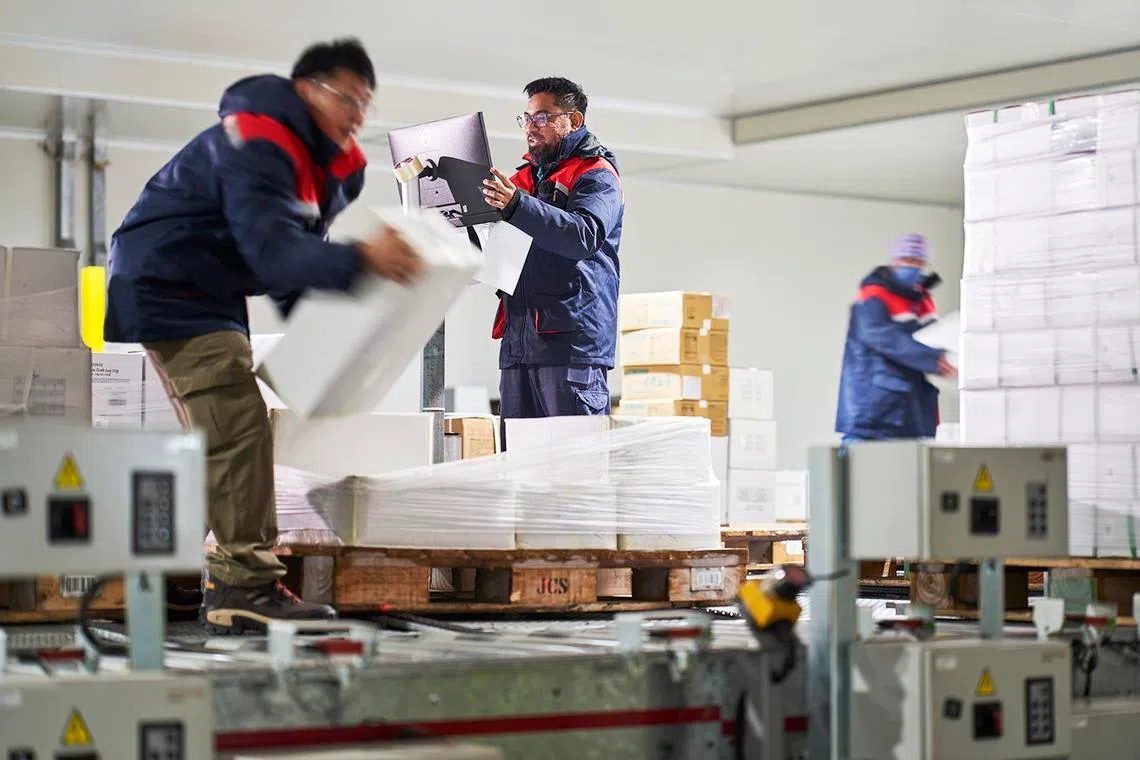
Staff pick and pack goods at the staging area before dispatch, ensuring each delivery is consolidated by destination to minimise time spent outside cold storage.
PHOTO: SPH MEDIA
The change brought about results quickly. On top of eliminating food wastage, JCS saw an end to freezer and chiller breakdowns, since equipment irregularities could now be caught before they escalated.
The sensors and data recording systems they installed to meet SS 668 requirements meant real-time monitoring of all zones – problems were flagged earlier, eliminating the need for emergency repairs and unplanned downtime. In the first three months alone after adopting the standard, the company saved $50,000.
Strengthening the process also pushed JCS to invest in a fully digitised inventory and warehouse management system that allows customers to remotely track their inventory, monitor deliveries and verify how products are handled.
For overseas companies looking for a logistics partner in Singapore, that transparency – backed by a recognisable standard – carries weight.
According to Lee, JCS’ overseas clients have grown by 10 per cent since adopting SS 668. They include a popular Japanese sushi restaurant chain and a China-based food supply chain operator.

Lee discusses inventory movements with her team against a live view of Jurong Cold Store’s automated warehouse tracking system.
PHOTO: SPH MEDIA
“When people want to do business with you, one of the first things they ask is what standards you hold. If you have Singapore Standards, they have confidence in you,” says Lee.
JCS supports international customers that require end-to-end cold chain services, covering cargo clearance, cold storage and final-mile distribution to retailers and F&B outlets. Since having SS 668 in place, JCS has seen a 30 per cent increase in revenue across three years.
To meet the growing demand, the company is building a second facility alongside its existing premises at Chin Bee Drive, scheduled for completion in 2027, that will double its capacity to 30,000 pallets.
Lee attributes the company’s growth to the discipline that SS 668 instilled.
The standard took more than two years to develop, with input from industry players and government agencies. Lee was one of them, sitting on the working group and pushing for plain language that operations staff could actually follow. The Singapore Logistics Association conducts two-day training courses, with costs supported by the Enterprise Development Grant.
Yet adoption among SMEs remains uneven. Lee thinks the hesitation is misplaced.
“For SMEs in the cold chain food industry that don’t have KPIs or one single operations playbook that everyone can refer to, SS 668 can be very advantageous as their SOP to follow,” she says.
For JCS, it has become something more fundamental than a framework.
“Standards are not just a checklist. It’s part of how we work every day,” she adds.
This story is part of a series on how home-grown companies stay competitive and are benefitting from the adoption of standards, with the support of Enterprise Singapore. Find out more here.