


SINGAPORE – When Lim Wei Yung was 11, he accidentally broke a school canteen window kicking a football. His parents paid for the damage, but made him reimburse them through deductions from his weekly allowance.
“It took me a year to pay it off,” says the 32-year-old on his first lesson about money. “That was when I realised money is hard to earn and does not grow on trees.”
Years later, he had his first taste of entrepreneurship when he bought an espresso machine and resold it on online marketplace Carousell for a profit.
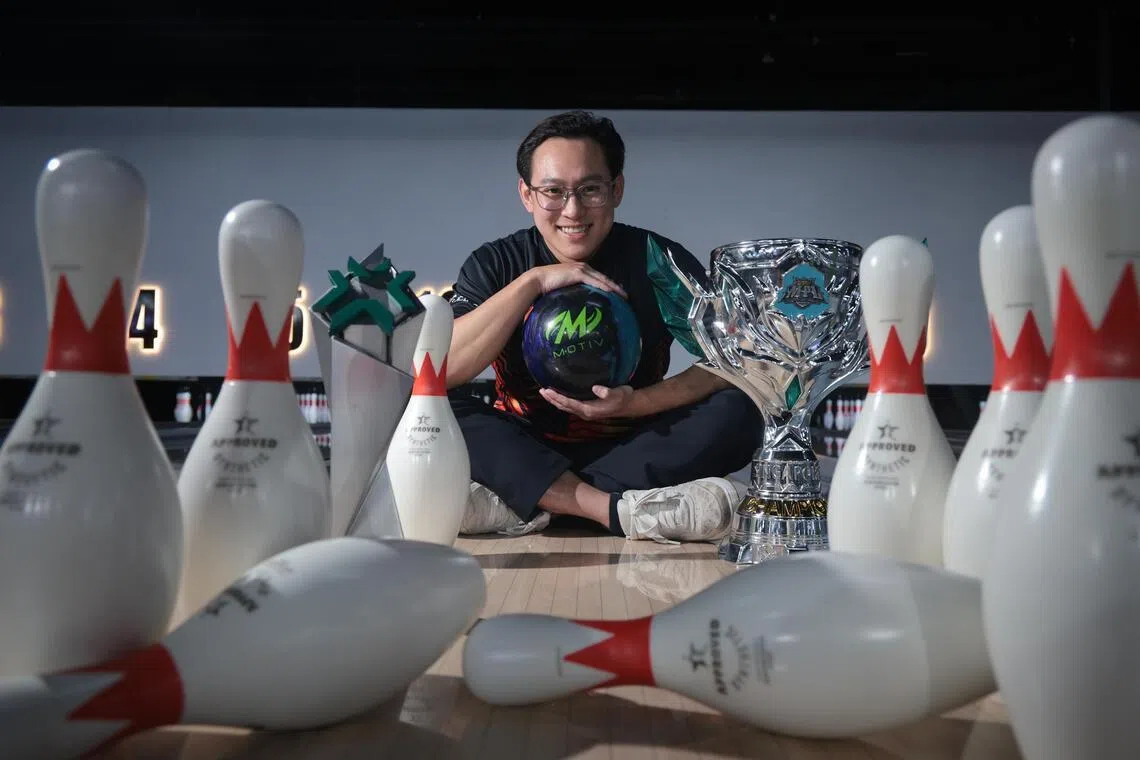
Now, Lim owns two Cafe4You outlets – at Hillview Link and Bukit Merah Central – serving local and international fare, and is also the founder and director of Sonic Bowl, an entertainment bowling centre chain that blends the sport with food, music and social experiences.
“My most valuable assets are my businesses,” he says. “The Covid-19 pandemic definitely burnt a huge hole in them, but the profits eventually started to return.
“I made the hard decision to reinvest my profits into renovating my outlets and I hope my customers will appreciate it.”
Lim, who is single, is pursuing a communications degree at the Singapore University of Social Sciences.
A: I mostly reinvest in my bowling business. Because bowling serves as both a co-curricular activity and a weather-proof venue for team bonding, I do not see it as a sunset business.
I also took over the South-east Asia distributorship for US-based Motiv Bowling, one of the largest bowling equipment brands in the world.
Recently, I invested in e-sports. I opened two LAN gaming centres, where customers pay to play networked video games, and own professional teams in two e-sports titles, Valorant and Mobile Legends.
A: It is good to understand your life’s timeline, even if things do not go according to plan, such as getting married, buying a car or purchasing a house.
When I was younger, I had planned to get married before I turned 30, but it didn’t happen, and I used the money I had saved for my business instead.
I believe it’s good to plan for certain milestones in life and not be hesitant to move money around for other uses.
A: I invest in Pokemon cards. It started a couple of years ago when I followed my friends to buy Pokemon packs in Japan and began opening them in search of rare cards. That sparked my desire to collect them all.
I also collect watches of brands such as Rolex, Seiko and Grand Seiko.
I’m not the crazy type of watch collector, though. Most of my collection consists of limited-edition Seiko watches, which range in price from $500 to $2,000. I find them more affordable than a Grand Seiko or a Rolex.
As the Singapore dollar strengthens against the Japanese yen, I have taken the opportunity to buy more Pokemon cards and watches.
A: I used to collect cameras. It started when I broke my leg in Secondary 4 and felt hopeless because I could not play football or go swimming with my cousins.
My father bought me a camera so I could take pictures while my friends played. The perspective through a lens and its interpretation can change how an observer sees something.
That led me to buy different camera bodies and lenses, eventually building a collection.
A: My biggest financial mistake was spending up to $12,000 a night on drinks at nightclubs to impress the people around me when I was in my early 20s.
A: My best financial decision has been investing in people.
When I started my bowling business during the Covid-19 pandemic, I knew I would have a hard time finding a team that would work for a young boss.
During that period, I spent significant resources developing my team, sending them for courses and helping them shape their portfolios and job responsibilities.
A: One core memory from my childhood is that of my parents giving me a monthly allowance when I started secondary school.
That taught me from a young age how to allocate my money and not spend it all at once. It shaped my approach to saving and spending, and later helped me grasp dollar-cost averaging when I started investing.
A: My childhood dream was to become a doctor, but I guess you could say that I’m now a surgeon who dissects business problems and finds cures for them.
A: I worked at a pet-friendly cafe within walking distance of my home.
A: I was a relief teacher for a couple of years, gave private tuition and also worked in a sports retail shop.
A: As a child, I always wanted to buy my parents a meal with my first pay cheque.
I never really wanted to buy anything tangible. I preferred making my parents and the people around me happy through fellowship over a meal.
I was more of a spendthrift when I was younger, but as I grew older and started planning for my future, I spent less, and my saving habits became more aligned with my life goals.
A: Play hard, work hard and save as much as you can.
A: I have been driving an electric vehicle (EV) for five years.
Electricity costs much less than petrol and, looking at how petrol prices have increased, I’m glad I switched to an EV early.
Maintenance costs are low and charging stations are now far more abundant than in the early days.
A: My silliest purchase was six popcorn buckets at Tokyo Disneyland, simply because they had no queue – unlike the three-hour waits for rides.
A: Work-life balance means being able to accomplish the work that needs to be done while also having time for myself.
Sometimes work requires more of my time, so I have to sacrifice some of my personal time and vice versa.
Learning how to plan and accommodate both sides is work-life balance to me.
A: When I first started working, I spent money on clothes, food and drinks.
As I grew older, I started spending more on skill courses, masterclasses and technology.
A: My perfect day would start with wonton mee for breakfast, followed by a few meetings.
I would have nasi lemak for lunch and catch up with my staff, then have char kway teow for dinner followed by a bowling league session. I would grab a supper of noodles before heading home to play a few games of Valorant.