


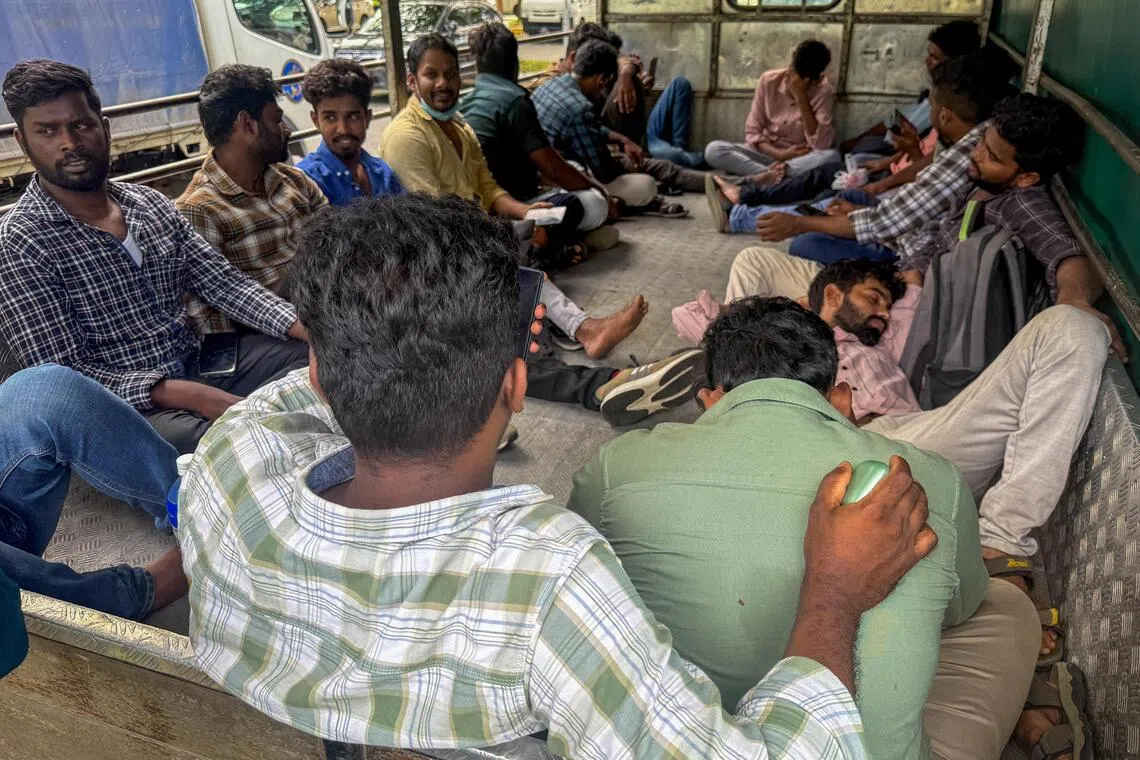
SINGAPORE – The Ministry of Manpower confirmed that around 400 migrant workers from VVR Plant Engineering, KPA Engineering, and SK Industries are owed between two and four months of wages, after Ramu Palani Velu, the same director for all three firms skipped town.
Questions have been raised over whether the companies involved could have abused the foreign worker quota, the legal consequences for employers who fail to pay salaries and the financial safeguards for migrant workers in such a predicament.
Here’s what we know so far.
The number of foreign workers a company can hire is limited by the dependency ratio ceiling, a quota set by the Ministry of Manpower (MOM). The ceiling varies by sector.
For companies in the construction sector such as VVR Plant Engineering, they can hire five worker permit holders for every resident employee, who earns at least the local qualifying salary (LQS) of $1,600 a month. The LQS will be raised to $1,800 a month from July 1.
For companies within the manufacturing sector such as KPA Engineering, companies can hire 1.5 foreign workers (including both work permit and S pass holders) for every resident employee.
The system is designed to ensure that employers in Singapore hire local workers and pay them fairly.
Employers have been caught for inflating their foreign worker quota by making false CPF contributions to locals who are not their real employees.
According to MOM, about 100 employers have been taken to task for making such “phantom worker” arrangement between 2024 and 2025.
Lawyers who spoke to ST said migrant workers are protected under the Employment Act and Foreign Worker Employment Act.
Under the Employment Act, employers who repeatedly do not pay wages can face fines of up to $30,000, or jailed up to 12 months, or both. Company directors or senior officers who know about the lapse but allow it to happen anyway may also be held liable.
In some cases, the court may order that fines collected from the employer be paid to affected employees, allowing workers to recover at least part of their unpaid wages, said Khelvin Xu, Director at Covenant Chambers LLC.
Employers must buy a $5,000 security bond for each non-Malaysian work permit holder they employ. The bond, which can be purchased from any authorised bank or insurance company, is meant to ensure that both employers and workers comply with the work permit conditions.
If an employer fails to pay salary on time, the security bond may be forfeited by MOM, who will then help with wage recovery.
Apart from this, there is no incentive for employers to put in place any more safeguards since that would increase operating costs, said Xu.
“Migrant workers who have already paid hefty fees for a chance to work in Singapore have no real bargaining power to try pushing for more protections, especially at the beginning of the employment relationship and for fear of being labelled troublemakers,” he added.
Mmigrant workers may file a salary claim with the Tripartite Alliance for Dispute Management (TADM). A migrant worker may claim up to $20,000 if he is not a union member, and $30,000 if he is a union member.
TADM will facilitate mediation between the worker and employer to negotiate payment. If mediation is unsuccessful, the worker may bring the claim before the Employment Claims Tribunals, which can order the employer to pay the outstanding salaries.
However, if the company has gone bust, recovering the salaries would be more difficult as workers would have to make a claim through the liquidation process. Any payout would depend on the company’s remaining assets and whether there are secured creditors, said Ian Lim, partner and head of employment at TSMP Law Corporation.
The debts will be paid according to a legal order of priority, employees’ unpaid wages are ranked ahead of most unsecured debts. However, if the company has no real assets or cash, employees may not be paid, he added.
Under the Employment of Foreign Manpower Act 1990, the employer is responsible for the costs of sending their employees home.
They should reach out immediately to organisations such as the Migrant Workers’ Centre (MWC), Humanitarian Organisation for Migration Economics (HOME) or Transient Workers Count Too (TWC2), who will be better placed to provide practical assistance, said Xu.
Workers may receive emergency financial assistance through funds such as the Migrant Workers’ Assistance Fund, although such support may not cover the full amount of unpaid wages, said Prashant Somosundram, director of HOME.