


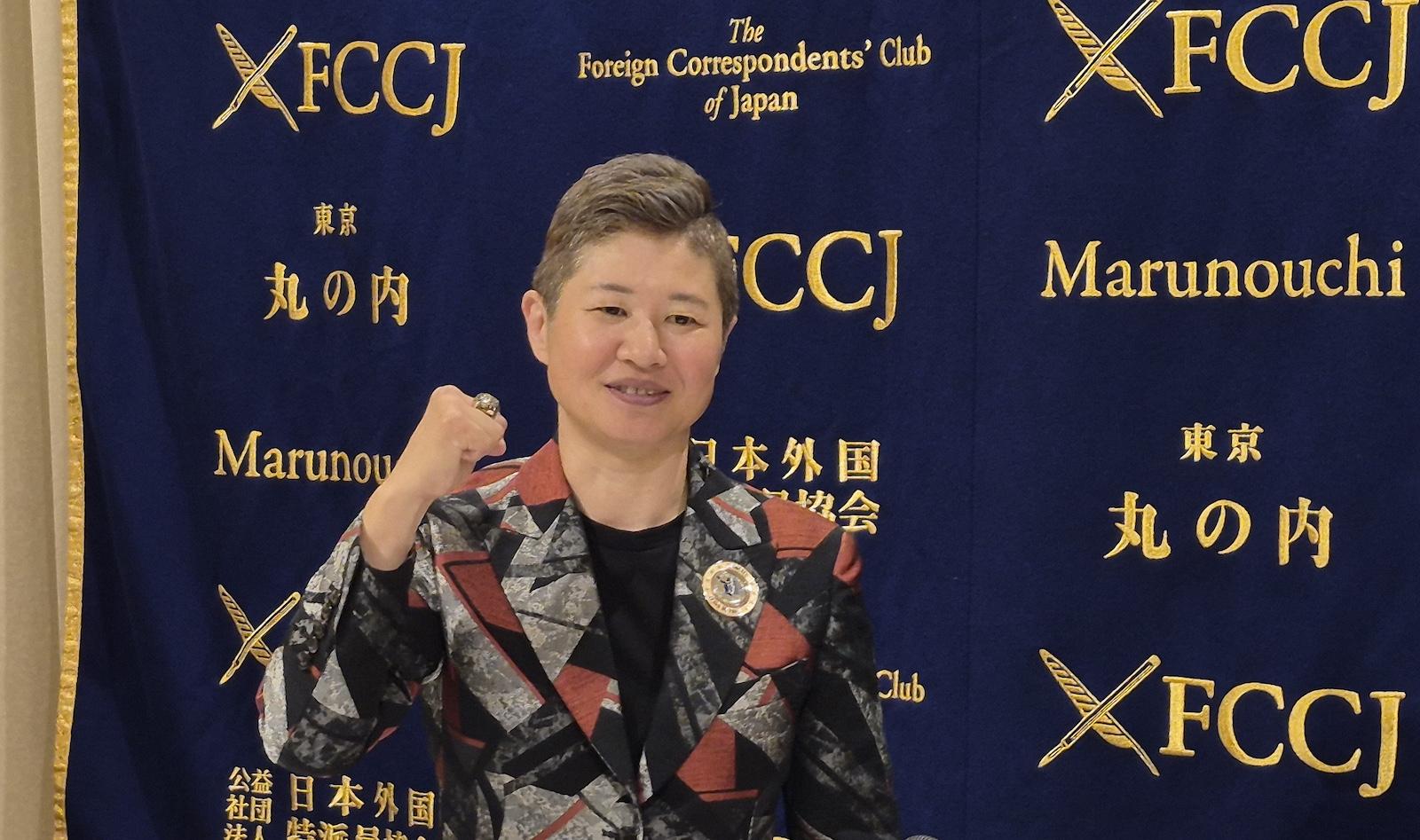
When you think of Japanese boxing, the name Naoko Fujioka might not immediately spring to mind, but she has been a trailblazer for women’s boxing in Japan and has just become the first Asian woman to be inducted into the International Boxing Hall of Fame. That in itself is remarkable; even more remarkable is that she didn’t decide to turn pro until she was 33 and only retired three years ago at the age of 47, having won world titles in five weight categories.
At a press conference at the Foreign Correspondents’ Club of Japan on Tuesday, she also showed that she is a champion for women and minorities and has a sharp view of the world of boxing and women in sports.
She admitted that to get into a ring and try to beat an opponent, you need a “bad personality,” but that side of her character clearly only exists in the ring. She’s not about beating up people.
“To be truly strong, you need strength and an equal amount of kindness,” she said. “You weigh each other’s character and personality when you are in the ring and you need that ‘bad’ personality when you are going up against each other, but this is why I believe even more when you’re out of the ring, when the match has ended, that you need to be truly magnanimous.”
And maybe stubborn. She was actually a standout softball player and was part of a company team in her native Miyagi Prefecture. But she clashed with the company president over the direction the team should take. The president told her, “There are plenty of others who could easily replace you.”
So she quit and decided to try karate but encountered more negativity. “I was told it would be tough to start at the age of 23,” she recalled. So that was a non-starter. Then she saw an ad in a community center newsletter that was looking for people to try boxing. She wasn’t content with doing it as an exercise; she wanted to fight people. There was an opportunity, she was told – once a year, although they hadn’t had a female boxer before. But it was enough for her to get started on the road to world fame, although clearly that wasn’t in her mind at the time.
“Our training location back then was a gym set up in a community center called the Rural Women’s Centre,” Fujioka said. “It’s a name that’s somewhat hard to imagine for a gym these days, and we could rent it for training just three times a week. I often think back and try to imagine what my younger self from those days would say if she could see me now. Back then, I never dreamed that I would become a world champion, let alone be inducted into the International Hall of Fame. If there is something like a God of boxing, I believe that they have been watching over me throughout these 24 years.”
As in many great sporting stories, there was an element of luck. A pro gym came to watch one of her bouts. But not to see her; they were eyeing her opponent. Fujioka impressed and the gym rep realized he was looking at the wrong boxer. But there was another impediment to becoming a pro.
At that time, she was 33 and the age limit to take the pro license test was 32. However, there weren’t many women boxers around at the time and she was eventually allowed to take the test. So started her professional journey, which resulted in 23 bouts, 19 wins, one draw and three losses.
Fujioka made her professional debut on September 15, 2009, scoring a second-round technical knockout victory against Thailand’s Napaporn Boonchuon at Korakuen Hall in Tokyo. After winning her first three fights, all by TKO, she faced another Thai, Kanittha Kokietgym, for the vacant WBC-OPBF female minimumweight title on September 24, 2010, also at Korakuen Hall. Fujioka captured her first professional title via unanimous decision.
She was scheduled to meet Anabel Ortiz for her first world title fight on March 12, 2011. That was the day after the Great Eastern Japan Earthquake that devastated much of northeastern Japan, including Miyagi Prefecture. The bout was rescheduled for May 8 and she battered Ortiz into retiring after eight rounds.
Keen to repay those who supported her
Having achieved titles in five different weight classes, Fujioka is keen to repay those who supported her and those who need her support.
“My goal is to work mostly alongside women, helping them to build self-esteem, protect themselves from harassment and violence, and live authentically by making their own choices in life,” she said. “Because of the support of so many people, looking both at Japan and the rest of the world, the environment of women’s sports and women’s boxing still faces many challenges. I also went through various struggles and there were many times when things did not go as planned or as I had hoped. Winning world titles across five different weight divisions is certainly one of those blessings, but far more important than that are the people that I connected with and the experiences that I had through boxing.”
Fujioka is keen to relate that she achieved her success not only through her own efforts, but also through people who have helped her along the way and who have encouraged her. “The reason I was able to achieve what I did was that there was always someone there to guide and support me.”
She is currently working on a Masters’ Degree in sports management at Juntendo University, another opportunity that came about through a friendly connection. She’s keen to pass it forward. “I intend to give all of my efforts to anything I can do to contribute to future generations as well. What stays with me since I retired is the people around me, the people who have continued to support me and have been alongside me throughout my journey. The people who were supporting me while I was still active as a boxer are still close by me, still supporting me and everything that I’m doing now.”
One of the ways she wants to contribute to society is to change the perception of women in sports. “In regards to the vision of women’s sports, I think within the media maybe they have questions about how they should be covering women sports. I think it’s always been secondary to men’s sports in the way that it is covered and portrayed. So often, the focus is not on the skill or the technique, the sports itself, but on the appearance, saying this beautiful athlete and so on, for example. This is something which I find really unfortunate, rather than focusing on their strength in the competition or the beauty of their skills. This is something which I’ve always seen as a dilemma in the way that women’s sports is portrayed.”
Fujioka clearly is also not a fan of movies that feature female boxers. “Rather than being inspired by movies, actually, there’s something that I would like to say about those movies that portray female boxers and that is that they tend to be very dark, tragic stories. It’s very different when we see movies that are talking about male boxers. It’s not inspirational; rather, it’s something very sad and tragic. And that tends to be how female boxers are portrayed in these kinds of movies. What I hope to see from now is movies that will show female boxing in a different way, that can show the beauty and the strength of the competition, of the skill itself as well, and emphasize that rather than this tragic aspect.”
© Japan Today