


SINGAPORE – Singapore workers aged under 35 report lower engagement and more daily stress than their older colleagues.
This group shows a generational engagement gap that is three times wider than the global average, according to the inaugural Singapore Workplace Report 2026 released on June 22.
The report, produced by workplace consulting firm Gallup and the Singapore Institute of Directors, found that these younger employees report an engagement rate of just 10 per cent, compared with 16 per cent among those aged 35 and older.
Overall, only 14 per cent of the Singapore workforce is engaged – a figure that has stagnated since 2019, and is below the South-east Asia regional average of 25 per cent and the global average of 20 per cent.
Disengaged Singapore employees are also twice as likely to report daily stress as their engaged counterparts, and three times as likely to experience daily anger, according to the report.
In his keynote speech at Andaz Singapore on June 22, Minister of State for Manpower Dinesh Vasu Dash pointed out that even though the Singapore workforce is less engaged, the Republic performed better in the area of overall well-being.
Forty per cent of Singapore’s employees rated their lives positively, above the South-east Asia average of 36 per cent and the global average of 34 per cent, he noted.
He added factors that comprise a “good job” include how the organisation treats its workers, giving workers the autonomy to determine how tasks are completed, and good workplace relationships with bosses and colleagues.
“For Singapore, an engaged workforce accrues to a powerful engine of sustained economic growth and, most importantly, social cohesion.”
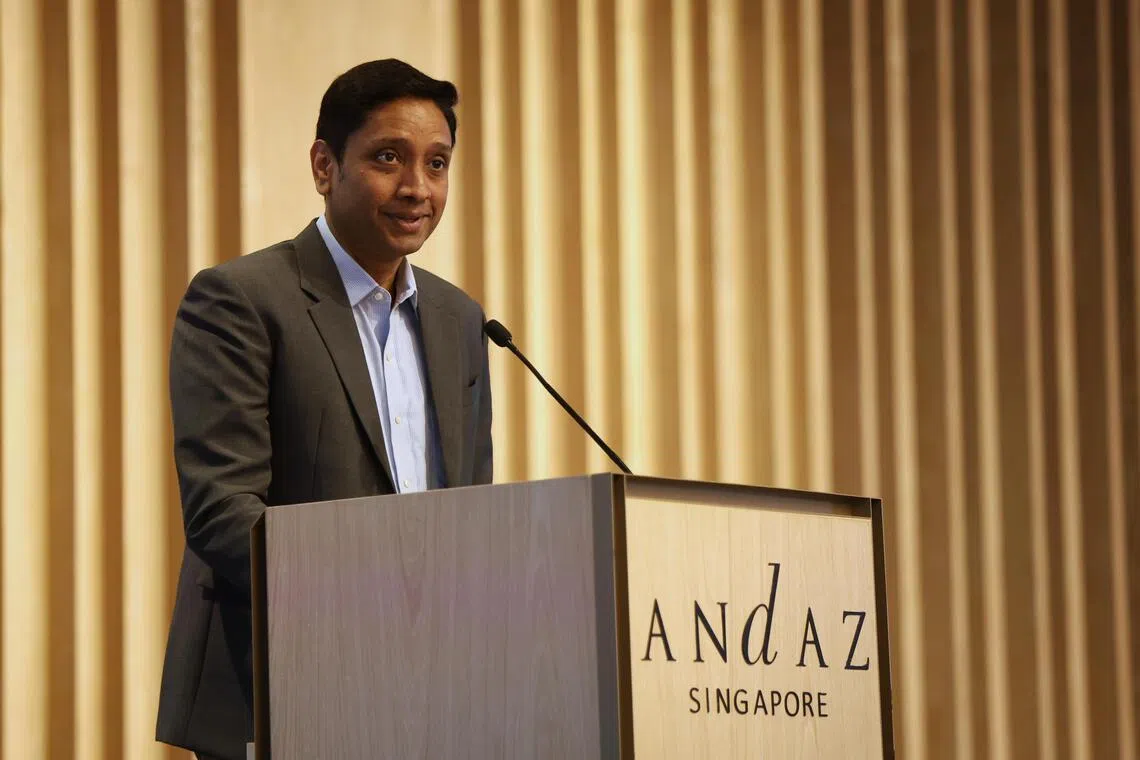
In his keynote speech at Andaz Singapore on June 22, Minister of State for Manpower Dinesh Vasu Dash pointed out that even though the Singapore workforce is less engaged, the Republic performed better in the area of overall well-being.
ST PHOTO: SARAH LEE
Many of those surveyed blame the low level of engagement on factors such as global market forces and challenging economic conditions. Others attribute it to the highly competitive nature of the business environment that puts pressure on employees, an employment landscape that consists largely of small and medium enterprises, and many family-owned listed companies.
One executive who was interviewed said in the report: “Sixty-two per cent or so of the listed companies in Singapore are family owned. So if you have a tycoon or some first- or second-generation guy, he’s not going to have all these best practices.”
The report draws on Gallup’s 2026 global workplace research that polled about 1,000 employees in Singapore and includes interviews and a roundtable with 33 senior leaders.
Employees believe their direct managers play a critical role in their performance and engagement levels.
Gallup’s global workplace research found that 70 per cent of the variance in team engagement is attributable to the manager. Engagement, it found, comes down to employees’ daily relationship with their managers – not company town halls or annual surveys.
Younger workers especially want a “productive and protective relationship” with a manager who is direct and efficient – something most managers are not equipped to provide.
Leaders interviewed “overwhelmingly expressed” that managers are critical to the engagement and productivity of their employees, as well as the performance of their organisations.
“The right manager can transform engagement at any age,” said Gallup Singapore regional director Kanika Singh. “Closing Singapore’s generational divide starts with building a generation of managers who know how to coach, develop and genuinely see the individuals on their teams.”
Senior leaders who participated in the roundtable highlighted the common practice of rewarding managers based on their own performance rather than on how well they manage their teams. They also highlighted how companies often invest heavily in technical skill development, but offer dismal preparation to help people transit to managerial roles.
“Managers are rewarded for performance, but they’re not rewarded for being good managers,” said one participant.
Research findings identified what it takes to form highly engaged teams, including equipping managers with the time to coach, not just execute; tools and guidance to help them have better coaching conversations; and the systems to support team-level accountability.
Leaders who were interviewed brought up concerns relating to the use of artificial intelligence.
While most leaders – 85 per cent – agreed they were confident in the value of AI to their organisation, they were less optimistic about the “future direction” of Singapore’s workforce, suggesting low confidence in employee preparedness. More than one-third agreed they were optimistic about the direction.
A concern raised was the “AI incentive conflict”, which refers to employees believing that the use of AI could reduce the need for their roles, making them resistant to it.
The other was the “AI career stage split”, which relates to the use of AI eliminating repetitive, entry-level work that has traditionally been given to junior employees to hone their foundational skills. This increased the risk of mid-career professionals who were never trained.
The report also found that preparedness for AI adoption does not appear to be universal among companies.
One leader said in the report: “What concerns me is that we are not investing enough to prepare the younger generation for the disruption. Technology and disruption – there will be winners and losers, but the benefits would not be distributed evenly.”