


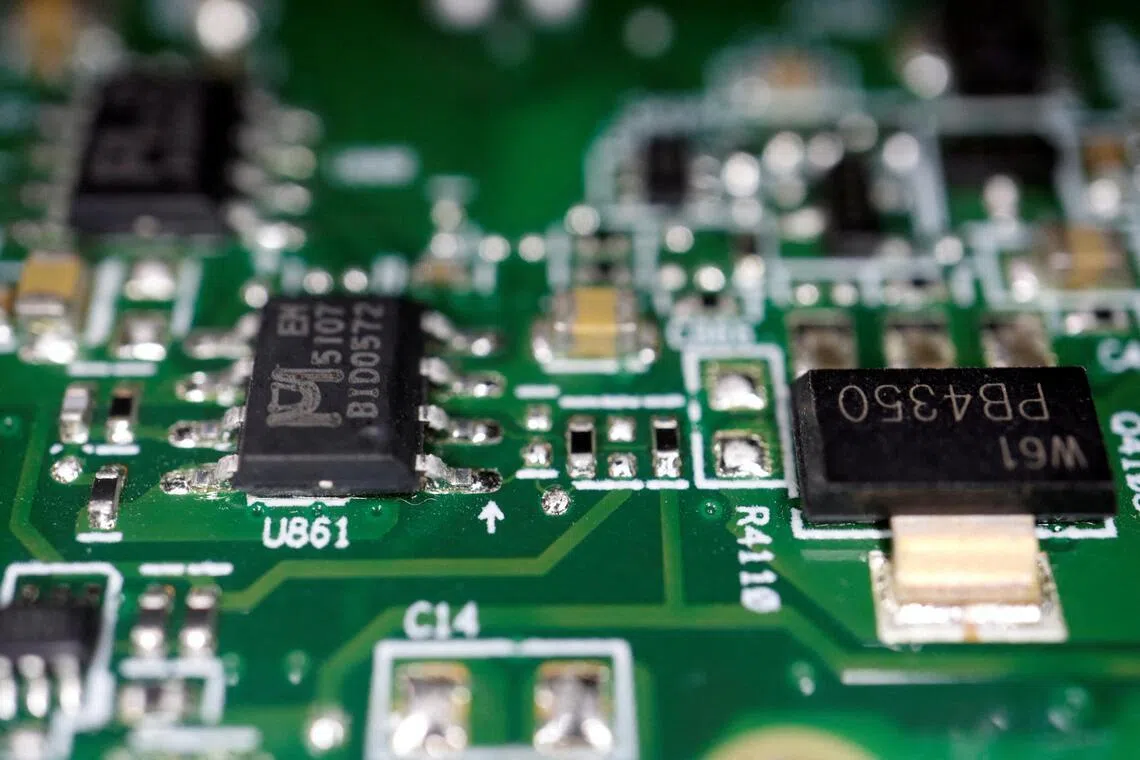
TAIPEI – Wu Biing-seng has spent most of his career developing tiny chips that tell pixels on flat-screen displays how and when to light up.
Twenty-five years ago, he teamed up with his brother Jordan Wu to develop such chips for screens. Today, products from their company, Himax Technologies, can be found in everything from Lamborghinis to smartwatches, and have turned the duo into billionaires.
The brothers own 24 per cent of Himax, whose US-listed shares have more than doubled in value in 2026. Their stake in the Taiwan-based firm, as well as proceeds from dividends and stock sales, give them a combined US$1 billion (S$1.3 billion) net worth, according to the Bloomberg Billionaires Index, which is valuing them for the first time.
The wealth marks a big milestone for the siblings and their company, which says it holds a 40 per cent market share for display chips – known in the industry as driver integrated circuits – used in cars. Its customers include Ferrari, Volkswagen, Porsche and more.
It’s “not the kind of chip that grabs headlines the way an AI processor does,” said Charles Shum, an analyst with Bloomberg Intelligence. “But without it, you’d be staring at a blank screen.”
In a rare interview in 2022, Jordan told a Taiwanese news outlet that Himax made a bet on car display chips about two decades earlier, even though few automobiles had screens back then and Himax’s resources were limited.
Today, “there are very few automakers that don’t use our products in some form,” he said. “Looking back, it was nothing short of a miracle.”
Those early investments helped Himax build a competitive edge, Himax spokeswoman Karen Tiao said in a text message. The company’s current bet on smart glasses, AI and co-packaged optics – a technology that could help data centres handle soaring bandwidth demand while consuming less power – is an extension of that, she said.
The brothers, who declined to be interviewed, aren’t the only Taiwanese to reach billionaire status as the island becomes a tech powerhouse during an industry boom. The number of billionaires in Taiwan rose 9 per cent to 51 in 2025, according to the UBS Billionaire Ambitions Report 2025. That’s more than Japan’s 41 and 31 in South Korea, the report said.
Banker, scientist
Biing-seng, 69, got a Ph.D. in electrical engineering from Taiwan’s National Cheng Kung University in 1985. He served at the Industrial Technology Research Institute, a government-backed entity meant to boost the tech sector, where he led Taiwan’s early efforts to develop TFT-LCDs, a kind of flat-screen display. He later helped launch Taiwan’s first manufacturing plant for those products.
Around three decades ago, Biing-seng met the founder of Chimei Corp., a Taiwanese conglomerate, to pitch him on a new venture. He later joined Chimei Optoelectronics, helping it become one of Taiwan’s leading display makers.
Jordan, 66, got an MBA from the University of Rochester and worked as an investment banker at Merrill Lynch and Barclays before getting into the tech sector.
The brothers founded Himax in 2001, using their own money before taking in some venture capital. A few Chimei employees joined them at the start-up. Chimei became an early customer.
Jordan took over as chief executive officer in 2005, with Biing-seng serving as chairman. The company went public on the Nasdaq in 2006, raising US$468 million.
In 2013, Alphabet, then known as Google, acquired a 6 per cent stake in its subsidiary Himax Display.
Today Himax has 2,200 employees, of whom it says more than 90 per cent are engineers, and offices in Taiwan, China, South Korea and the United States. It’s a so-called fabless company, meaning it outsources the manufacturing of its chips.
In a 2022 speech at his alma mater, Biing-seng, who remains Himax’s chairman, shared some of the secrets of his success: Learning is the most important thing. Sleep well. Maintain good physical strength. Wait for the right opportunity to start a business. Seek advice from experts.
“I’m always afraid of being overtaken,” he said. “So I have no choice but to keep running forward.” BLOOMBERG