


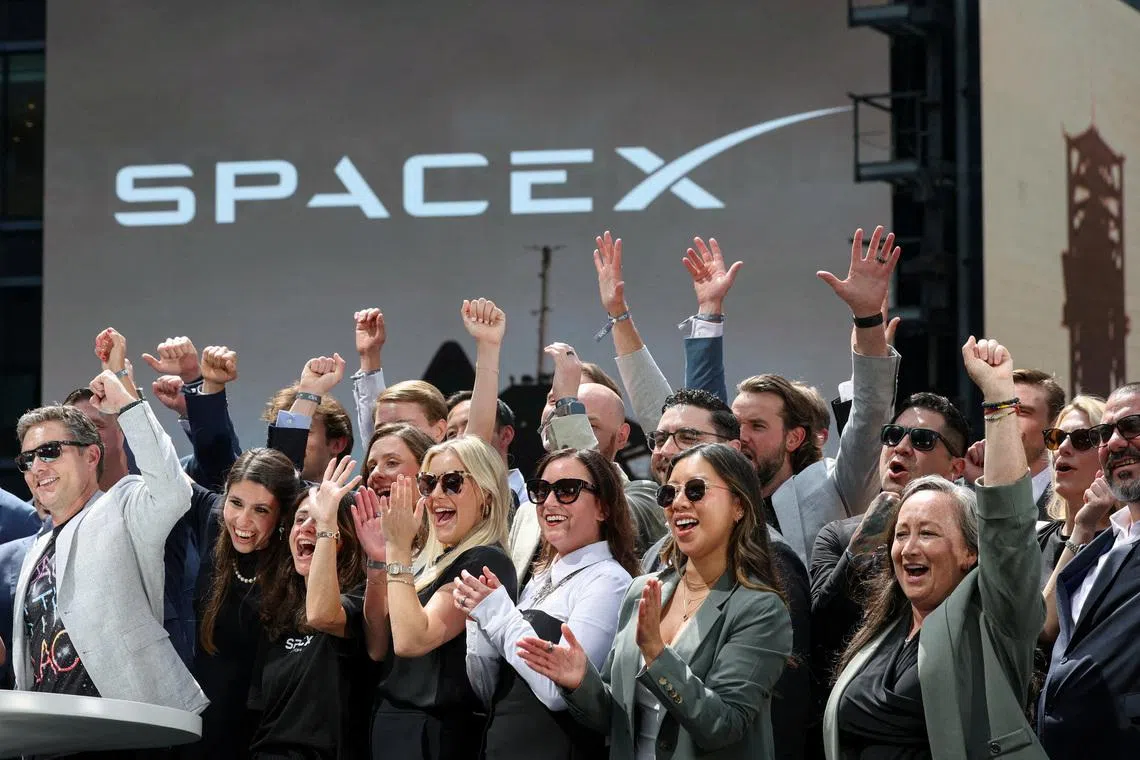
SINGAPORE – SpaceX’s lift-off on Wall Street has been a hit among retail investors so far, with shares of the Nasdaq-listed company among the most actively traded on Singapore’s online brokerage platforms.
While they did not disclose exact figures, online brokerages told The Straits Times that retail participation in SpaceX has been “overwhelmingly” strong, with the stock among the most actively traded counters by value on their platforms since it listed on June 12.
They added that future listings by AI firms such as OpenAI and Anthropic could generate a similar wave of trading activity as investors seek exposure to one of the market’s hottest sectors.
The surge in interest has sparked concerns that investor capital could flow to the US at a time when Singapore is making good progress reviving the local stock market and IPO pipeline.
But analysts said there is little evidence so far that demand for SpaceX has come at the expense of local equities, as many investors are already seeking to reduce their exposure to US assets.
Meanwhile, growing interest in Singapore’s own pipeline of IPOs is expected to keep most retail investment funds at home.
Having a deep pool of investor capital in the Singapore stock market is important because it helps local companies raise funds for growth and sustain liquidity.
In his speech at a Singapore conference on May 13, Deputy Prime Minister Gan Kim Yong said Singapore must become “a place where (capital) flows are orchestrated, financed, governed and translated into higher economic value.”
He added that the Republic must become a place where capital is raised, structured, deployed and managed across the region.
SpaceX’s IPO, which made Elon Musk the world’s first trillionaire, attracted significant retail interest, with US individual investors purchasing a net US$117.6 million (S$150.9 million) worth of shares on its trading debut.
This accounted for around 56 per cent of all retail net buying across single stocks in the US, making it the largest single-day net retail purchase for any IPO on record, according to investment research firm Vanda Research.
In Singapore, retail investor appetite in the high-profile stock has been ravenous too, with brokerages seeing strong activity on their platforms.
A Syfe spokesperson said that SpaceX was the most actively traded first-day listing on its platform, by a factor of 25. It noted that the level of demand was “exceptional”, and its users were already queuing trades ahead of SpaceX’s listing.
This was in spite of concerns over the stock’s extreme price volatility and limited free float, with only about 4 to 5 per cent of SpaceX’s outstanding shares available for public trading.
Longbridge said the space-themed NASA exchange-traded fund (ETF) appeared among the top 12 US names traded on IPO day, pointing to some interest in adjacent themes.
It added that Singapore investors added new capital rather than reallocating from existing positions, and also showed greater willingness to hold SpaceX shares for the longer term, reflecting stronger conviction in the stock compared with some regional markets.
Interest in SpaceX’s IPO comes even as investors had been reducing exposure to US assets amid geopolitical and economic uncertainty, a weaker US dollar and heightened market volatility, analysts said.
But they added that the recent interest in Wall Street reflects temporary enthusiasm for the AI theme rather than a broader shift in investor behaviour, and that Singapore is unlikely to see a significant outflow of capital into US assets.
“Given the substantial size of these IPOs and the scale of capital being raised, it is inevitable that investors reallocate their portfolios and liquidate existing holdings to fund participation in these landmark IPOs,” said Mr Foo Siang Sheng, Singapore head of investment banking at CGS International.
Any capital flowing into blockbuster US IPOs is likely to be temporary, as investors tend to rebalance their portfolios after assessing their allocations and exposure, said OCBC Bank’s head of equity research Carmen Lee.
“We do not see this as a permanent outflow of funds. Money is always chasing for a better place to park and hopefully grow.”
Longbridge said there was no clear sign that SpaceX’s listing had come at the expense of trading activity in Singapore stocks.
In fact, trading in Singapore stocks has remained strong.
Mr Chawla Vikramjit Singh, director and head of securities (retail sales) at Phillip Securities, said the brokerage has seen a significant increase in trading of Singapore Exchange (SGX) stocks, with tech counters such as AEM Holdings, Frencken Group, UMS Integration and Venture Corporation among the most actively traded on its platform.
Syfe said that the proportion of its users trading in non-US markets has doubled in 2026, driven by SGX-listed equities, among other things, while OCBC’s Lee observed that most exchange-traded funds (ETFs) have seen a net inflow in June.
As the hype around SpaceX begins to taper, investor attention is likely to return to Singapore’s own IPO market, where at least 30 companies are looking to potentially list on the SGX, the bourse has said.
These reportedly include Singapore’s Foundation Healthcare, the property and restaurant arms of Thai conglomerate Minor International, Hong Kong’s Link Reit, and global data centre operator DayOne which is considering a dual listing in the Singapore and the US.
Still, the IPO market has gotten to a relatively quiet start in 2026 with only five listings so far – compared to 16 the previous year.
While trading has improved, risk appetites in Singapore, where the equity market is sensitive to shifts in global investor sentiment, have grown weaker as a result of geopolitical uncertainty stemming from the Middle East conflict, analysts said.
Persistently elevated US interest rates and rising oil prices have also fuelled inflationary pressures, which could have led to a slower start for the Republic’s IPO market since January, said CGS International’s Foo.
“Investors are increasingly cautious, with many opting to liquidate existing positions and remain on the sidelines while awaiting greater macroeconomic clarity before re-entering the market,” he said.
Retail investors may remain cautious, however, given the underwhelming performance of several companies that have listed on the SGX this year.
Co-working space operator JustCo, which is backed by GIC, ended its maiden trading day on the Mainboard on May 22 17.6 per cent below its IPO price of 94 cents. As at June 18, its share price has fallen around 28 per cent since listing.
Similarly, co-living operator The Assembly Place has fallen around 29 per cent since listing on the Catalist board in January.
Despite the sub-par performance of these recent listings, OCBC’s Lee pointed to SGX’s healthy pipeline as cause for optimism.
“Once valuations improve, more companies will hit the market and new companies will also consider seeking a listing,” she said.
Mr Chan Yew Kiang, Asean IPO leader at EY, added that the success of several mega IPOs in the US as well as in Hong Kong may also prompt more regional companies to list, including on the SGX.
Therefore, it is important that Singapore remains a relevant listing destination “for these regional champions”, he said.