


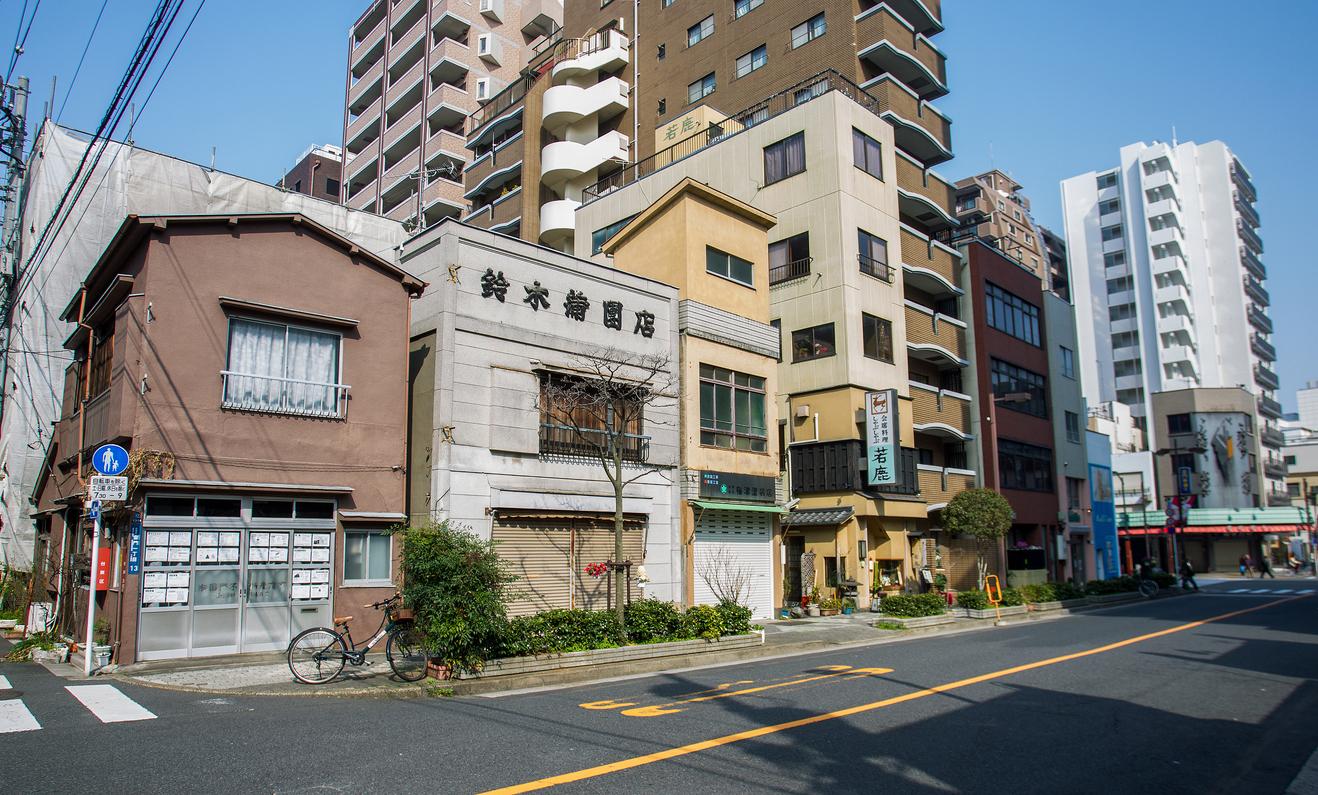
In 1979, the contents of a confidential internal memo from Sir Roy Denman, director-general for external relations of the EC Commission, was leaked to the media. In it, Denman derisively referred to the Japanese as “workaholics living in rabbit hutches.” The term quickly caught on with a vengeance and still pops up occasionally in news articles.
In case you were wondering, Japan does have recommended standards for living space. The Ministry of Land, Infrastructure, Transport and Tourism states that for “healthy, cultural living,” the minimal residential space should be 25 square meters for a single person living alone; 30 square meters for a two-person household; and 50 square meters for a family of four.
Plenty of homes exist that don’t meet these standards. Weekly Playboy (June 29) dispatched its reporter to take a look-see at the current situation and found that as of 2023, 17.8% of residences in metropolitan Tokyo, or roughly 1.3 million households, live in places that fall short. The percentage is even higher, 21.8%, among people living in rentals.
To prove a point, the writer ran searches on sites listing rental properties of five to six jo (tatami mats, used as a unit for measuring floor area, equivalent to around 15 square meters), and quickly found 3,500 places for rent. Another 500 were so small that by inserting a bed and writing table, the remaining space would be less than 10 square meters.
Realtor Masayoshi Suzuki, who operates Rakuda Fudosan, tells the magazine, “In the central areas of the city, property values are in the process of rising, and with it, the supply of tiny residences have been increasing. It’s become more difficult to find good properties that meet recommended standards, with the result being builders are making moves to hold down prices both for lots and buildings.
“So at the moment, because of the solid demand for housing in Tokyo, we’re seeing an accelerating trend for smaller residences,” Suzuki stated.
Last March, when the government issued its guidelines for housing over the next 10 years, no mention at all was made this time of minimal residential space. Its deletion perhaps might give greater impetus to an increased supply of micro-houses.
Subdividing plots of land into smaller rental properties offers advantages to both land owners and realtors. For example, if an operator obtains a 200-square-meter lot from a land owner, it stands to profit more by dividing the land into five 40-square-meter lots than it will by dividing the land into four 50-square-meter lots.
Ironically, this also works to the advantage of the buyer, because that holds down his property tax.
Architect Tsuyoshi Kobayashi was requested to design a house on a lot 2.5 meters wide by 11 meters long. Small, yes, but as he sees it, more than the land area, it’s important to consider the building’s total capacity.
Ordinarily a house will have a ceiling height of from 2.4 to 2.5 meters. But for this particular house, the ceiling height was raised to nearly 3.5 meters. So by adoption of a careful design incorporating a loft (for sleeping) and atrium, the impression of vertical space can be realized.
Another house in Tokyo’s Arakawa Ward is built on an area measuring 5 tsubo (16.52 square meters). Its frontage is roughly 2.7 meters in width, into which two entrances are incorporated. The owner, a married couple, live upstairs; they rent out the ground floor.
Realtor Suzuki concedes building such houses can entail a variety of problems.
“Since there are more dangers and short cuts in the construction, many carpenters or builders refuse to take on such jobs,” Suzuki says.
Architect Tsuyoshi Kobayashi, who operates a studio named “Another Apartment,” agrees, adding, “Since fewer builders are available, we architects have developed a network in which we’re able to swap data to search out available builders.”
As for the people who order such homes, well, you can find all types. In Tokyo’s Taito Ward, within walking distance of Ueno Station, a 60-year-old single woman occupies a two-story house built on 10 tsubo of land. The architect talked her out of building 3 stories (“as climbing steps would become a burden for her in the future”). Instead, he went with cellulose fiber materials enabling a high degree of insulation, with interior walls of diatomaceous earth, and a heat-transferring air circulation system that will make for enhanced comfort.
Normally the cost for constructing a two-story house on a lot of 15 tsubo will run between 15 and 17 million yen, raising the total price to about 20 million yen for land and building.
So if you’re willing to live under such space constraints, building one does make some sense.
It’s important for buyers to realize what they’re getting themselves in to.
Aside from the obvious shortfalls of having limited space, the article raises three caveats:
“When they first move in,” says realtor Suzuki, “I’ll hear feedback like, ‘Yikes, the ceiling is a lot lower than I expected,’ so before signing the contract they’ll need to be well advised that this is what they’ll be getting.”
The second problem is that many cases, the gap between a pencil house and the place next door can be as small as 30 centimeters, making it difficult to access areas to spray for termites or repair water leaks.
The third problem involves disputes known to occur due to the extremely close proximity to neighbors, which can lead to spillovers onto the neighboring property or a parked car blocking an the neighbor’s entrance.
Before you decide to go with a tiny house, the article advises, don’t just consider factors like your budget and the room layout, but also who you’ll be living next to.
© Japan Today