


SINGAPORE – Singapore’s job market weakened in the first quarter of 2026 as vacancies fell and retrenchments hit the highest since the third quarter of 2023.
According to the Ministry of Manpower’s (MOM) finalised data in its Labour Market Report, the number of job vacancies fell from 77,700 in December 2025 to 73,300 in March 2026. This compares with 80,100 vacancies in March 2025.
The ministry noted the decline was driven mainly by reduced job openings for non-professionals, managers, executives and technicians.
As demand for skilled workers rose, job vacancies for professionals, managers, executives and technicians rose in March 2026. For instance, the number of job vacancies in financial services increased from 4,300 in the previous quarter to 5,800 in March.
Overall, there were 1.46 job vacancies for every unemployed person in March 2026, as compared with 1.58 vacancies in December 2025.
The number of retrenchments stood at 3,830 in the first three months of 2026, up from 3,690 in the last quarter of 2025.
This is the highest quarterly figure since the third quarter of 2023, when 4,110 people were retrenched. On a yearly basis, the figure is the highest since the first quarter of 2017 which saw 4,000 retrenchments.
Degree holders saw the sharpest rise in retrenchments in the first three months of 2026, from 2.6 to 3.1 per 1,000 resident employees, MOM said.
This suggests that restructuring activity in the first quarter of 2026 remained concentrated among higher-educated workers, it noted, reflecting ongoing organisational restructuring in professional and knowledge-intensive sectors like manufacturing, financial services and professional services.
The ministry added that business reorganisation or restructuring, rather than cost-cutting, remained the main reason for retrenchment.
Post-retrenchment, the proportion of residents who found jobs within six months of being laid off continued to rise for the second quarter in a row, from 57.4 per cent in the final quarter of 2025 to 60.7 per cent in the first quarter of 2026.
MOM said: “Improvements were observed among professionals, managers, executives and technicians, degree holders and younger residents aged below 30, suggesting that retrenched workers continued to find employment within a reasonable timeframe.”
Also, more employees – 1,230 in the first quarter of 2026, up from 960 in the last quarter of 2025 – were placed on a short work-week or temporary layoff as employers sought to avoid retrenchments. The increase was most apparent in sectors such as construction and manufacturing, as well as among production and transport operators, cleaners and labourers.
Overall, Singapore’s labour market continued to expand in the first quarter of 2026, with employment growing by 9,400 – marking 18 consecutive quarters of growth since the fourth quarter of 2021.
Resident employment for Singaporeans and permanent residents grew by 5,400 jobs in the first quarter, up from 3,100 in the previous quarter, even as non-resident employment growth moderated.
Employment growth among Singaporeans and permanent residents was led by administrative and support services, and transportation and storage. Meanwhile, employment growth among foreign workers was supported by construction and manufacturing sectors.
The resident long-term unemployment rate held steady at 0.9 per cent in March, unchanged from the past two quarters.
MOM said retrenchments are “expected to stabilise”, with the proportion of firms intending to retrench dipping from 4.4 per cent in February to 3.6 per cent in March.
During a visit to Star Furniture on June 15, Manpower Minister Tan See Leng cited the MOM’s survey which found firms were three times more likely to redesign jobs and work processes than reduce headcount for hiring. He added that close to 400 individuals benefited from Workforce Singapore’s Career Conversion Programme to reskill workers or redesign roles, including those with AI components.
“This is exactly why helping workers to pick up new skills and adapt to changing job requirements matters so much,” he said.
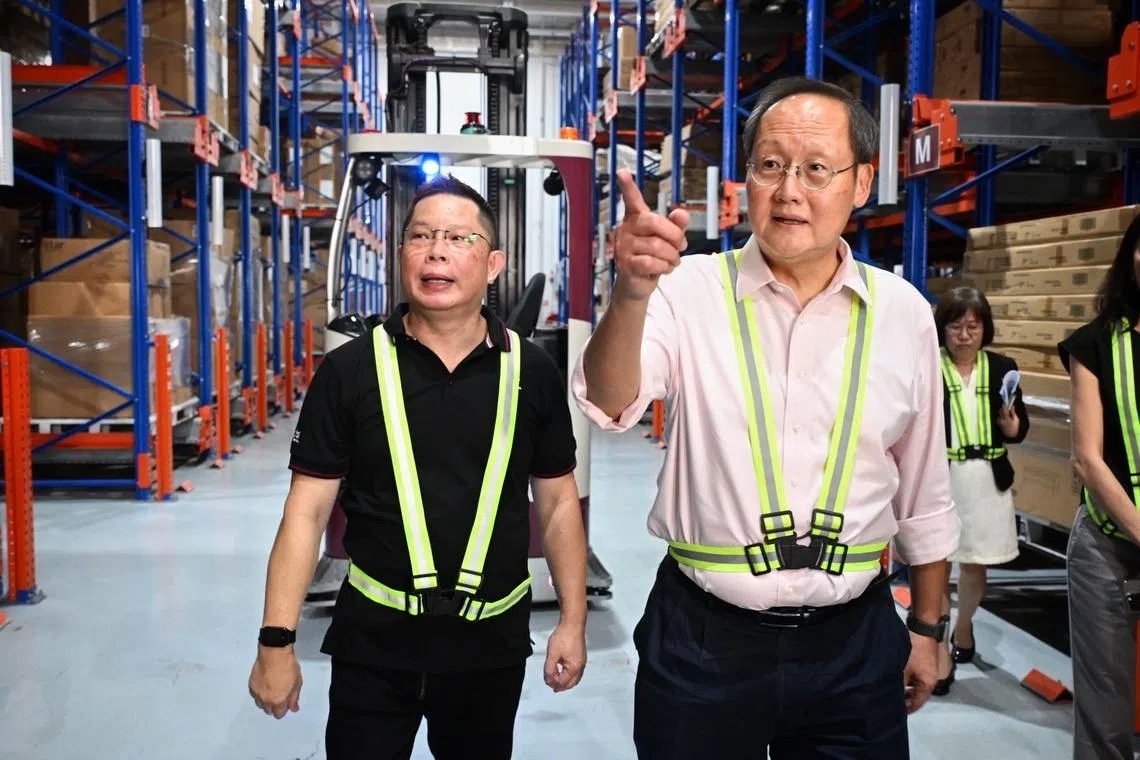
Manpower Minister Tan See Leng (right) was given a tour of the Star Furniture warehouse on June 15, including a demonstration of a forklift that is powered by AI.
ST PHOTO: CHONG JUN LIANG
According to an MOM survey earlier in 2026, AI adoption rates were highest in digitally intensive and knowledge-based sectors such as information and communications, which stood at 74.1 per cent, followed by professional services (57.5 per cent) and financial and insurance services (56.4 per cent).
About 6.2 per cent of firms surveyed reported AI-related reductions in headcount or hiring, while 18.9 per cent of firms were more likely to report adjustments within existing jobs, including the redesign of job functions.
“AI adoption is beginning to shape labour market adjustments, but its impact so far appears to be greater on how jobs are performed than on whether jobs continue to exist,” said MOM.