


Follow our live coverage here.
Singapore – Stocks rallied and the US dollar fell in early Asia trading on June 5 after the United States and Iran announced a peace deal to re-open the Strait of Hormuz and lift a US blockade on Iran.
Brent crude futures, the global oil benchmark, fell 4.3 per cent $83.59 per barrel as at 8.20am Singapore time, while US crude, West Texas Intermediate, slid 4.9 per cent to US$80.69.
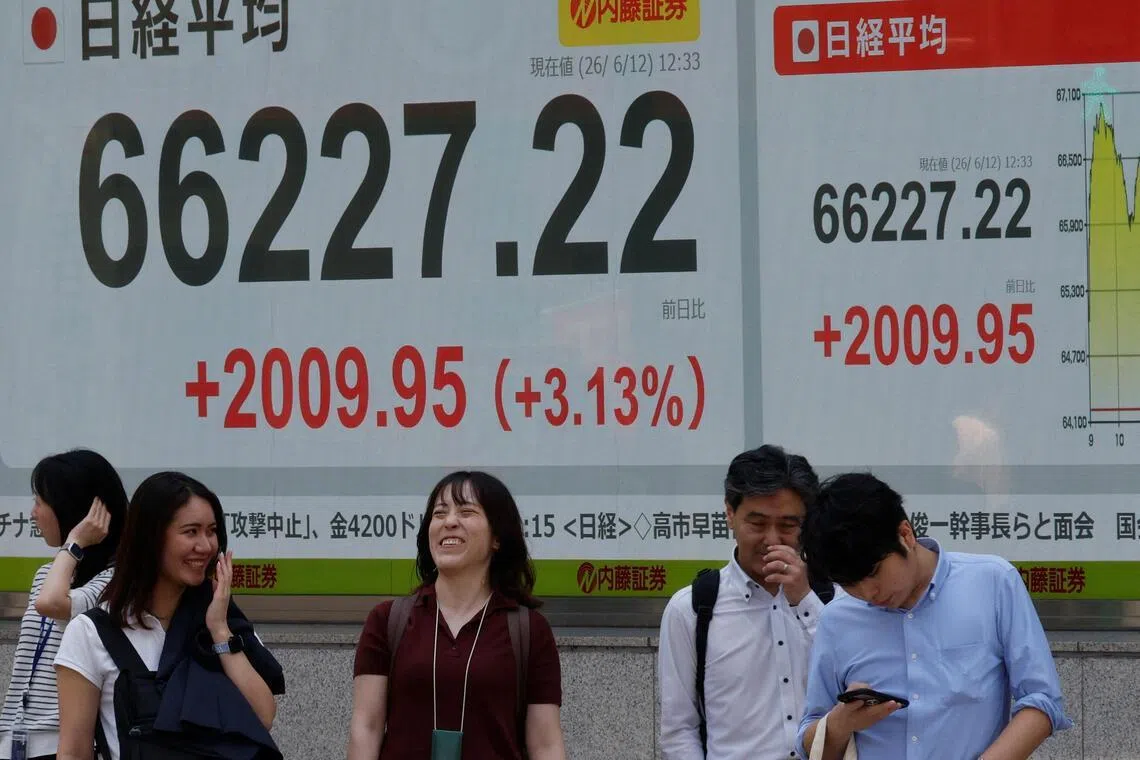
Japan’s Nikkei share index soared 4.4 per cent as at 8.40am Singapore time, while Australia’s S&P/ASX 200 rose 1.3 per cent.
US stocks futures tied to the Dow Jones Industrial Average were up 0.7 per cent. S&P 500 futures climbed 0.9 per cent while Nasdaq 100 futures popped 1.4 per cent.
Kristina Clifton, senior currency strategist for the Commonwealth Bank of Australia in Sydney, said: “It’s obviously good news for the global economy that the Strait of Hormuz will reopen. It has been our view, though, that it’s going to take some time for oil and gas flows to restart in full. Markets will be focused on how traffic is returning…and seeing how quickly production can come back online.
“It is our view that energy prices are not going to go back down to the levels that they were pre-conflict for quite some time…and it’s going to take a while for traffic to go back to normal as well.”
Imre Speizer, market strategist at Westpac in Auckland, said: “There’s still a few minor concerns – the Israeli skirmish with Lebanon remains a risk. And then you’ve got the signing date’s Friday, and that’s a long way off in this sort of environment. If it all goes according to plan…there’ll probably be one more leg to this set of mini rallies.”
The US dollar as news of the peace deal boosted demand for riskier assets.
The dollar index, which measures the greenback against a basket of currencies including the yen and the euro, fell 0.3 per cent to 99.492, the weakest level since June 5. The risk-sensitive Australian dollar fetched US$0.7075 , up 0.5 per cent.
Nick twidale. chief market strategist with ATFX Global in Sydney, said: “I think we’ll see the dollar fall over the course of the next few sessions. We’ll probably see some of the risk currencies like Aussie and yen appreciate a little bit. But I don’t think we’re going to see any huge moves.
“There’s going to be a lot of wait and see, on how quickly the Strait really reopens and how long it’s going to take for oil flow to really get back to normal. It’s certainly going to be months rather than weeks.
“I don’t think we’re going to see US$70 oil too quickly.” REUTERS