


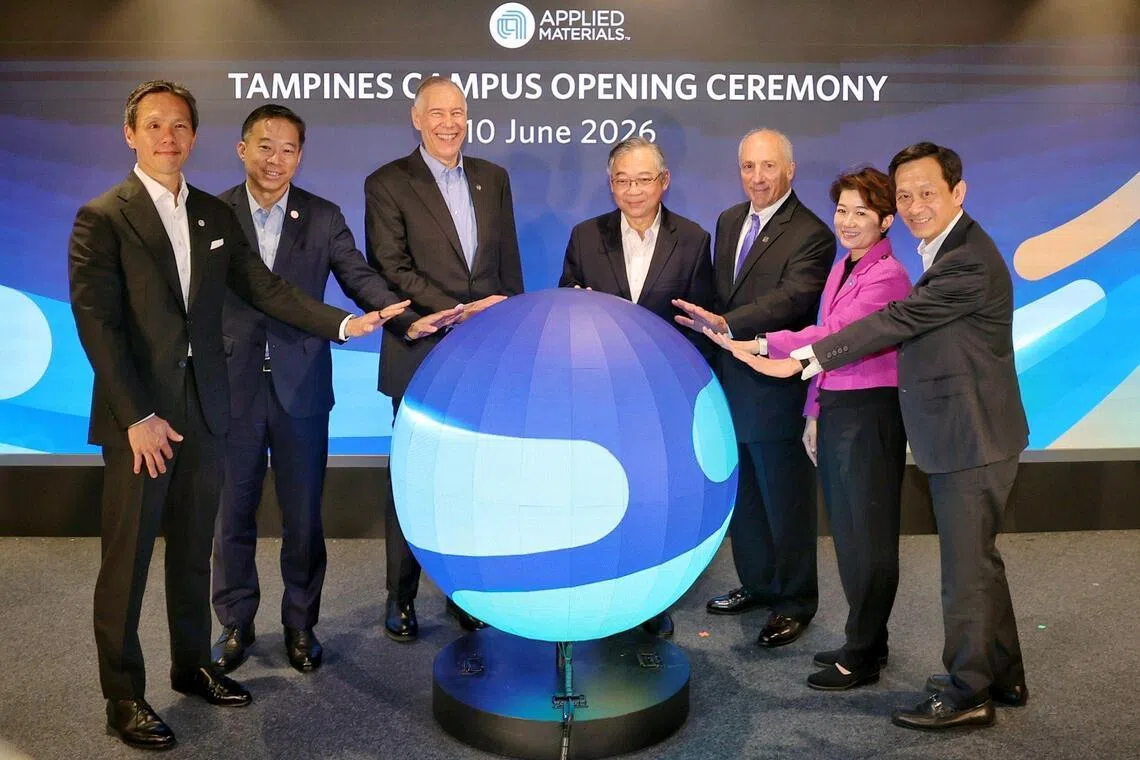
SINGAPORE – Applied Materials opened the doors of its new plant to produce chip-making machines, doubling its manufacturing footprint in Singapore and creating 1,000 new local jobs over the next few years.
The new Tampines Campus, already in operation, is focused on serving chipmakers that are expanding production to meet increasing AI-driven demand, the US’ largest chip-gear maker said on June 10.
Gary Dickerson, president and chief executive of Applied Materials, said: “Our expanded manufacturing operations in Singapore strengthen Applied’s ability to deliver semiconductor manufacturing equipment that chipmakers need to bring next-generation chips to market faster.”
The campus features an expansive manufacturing clean room and production capacity along with research and development (R&D) facilities to support global and regional customers.
Speaking at the opening ceremony, Deputy Prime Minister Gan Kim Yong said that AI is driving a sharp increase in demand for computing power and semiconductor performance, creating new opportunities for the chip industry.
“But to seize these emerging opportunities, companies will need more than scale,” he said, adding: “They will need reliable bases where they can anchor critical activities, access strong talent, integrate with deep ecosystems, and invest with confidence for the long term.”
Singapore fits that bill, said Gan, who is also the Minister for Trade and Industry.
“Over five decades, we have developed a strong ecosystem across wafer fabrication, semiconductor equipment, advanced packaging, IC design, specialty chemicals, precision engineering, and research and innovation.”
However, he noted that the industry is moving quickly, and competition is intensifying.
At the same time, geopolitical tensions are rising, trade and technology flows are becoming more fragmented, and countries are competing to secure their positions in critical supply chains.
“Semiconductors are at the centre of this contest,” Gan noted.
To stay relevant, Gan said Singapore must strengthen its leadership in areas where it can make a meaningful impact, and where its capabilities are difficult to replicate.
Hence, Singapore will attract and anchor new investments and capabilities that add depth to its ecosystem, strengthen its role in global supply chains, and create good jobs for Singaporeans.
“When a leading global company like Applied deepens its presence here, it creates opportunities for local suppliers, strengthens our advanced manufacturing base, and helps Singapore-based companies plug into global value chains,” Gan said.
Dickerson said: “I just have tremendous appreciation for everything that we have done together in Singapore…I do definitely believe the best is yet to come in semiconductors and in new ecosystems that we will enable together.”
The National University of Singapore (NUS) announced on June 10 that through the existing Applied Materials-NUS Advanced Materials Corporate Lab, the university will focus on research efforts that harness AI to accelerate semiconductor process development.
In parallel, beginning in August, NUS will introduce a new Applied AI for Materials and Process Engineering specialisation in its Master of Science in Semiconductor Technology and Operations programme, offered by the College of Design and Engineering at NUS.
Together, these initiatives position NUS to play a leading role in advancing the integration of AI and chip manufacturing through both research and education, it said.
Meanwhile, Singapore Institute of Technology (SIT) launched a strategic partnership with Applied Materials to advance AI-driven semiconductor research and talent development.
Under the initiative, SIT has established the Applied Materials Professorship, the University’s first industry-based Professorship.
It also launched the Applied Materials Scholarship to support deserving SIT Engineering undergraduates from financially disadvantaged backgrounds.
The scholarship covers educational expenses, including tuition fees, course materials, expenses for overseas immersion programmes and other educational activities.
Applied Materials said the new Tampines Campus deploys Autonomous Mobile Robots, autonomous assembly and testing systems, and AI-assisted quality inspection, which is deepening integration between manufacturing, R&D and ecosystem partners to accelerate time-to-market for new technologies.
Augmented and virtual reality (AR/VR) tools further support technician training and precision maintenance operations, the company said.
The company said that including the new campus in Singapore, it has invested more than US$400 million in its US equipment manufacturing infrastructure over the past five years.
Additionally, Applied’s new US$5 billion EPIC Centre in Silicon Valley – set to become operational this year – represents the largest-ever US investment in advanced semiconductor equipment R&D.
Singapore is a key node in the global semiconductor supply chain, accounting for one in ten chips and one-fifth of global semiconductor equipment produced annually.
The semiconductor industry contributes close to 6 per cent of Singapore’s gross domestic product and employs more than 35,000 people, according the Economic Development Board of Singapore.

