


SINGAPORE – It may soon be easier for consumers in Singapore and Malaysia to access financial products across the border with the development of a new two-way credit reporting service.
Credit Bureau Singapore and its Malaysian counterpart, Experian Information Services Malaysia, inked an agreement on June 9 that will enable lenders to consider the verified credit histories of individuals from the neighbouring market.
The credit reporting agencies said consumers will be assessed more fairly and comprehensively, instead of being treated as “new-to-credit” applicants when they move between Singapore and Malaysia.
This may especially benefit digital-native workers, entrepreneurs and professionals whose financial footprints span both jurisdictions, the agencies added.
Singapore and Malaysia have a growing economic relationship. Their annual bilateral trade has routinely exceeded $100 billion, with $145 billion of total bilateral trade in goods recorded in 2025, according to Enterprise Singapore.
Mr William Lim, executive director of Credit Bureau Singapore, noted that credit information systems needed to evolve, with individuals and businesses operating more seamlessly across Singapore and Malaysia.
“This collaboration represents an important step towards enabling more seamless and responsible access to credit for consumers,” he said.
Ms Dawn Lai, chief executive of Experian Information Services Malaysia, said: “By working together, we aim to enhance financial inclusion, improve risk transparency and support sustainable growth across both markets.”
The agencies will move to define how the cross-border sharing of data will work.
This includes mechanisms for obtaining and managing consumer consent for a one-time release of their credit reports, as well as safeguards for personal data protection and compliance.
Commercial and governance models will also be tapped to support the roll-out of the credit reporting service.
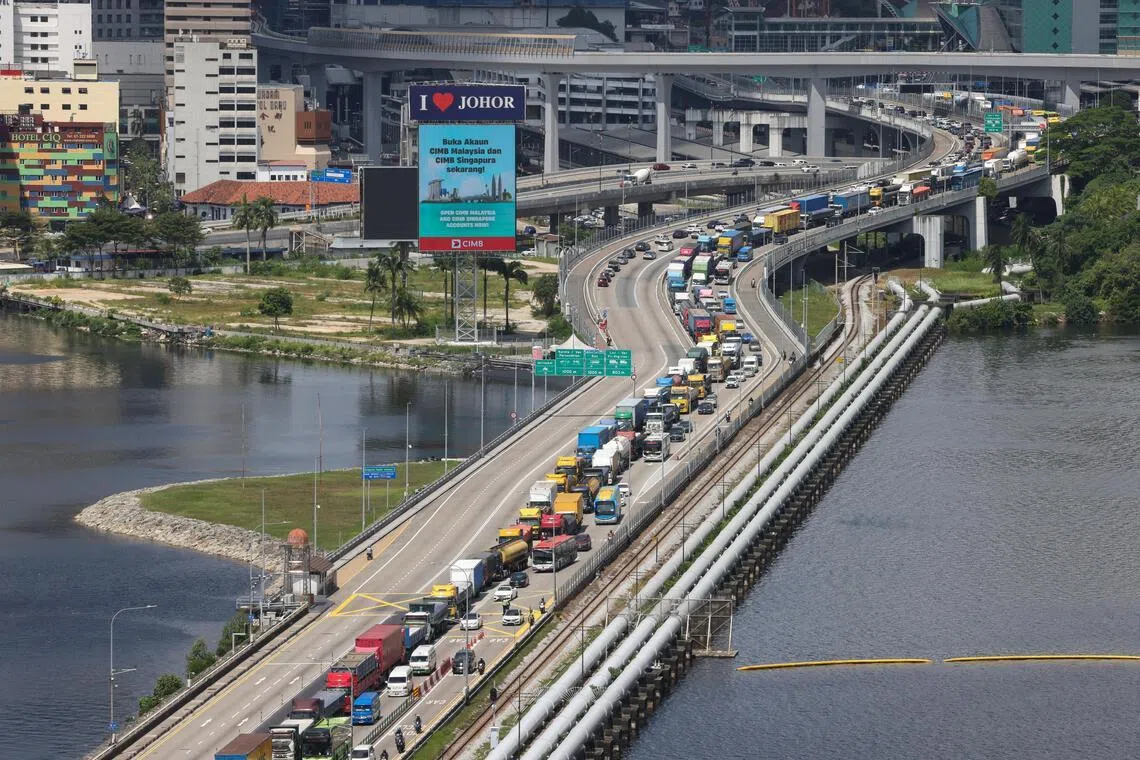
The agreement comes as the Johor-Singapore Special Economic Zone (JS-SEZ) picks up speed, raising the need for credit infrastructure that supports onboarding, responsible lending and access to capital in both markets.
Earlier in 2026, Singapore’s Deputy Prime Minister and Minister for Trade and Industry Gan Kim Yong said support for businesses expanding overseas will be improved through enhancements to existing government schemes and a streamlined grant application process from the second half of the year.
In addition, a 35ha district – Woodlands Gateway – is being developed in Singapore as a hub for manufacturers with connectivity to the JS-SEZ.
Singapore and Malaysia inked a deal for the special economic zone in January 2024, and formally established it a year later.
Maybank, which is Malaysia’s biggest lender, recently said it has facilitated around RM20 billion (S$6.3 billion) in financing and investments in the JS-SEZ over the last few years.
The bank’s president and group chief executive Khairussaleh Ramli told Bloomberg that the funding has spanned all financial services segments, including corporate, mid-sized companies and consumers.

