


SINGAPORE On the sixth floor of a new building at Science Park Drive, scientists in white coats are meticulously handling brown compounds and analysing data on monitor screens.
Behind them, numerous machines are churning even more liquids in various shades of brown. Pictures of the cacao fruit and displays of chocolate products around the facility reassure visitors that nothing in this pristine lab is hazardous, perhaps only to those with a sweet tooth.
This is the global innovation centre of leading chocolate manufacturer Barry Callebaut, where the latest in cacao coatings and fillings are born.
It is one of the numerous companies that have set up their offices in Geneo, a new life sciences and research hub in Science Park that aims to foster a vibrant ecosystem for firms and start-ups in the sector.
Officially launched by CapitaLand on May 22, Geneo comprises three properties which were progressively opened since 2019. The latest building, 1 Science Park Drive, received its temporary occupation permit in March 2025.
Companies can tap the new hub for access to not just cutting-edge facilities but also talent and collaboration opportunities, benefiting from the proximity to the National University of Singapore and the National University Hospital just across the road.
Innovation companies in Singapore Science Park include Dyson, Merck, and Johnson and Johnson, while Singapore’s start-up hub LaunchPad and upcoming artificial intelligence hub Kampong AI are in the vicinity at One-North.
Costing $1.4 billion, Geneo is part of a long-term redevelopment project by CapitaLand to transform Science Park from a traditional business park into a work-live-play innovation hub.
In addition to offices and research laboratories, the hub also houses food and beverage outlets and retail stores, as well as a 250-unit serviced apartment with a condominium currently being built nearby.
Of Geneo’s 180,600 sq m gross floor area, or about the size of 25 football pitches, about 80,000 sq m is purpose-built for biomedical research and development, flexible laboratories and innovation-ready Grade A business park spaces.
So far, more than 80 per cent of the hub has already been occupied, said CapitaLand Development’s chief executive Jonathan Yap in an interview with The Straits Times.
Some of these include multinational companies like Barry Callebaut and German advanced materials manufacturer Henkel, which moved its global supply chain hub and laboratories from separate offices in Singapore to its new 2,000 sq m location staffed by 160 employees in January.
Mr Liu Yeting, Barry Callebaut’s head of research and development in the Asia Pacific, Middle East and Africa, said Singapore has grown in importance in the company’s business strategies. With both its regional headquarters and global innovation centre now located in Singapore and serving Asia, Africa and the Middle East, the company is also aiming to expand its research team at Geneo.
Mr Yap added that that while there is healthy interest from companies wanting to set up their offices at Geneo, the real estate developer is mindful of ensuring the right mix of tenants.
Going beyond simply having a cluster of multinational companies, Mr Yap said he hopes Geneo will be home to an ecosystem where both large firms and small start-ups can work together, both within and outside of the hub.
“We see our role as a community facilitator. We study the profile of each prospective customer to see if they are like-minded, so that we can curate a community that will interact with one another.”
He envisions the ecosystem to foster more ideas and greater knowledge transfer that could also lead to the birth of new companies.
Speaking at Geneo’s opening on May 22, Minister for Manpower and Minister-in-Charge of Energy and Science and Technology Tan See Leng announced that A*STAR would establish biomedical research facilities at Geneo.
It will build on its strong foundation in Biopolis, while continuing to be situated close to key partners in the greater One-North area, he said.
“Such proximity brings the research, medical and business communities together, accelerating inter-disciplinary collaboration and the translation of research into real-world solutions.”
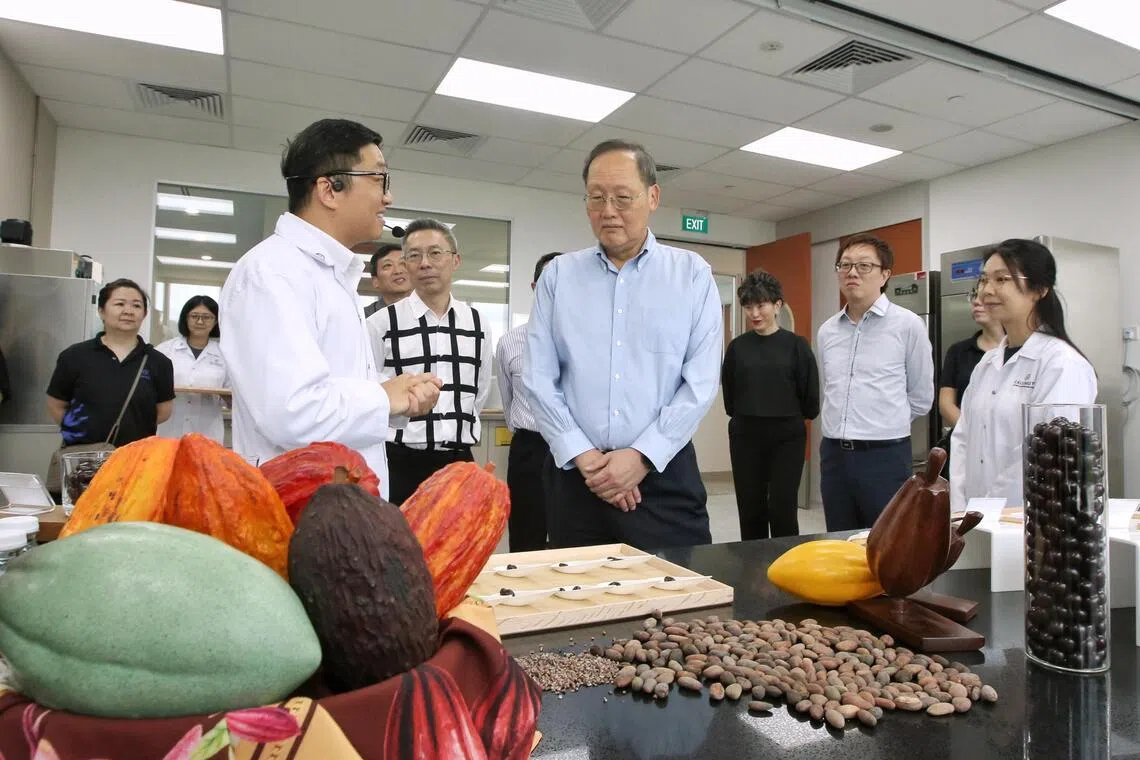
Manpower Minister Tan See Leng (centre) at Barry Callebaut’s global innovation hub in Geneo, with the chocolate manufacturer’s head of research and development Liu Yeting (left) and CapitaLand Development’s CEO Jonathan Yap (second from left).
PHOTO: LIANHE ZAOBAO
Another company that has already expanded beyond its premises in Biopolis is NSG Bio, which offers emerging life sciences companies access to wet-laboratory and office co-working spaces at a lower cost.
Chief operating officer Hasyim Sim said the company could build more private workrooms in its new premises, in addition to its open-bench lab spaces, to cater to the growing needs of its customers, who could also easily commute over to NUS or NUH to embark on clinical trials and studies.
Geneo’s convenient location opens the door to potential initiatives like mentorship programmes with the larger pharmaceutical companies, he added.
The launch of Geneo also marks the latest initiative in Singapore to build sector-focused hubs, following the Government’s announcement of Kampong AI during Budget 2026 as well as JTC’s refreshed masterplan to rejuvenate LaunchPad.
Mr Thomas Holenia, president of Henkel Singapore, said that Singapore’s small geographical size, with start-ups and headquarters of various multinational companies, offers a strong, unique selling proposition as a destination for ecosystems to thrive.
“It’s easier to collaborate in Singapore as everything is consolidated in a small space, which makes it easy to get together and interact with one another.”
This is vastly different from other regions such as Europe, where companies would have to frequently fly and commute for hours.
“Simply from a set-up perspective, Singapore’s advantage is it offers a faster, simpler and more agile approach.”

