


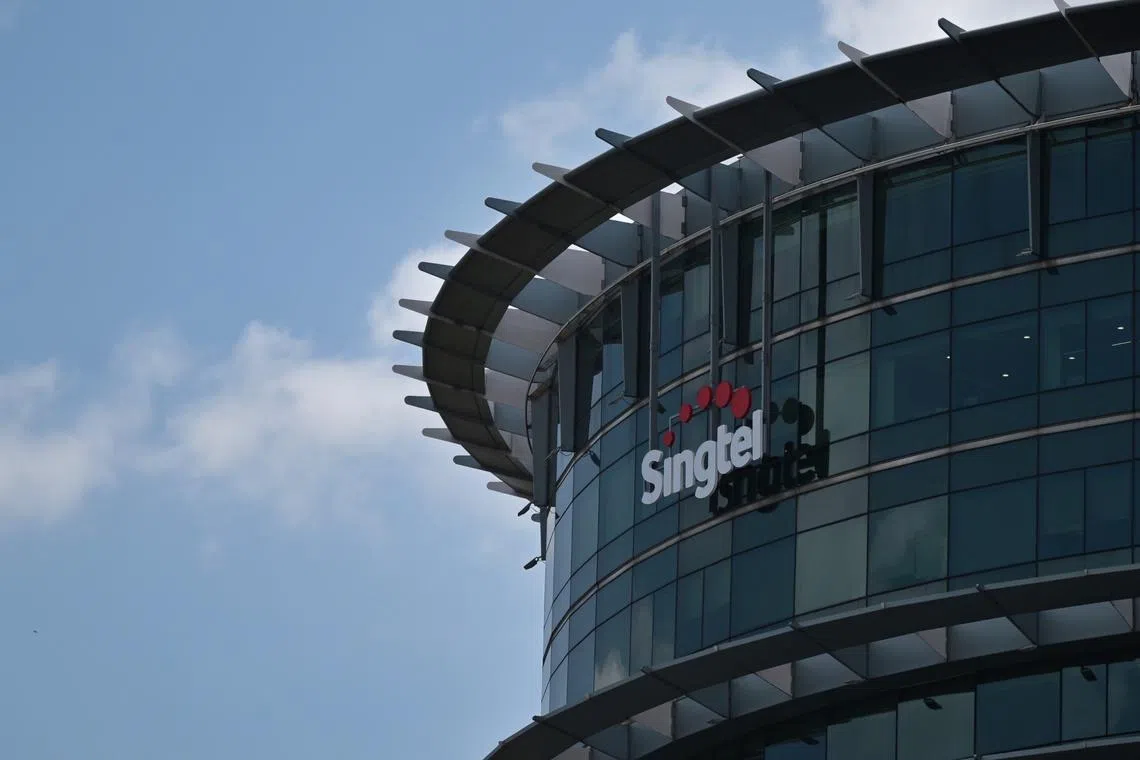
SINGAPORE – Shares of Singtel fell as much as 7.4 per cent after it disclosed its latest set of results on May 21, before paring losses to close the day at $4.70, down 6.4 per cent.
The telco revealed persistently tough conditions for its consumer business in Singapore, where heavy competition among the four existing telco operators is eroding prices and impacting profitability.
Here are the key takeaways from Singtel’s FY2026 results briefing:
Singtel is seeking to understand whether regulators would allow it to take part in any merger or acquisition involving the other telcos in Singapore after Simba Telecom’s proposed takeover of M1 fell through earlier in the week.
At a media briefing on May 21 to announce Singtel’s results for the financial year ended March 31, 2026, chief executive Yuen Kuan Moon told The Straits Times that the telco would be keen to “participate in market consolidation” if it gets the green light from the Infocomm Media Development Authority (IMDA).
Mr Yuen’s comments signaled openness to future industry consolidation involving Singapore’s four mobile operators – Singtel, StarHub, M1 and Simba – although he did not elaborate on any target.
He noted that Singtel would first need clarity from IMDA on whether any competition concerns could arise from potential consolidation, given Singtel’s position as the market leader with about 45 per cent market share.
These developments come as Singtel’s Singapore business continues to decline, with revenue decreasing 3 per cent year-on-year to $3.7 billion for FY2026. EBITDA (earnings before interest, taxes, depreciation and amortisation) fell 5 per cent to $795 million over the same period.
In FY2025, revenue for the Singapore business fell 2 per cent while EBITDA grew 2 per cent.
Although Singtel’s enterprise business has seen resilient growth and accounted for over 50 per cent of the telco’s domestic revenue, its local consumer business has been hit by an aggressive price war among the four telco operators in an extremely saturated market.
Mr Yuen said it would not be sustainable for Singapore to have four telco operators, which is more than other larger markets like Thailand, Indonesia and India that have already undergone consolidation.
He said Singapore would benefit from the consolidation of its telco market.
“I believe the regulators are open to consolidation,” Mr Yuen told reporters.
“If we are able to participate in the consolidation, we would definitely evaluate the opportunities and how it would help lift the industry altogether in Singapore.”
This would allow Singtel to provide better service for its customers, because it can invest more in innovation and services, he said.
In the meantime, Singtel hopes its product differentiation with three brands catering to different consumer segments would strengthen its position in the Singapore market, said Singtel Singapore chief executive Ng Tian Chong.
He noted that subscribers on its premium, higher-value 5G+ plans have grown 37 per cent year-on-year.
The weakness in Singtel’s consumer business stood in contrast to its broader financial performance.
While group revenue for FY2026 was flat at $14.3 billion, with about 80 per cent of the group’s business coming from overseas operations, group net profit rose 40 per cent year-on-year to $5.6 billion, and underlying net profit – excluding one-offs – also grew 12.1 per cent to $2.8 billion.
This growth was mainly driven by Singtel’s regional associates, including Thailand’s AIS and India’s Airtel which Mr Yuen referred to as “standout performers”, as well as the telco’s other subsidiaries NCS, Digital InfraCo and Optus.
The board proposed a final ordinary dividend of 10.3 cents per share, or around $1.7 billion in total for FY2026. This consists of a core dividend 7 cents a share and a value realisation dividend of 3.3 cents a share, bringing Singtel’s total annual dividend to a record 18.5 cents a share.
The telco doubled down on its commitment to its Australia subsidiary Optus, which has faced a series of network outages in recent years, including a major disruption in September 2025 that left some users unable to make emergency calls and was later linked to several deaths.
In a separate filing with the Singapore Exchange (SGX) on May 21, Singtel announced that it is searching for an Australian partner for Optus.
Mr Yuen said that it is looking for a local partner who can complement Singtel with its expertise in running the telco in Australia.
This strategy is no different from the telco’s partnerships in other markets such as India, Indonesia, Thailand and the Philippines, he said.
“It’s not a new operation or method of working in our overseas joint ventures. It is something that we are used to, very comfortable with, and brings the best out of Singtel.”’
He did not elaborate on the distribution of shareholding for this partnership.
Singtel fully acquired Optus in 2001, and since then has spent over $30 billion in capital expenditure, including more than $9 billion over the last five years.
Since FY2021, the Australian subsidiary has not been profitable, recording losses of between A$23 million (S$21 million) and A$208 million. It only managed to turn around in FY2025 with a marginal net profit of A$53 million.
In FY2026, its revenue grew 2 per cent to A$8.3 billion and EBITDA rose 6 per cent to A$2.4 billion, with growth in network sharing revenue and mobile customers, particularly in the prepaid segment as postpaid customers declined.
But operating expenses also rose, especially in the second-half of FY2026 with a 1.6 per cent increase to A$3.2 billion.
Optus chief executive Stephen Rue attributed this to higher equipment sales as well as increased capex spending to bolster its services following the network outage in Sept 2025.
It was Optus’ second major network failure in two years.
The telco was also fined A$100 million in September for selling phones and contracts to disadvantaged consumers, which the country’s federal court described as “clearly unconscionable” and “appalling”.
Citing how Singtel had ultimately reaped the rewards of holding on to India’s Airtel even though it had dragged down the group’s overall performance a decade ago, Mr Yuen said he believed Optus similarly has the potential to do well in the future and it is the right call for Singtel to continue investing in its Australian business for the long term.
He noted that Australia is a mature and sophisticated market that requires digital connectivity and services, and the existence of only three telco operators makes it a sustainable structure.
Singtel is mulling the possibility of listing a real estate investment trust (REIT) as part of its capital management strategy to fund growth and reward shareholders, Singtel chief financial officer Arthur Lang said.
A REIT listing would give the company a permanent source of capital through which it can regularly inject assets and raise funds for longer-term investments and expansion.
This would complement Singtel’s existing avenues of capital management, including asset recycling through the sale of non-core assets that generated $3.9 billion in FY2026, and capital partnerships like its joint acquisition of ST Telemedia Global Data Centres for $13.8 billion with global investment firm KKR.
The deal is expected to be finalised in the second half of 2026, and it is possible that the data centres could become part of the REIT’s portfolio.
Mr Lang declined to comment on the timeframe for a potential listing, noting that it hinges on multiple factors.

