


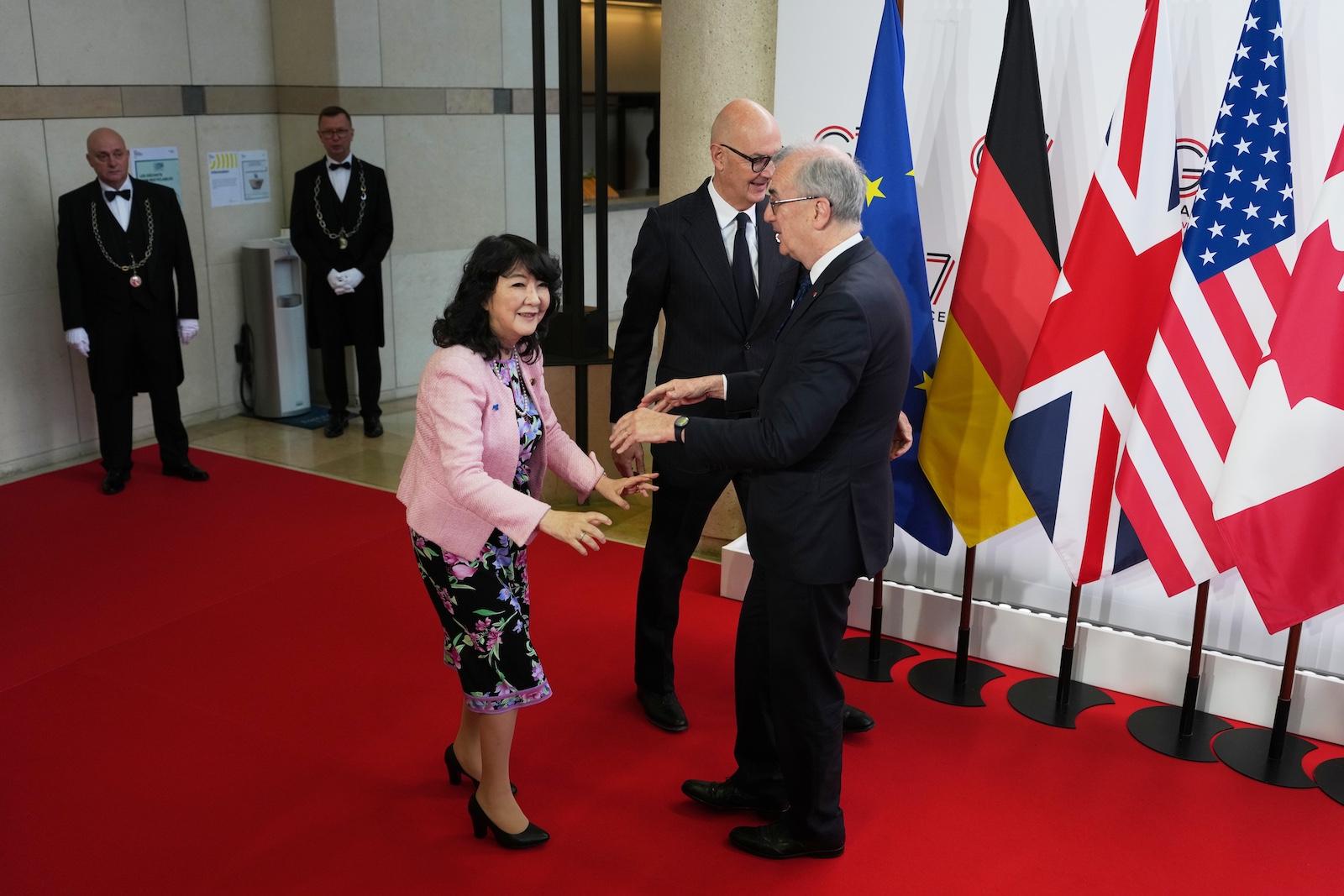
G7 finance ministers acknowledged mounting concern over public debt and bond market volatility as they met in Paris on Monday in the wake of a bond market selloff triggered by fears over inflation risks from the Iran war.
Ministers discussed the economic fallout from the conflict and volatility on global bond markets, which are of particular concern to Japan, as they also seek common ground on tackling economic tensions and global imbalances.
Japanese Finance Minister Satsuki Katayama said that it was up to each country to manage volatility and get the situation under control on its own.
“As for coordinated actions, such measures are not typically taken, and in fact, they have not been undertaken in the past either,” she told reporters.
Bonds from Tokyo to New York extended losses on Monday, with investors betting on central bank rate hikes over worries that rising energy prices could stoke inflation.
Asked if bond markets were collapsing, French Finance Minister Roland Lescure said: “They’re undergoing a correction – I wouldn’t say they’re collapsing.”
“We are no longer in a period where public debt is not a subject,” he told reporters as he arrived at the meeting.
DIVISIONS IN G7 SET STAGE FOR TRICKY MEETING
The G7 finance ministers were seeking common ground on tackling global economic tensions and coordinating critical raw material supplies. But divisions within the G7 complicate efforts to project unity as ministers prepare for a June 15 to 17 leaders’ summit in the spa town of Evian.
“Don’t put in place measures that would make the situation worse,” International Monetary Fund chief Kristalina Georgieva said as she arrived for the meeting.
At the core of the Paris agenda will be what Lescure described prior to the meeting as deep-seated global economic imbalances that are fuelling trade friction and risk a turbulent unwinding in financial markets.
“The way the global economy has been developing for the past 10 years or so is clearly unsustainable,” he said, pointing to a pattern in which China under-consumes, the United States over-consumes and Europe under-invests.
UPDATE ON TRUMP-XI SUMMIT
Lescure, who hosted the talks, said the G7 offered an opportunity for frank dialogue among allies at a time of widening disagreements with Washington.
The two-day meeting follows a summit between U.S. President Donald Trump and Chinese President Xi Jinping in Beijing that yielded few concrete economic breakthroughs, as tensions over Taiwan and trade simmered beneath a display of diplomatic cordiality.
Finance ministers will be looking for an update on U.S.-China relations following the Trump-Xi summit and the latest U.S. efforts to re-open the Strait of Hormuz.
U.S. Treasury Secretary Scott Bessent said the trip to China had been very successful, adding that he would urge the G7 to follow sanctions to target Iran’s “war machine”.
CRITICAL MINERAL DEPENDENCE
Another priority will be critical minerals and rare earths, where G7 governments are trying to coordinate efforts to reduce reliance on China, which dominates supply chains vital for technologies such as electric vehicles, renewable energy and defence systems.
Lescure said the G7 would push for stronger coordination to monitor markets, anticipate disruptions and develop alternative supplies, including through joint projects spanning allied economies.
“The proposals are all on the table and we have no time to lose,” German Finance Minister Lars Klingbeil told reporters.
G7 countries are trying to make progress on a common toolbox of measures to stabilise markets and encourage domestic investment, possibly through price floors for producers, pooled purchases and also tariffs.
© Thomson Reuters 2026.

