


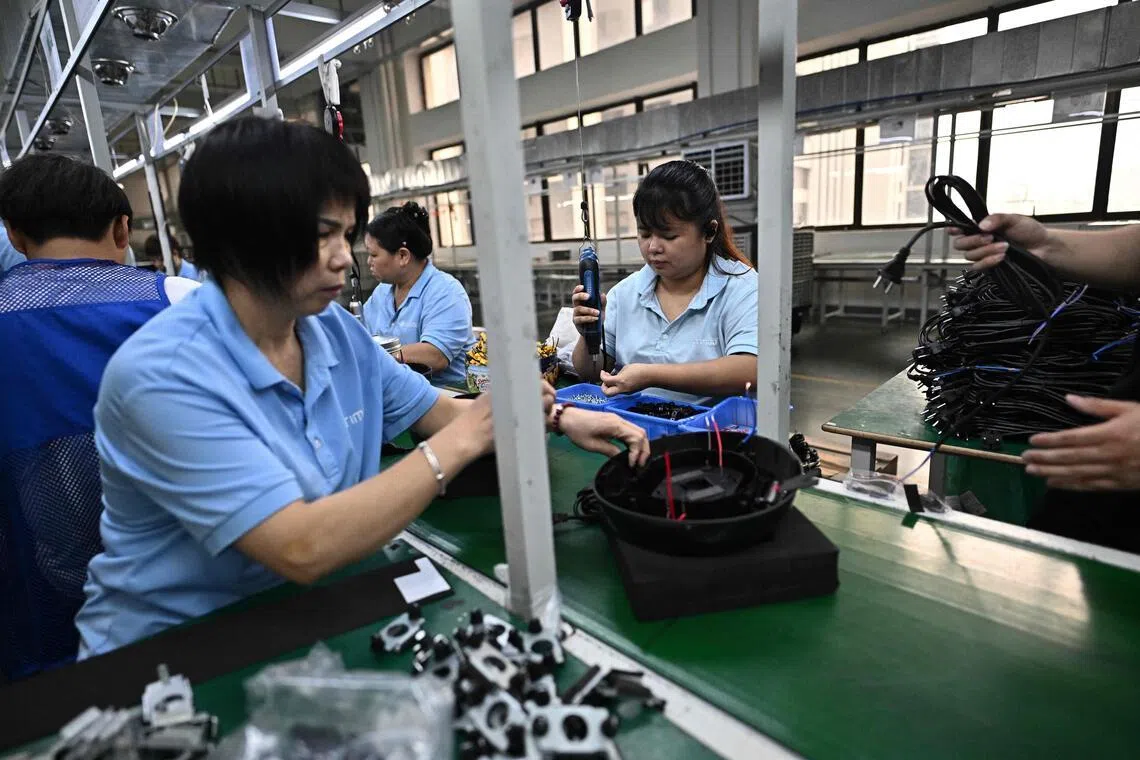
BEIJING – China’s factory prices grew at the fastest pace since the pandemic four years ago as the fallout from the Iran war sharply raises costs and leaves profits under pressure.
Producer prices rose 2.8 per cent in April from a year earlier after an increase of 0.5 per cent in March, according to data released by the National Bureau of Statistics (NBS) on May 11. That was the fastest since July 2022 and higher than all estimates in a Bloomberg survey of economists, whose median was 1.8 per cent.
Though food prices slumped, consumer inflation unexpectedly climbed to 1.2 per cent from a year earlier, surprising analysts who expected a slight slowdown from 1 per cent in March.
“China has officially exited deflation and will no longer provide support for global risk assets,” said Carlos Casanova, senior Asia economist at Union Bancaire Privee in Hong Kong.
Triggered by the war in Iran, the worst energy disruption in generations has already helped end three and half years of factory deflation in China. But it’s now piling pressure on profits as companies struggle to pass on higher costs to their customers, as domestic demand remains weak and the labour market shows signs of deterioration.
Economic damage from the conflict in the Middle East will likely feature prominently in talks this week between the US President Donald Trump and Chinese leader Xi Jinping.
Mr Trump is expected to press Mr Xi over Beijing’s approach to Iran, senior US officials said on May 10. While China has been adding its voice to global pressure to stop the conflict, revenue that it provides to Iran as well as potential weapons exports would be among the topics discussed, one of the officials said.
The US leader and Iran have rejected each other’s latest peace proposals to end the war as the two sides struggle to maintain a fragile ceasefire. The conflict that began with US-Israeli strikes on Iran on Feb 28 has upended oil and gas markets, with soaring fuel prices piling pressure on governments and consumers worldwide.
So far, the Chinese economy’s main engine – exports – is still holding up better than expected despite falling shipments to the Middle East.
Cushioning the blow of higher production costs, a boom in artificial intelligence-related demand drove an explosion of high-tech sales, including a 100 per cent surge in shipments of integrated circuits in April.
But in a sign of growing pressure on factories’ profit margins, the purchase price index rose 3.5 per cent from a year ago. That’s the biggest gap with selling prices since August 2024.
The acceleration in producer inflation was “driven by factors including the rapid rise in international commodity prices, increased demand in certain domestic sectors and improved market competition,” NBS statistician Dong Lijuan said in a statement accompanying the data release.
After a monthslong rally in commodities like copper, price increases in the mining and processing of non-ferrous metals accounted for almost 1.6 percentage point of the year-on-year increase producer inflation.
Meanwhile, several industries impacted by the Iran war – including crude oil extraction and processing, as well as chemical materials manufacturing – contributed to 1.5 percentage point, according to Dong.
A global shortage of chips used for AI has led to higher prices for everything from smartphones to computers. As a result, electrical machinery and electronics manufacturing made up slightly less than half a percentage point of the overall increase in the producer-price index.
China had been trapped in a deflationary spiral since late 2022, as a manufacturing glut and sluggish domestic demand led to intense price wars.
Still-weak consumer demand meant that factory prices for consumer durables and daily-use products continued to decline from a year ago, even though their decrease narrowed compared with March.
“It is possible that cost-push pressures work their way through to wider inflation over the coming months,” analysts at Capital Economics said in a report. “But with overcapacity in most sectors unresolved and domestic demand growth still sluggish, the ingredients for a sustained reflationary impulse still appear to be missing.”
Though consumer inflation inched up in April, the main drivers behind its increase were higher motor fuel and gold prices.
The cost of gasoline surged nearly 20 per cent from a year ago, contributing almost 0.6 percentage point to April’s inflation.
The core consumer price index, which excludes volatile items such as food and energy, rose slightly in April to 1.2 per cent from a year earlier.
With economic growth rebounding more than expected in the first quarter, policymakers may conclude that China needs less aggressive stimulus measures, especially as rising energy prices ripple through factory and consumer inflation.
The government already pulled back on fiscal spending in March, with the central bank keeping its policy interest rates on hold for a year.
“Given that the conflict in the Middle East has yet to reach a peaceful resolution, the secondary effects of imported inflation will spread to other price components,” said Allen Ding, chief economist at China Citic Bank International. “This will likely make the central bank more cautious about decisions on cutting interest rates and the reserve requirement ratio.” BLOOMBERG

