Singapore is widely known as a global business hub, but did you know it is also ranked among the world’s top five most innovative economies in the 2025 Global Innovation Index?
This is driven by its strong mix of skilled talent, advanced research and manufacturing capabilities, which enable companies to develop and commercialise new products and solutions at speed. A collaborative, trusted business environment and strong connectivity with Asia-Pacific and the world further support this.
From safer MRT commutes to smarter wellness technology and seamless digital payments, here are six products developed in Singapore by leading local and international companies, with the help of Singaporeans in their research and development (R&D) teams.
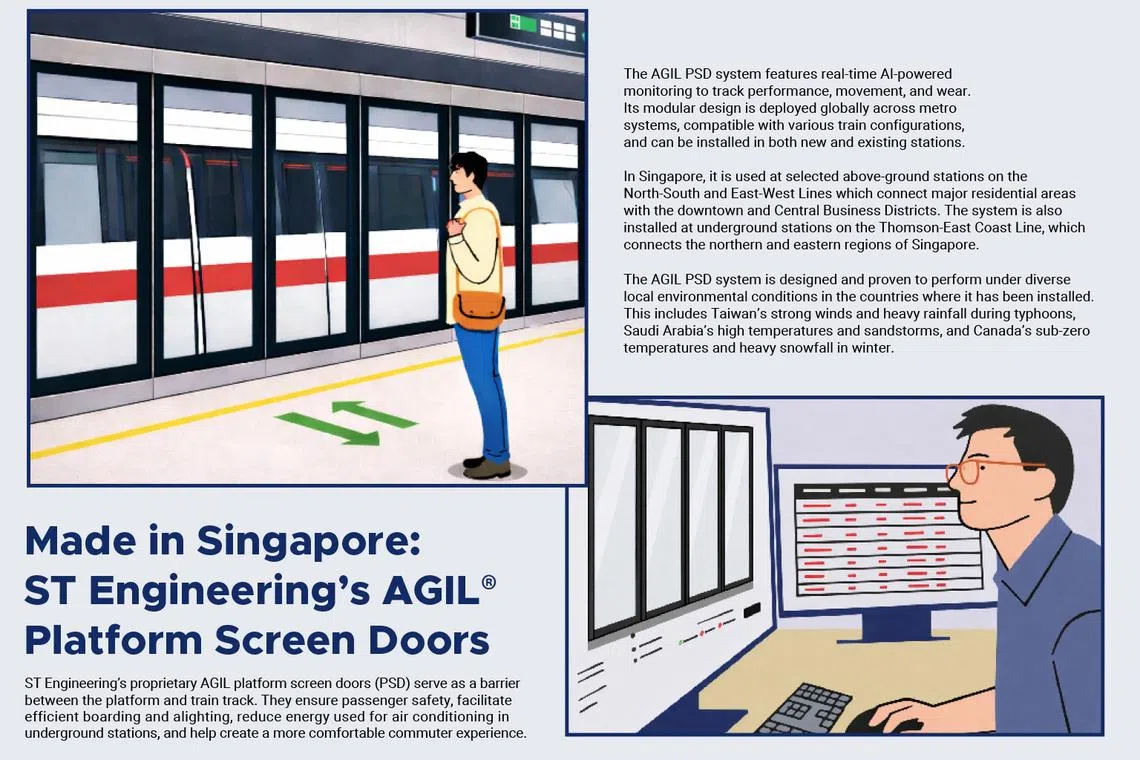
ST Engineering’s AGIL Platform Screen Door system keeps commuters safe by preventing access to the tracks until trains arrive and doors are aligned.
ILLUSTRATION: SINGAPORE ECONOMIC DEVELOPMENT BOARD
At train stations, ST Engineering’s AGIL Platform Screen Door (PSD) system serves as a safety barrier, helping to protect commuters from accidentally stepping onto the tracks. Installed along elevated, at-grade and underground platforms, the modular barriers remain closed until a train has fully arrived and open only when the train’s doors are aligned.
Beyond safety, the PSD also improves temperature control within stations by preventing cool air leakage from air-conditioning systems to the underground tunnels. This improves energy efficiency and reduces energy costs.
The AGIL PSD can be fitted with digital displays and smart features such as passenger-counting and real-time diagnostics, enabling rail operators to monitor crowd flow and equipment conditions more effectively. Additionally, an intelligent monitoring system uses artificial intelligence (AI) to track door movement, motor performance and wear indicators, enabling more precise and predictive maintenance. Together, these capabilities contribute to service reliability.
The AGIL PSD is also certified to international safety and cybersecurity standards, underscoring its reliability and robustness.
ST Engineering’s PSD capability is driven by its Urban Solutions business unit at its Singapore headquarters. Access to a strong talent pool allows much of the development work to be done locally, from design and prototyping to testing and refinement. This enables fast turnaround, tight quality control and closer collaboration between engineering disciplines.
The ideal environment for innovation and capability building in Singapore has helped transform the AGIL PSD system from a locally engineered solution into a globally recognised platform, now used in modern metro networks around the world – including in Canada, India, Saudi Arabia, Taiwan and Thailand.
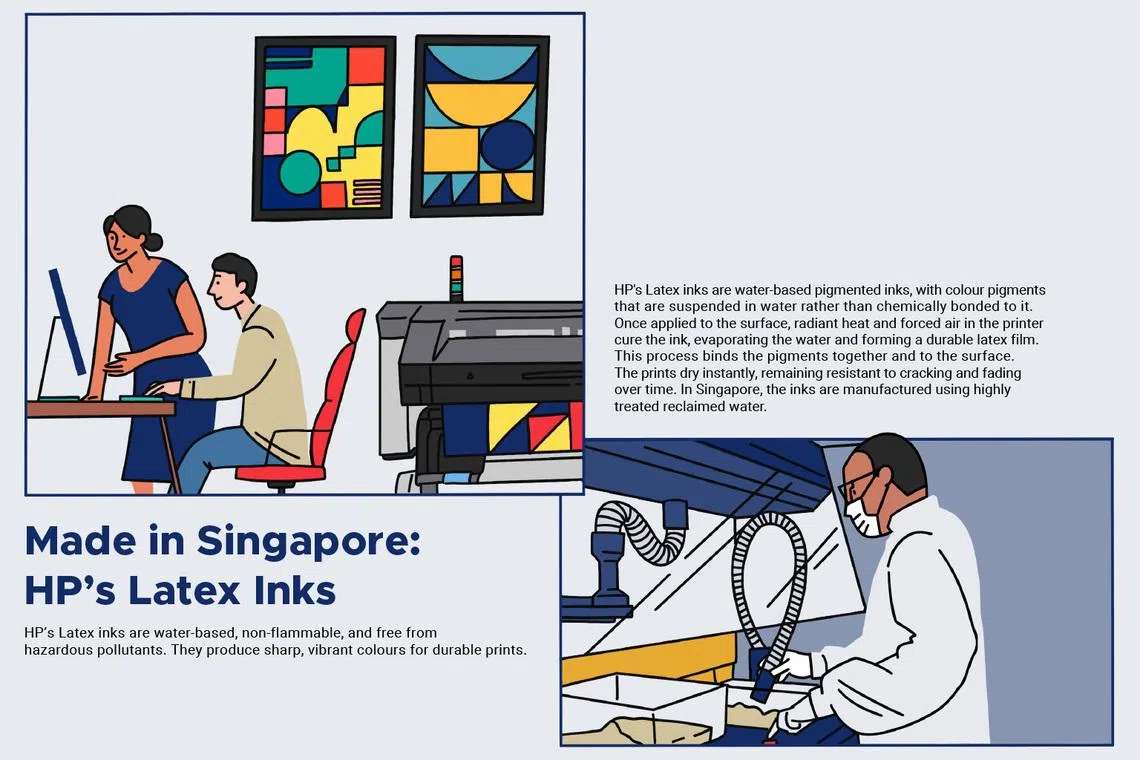
HP’s water-based Latex inks produce sharp, vibrant prints while helping businesses create a more comfortable work environment.
ILLUSTRATION: SINGAPORE ECONOMIC DEVELOPMENT BOARD
US-headquartered HP’s Latex inks deliver sharp, vibrant colours while producing high-quality, odourless prints, creating a more comfortable work environment for businesses. As a water-based, non-flammable solution free from hazardous pollutants, these inks make it easier to adopt sustainable printing practices.
Singapore has long been an integral base for HP, serving as the location for its Asia Pacific headquarters and housing its first manufacturing plant in the region since 1970. Over the decades, Singapore has become an innovation hub for the company, where it has grown R&D capabilities across various sectors, including printing, personal systems, and smart manufacturing applications.
HP’s Singapore manufacturing facilities are a prime example of the company’s commitment to excellence and sustainability. One of these facilities is recognised as a World Economic Forum Lighthouse – an industry benchmark for manufacturing excellence. This recognition highlights the facility’s leading-edge use of AI, automation, and sustainable practices. The Tuas facility is particularly notable for its innovative approach to producing latex inks. It uses reclaimed water in the manufacturing process, contributing to the creation of inks that are up to 65 per cent water, non-toxic and environmentally friendly.
HP continues to deliver several world-firsts from Singapore, including the Smart Manufacturing Applications and Research Center, a pioneering effort in advancing smart manufacturing technologies. In 2025, it launched Garage 2.0 – a first-of-its-kind platform that supports AI startups in turning ideas into impactful solutions. HP will provide mentorship and go-to-market support, reinforcing Singapore’s position as a hub for breakthrough technologies.
HP’s commitment to investing in Singapore not only highlights the country’s strategic value in serving the regional market, but also showcases how innovation and sustainability can go hand-in-hand to advance modern manufacturing technologies.

Designed for hassle-free travel, the Wise debit card helps users avoid heavy fees and skip carrying large amounts of cash overseas.
ILLUSTRATION: SINGAPORE ECONOMIC DEVELOPMENT BOARD
While Britain-headquartered fintech company Wise was founded in London, it chose Singapore as the base for the product and engineering team that designed and launched its debit card in 2019.
With the Wise multi-currency debit card, travellers can avoid expensive credit card fees and skip the hassle of carrying large amounts of cash abroad.
The team brought the product to market in just six months – their progress enabled by Singapore’s strong regulatory environment and its role as a leading financial hub in Asia-Pacific. Working closely with compliance and servicing functions, the Singapore team built the core infrastructure from the ground up, and localised it for the region’s unique regulatory requirements and payment networks. They also navigated challenges such as e-wallet limits, to ensure a fast and seamless customer experience.
Being based within Singapore’s fintech environment enabled Wise to collaborate efficiently with key partners, including major payment networks like Visa and Mastercard. This proximity allowed for quick technical and contractual agreements, speeding up the development process. As a result, Wise has since been able to issue over 11 million debit cards to its customers across 42 countries.
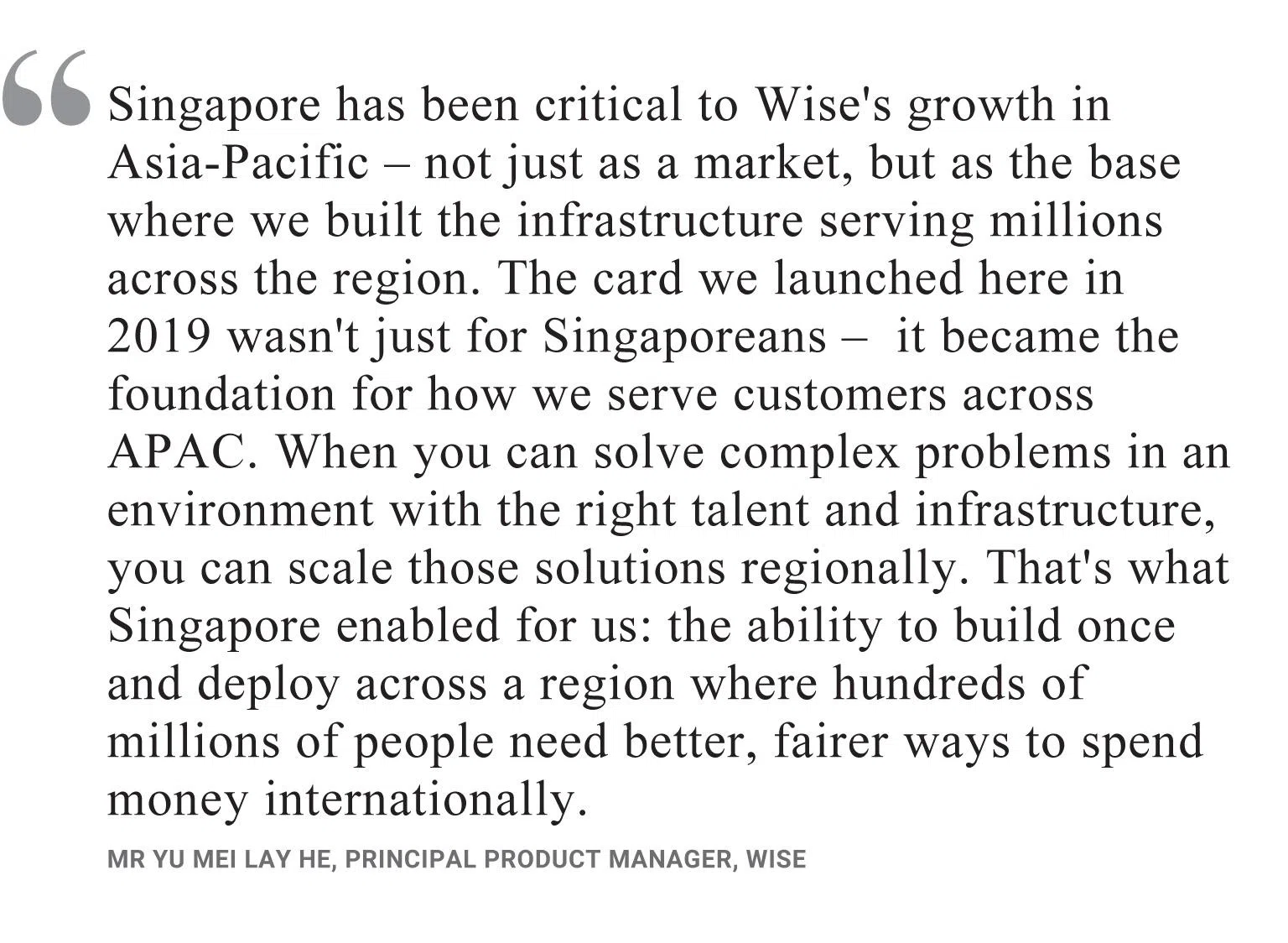
Singapore has served as Wise’s Asia Pacific hub since 2016, bringing together teams across Product, Compliance, People, Operations and Customer Service.
The Engineering team in Singapore represents about 10 per cent of the company’s global engineering workforce. Wise has been steadily expanding its office – from a one-man setup to a 31,800 sqft space hosting more than 600 staff – to tap into Singapore’s diverse talent pool and global connectivity. Beyond the Wise debit card, the Singapore-based teams have also launched several other products globally such as investment and finance management solutions. Wise’s decision to continue deepening its presence here demonstrates Singapore’s strength as an innovation hub. The country’s business environment supports global fintechs and their growth ambitions, helping them scale quickly and efficiently in Asia’s dynamic digital economy.
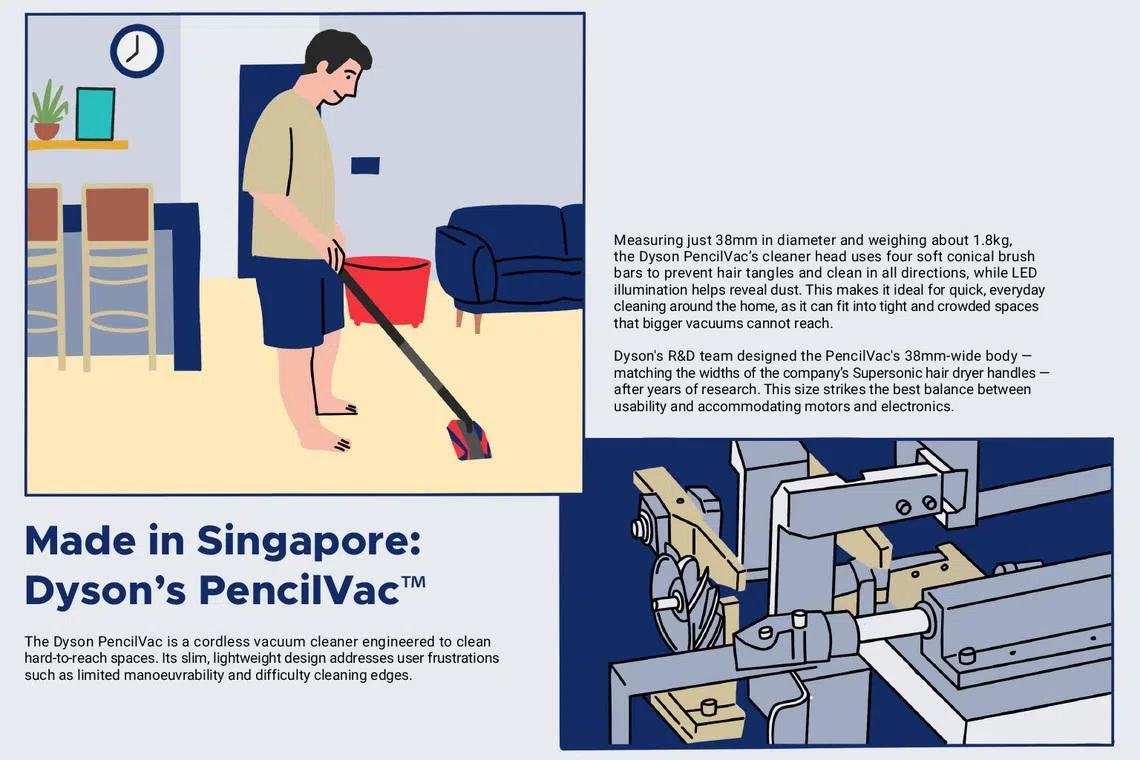
Dyson’s PencilVac is powered by its smallest, fastest motor, delivering high performance in an ultra-compact design.
ILLUSTRATION: SINGAPORE ECONOMIC DEVELOPMENT BOARD
Dyson’s latest cordless vacuum, the PencilVac, features a slim, lightweight build that improves manoeuvrability and makes it easier to reach edges and confined areas.
The main challenge in its development was fitting all the components into a compact 38mm body frame. The task entailed not just miniaturising each part, but redesigning them for greater efficiency without compromising performance.
At the core of the PencilVac is the Hyperdymium 140k motor, Dyson’s smallest and fastest motor to date. Developed and manufactured in Singapore, this motor powers the vacuum’s high performance in an ultra-compact form. The PencilVac is also Dyson’s first connected cordless vacuum, pairing with an app to provide users with real-time battery and maintenance alerts. The software and user interface were developed by the company’s software team in Singapore.
Since establishing its global headquarters in Singapore in 2019, Dyson has built a significant ecosystem encompassing engineering, supply chain, finance, procurement, IT, and manufacturing operations. Dyson operates nearly 50 research laboratories in total across its Singapore campuses. These laboratories explore diverse fields that range from software and machine learning, to robotics, sensing and vision systems.
Dyson’s Singapore Advanced Manufacturing facility, which houses seven fully automated production lines that produce one motor every two seconds, plays a key role in the company’s operations. The factory employs over 300 robots to assemble motors with precision.
Singapore remains the centre of Dyson’s innovation efforts, as the home to its full range of engineering capabilities that drive the development of new technologies. The company employs over 2,000 staff in Singapore, half of whom are engineers. These engineers have played a key role in developing the PencilVac and the Hyperdymium 140k motor, which was built on the first-generation motor made in Singapore in 2004.
Dyson marked a significant milestone of having produced 100 million motors – powering its vacuum cleaners and beauty technologies – in Singapore by the end of 2025.
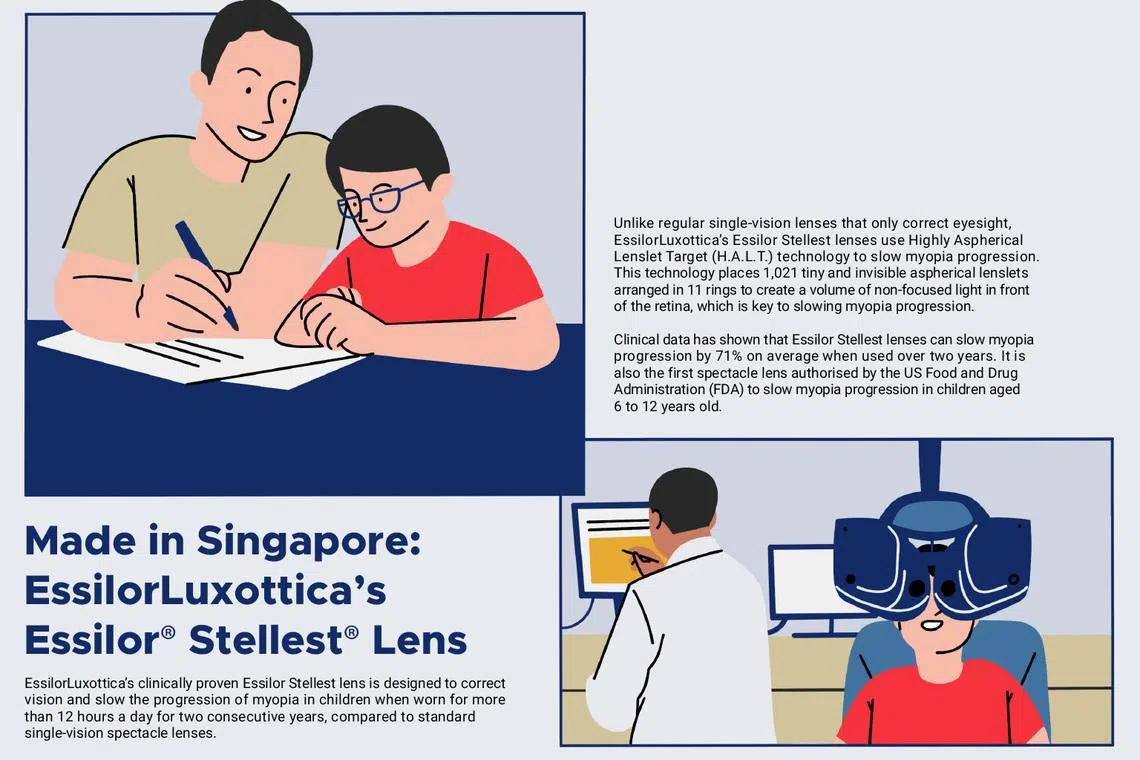
Essilor Stellest lenses help to slow myopia progression in children by an average of 71 per cent over two years.
ILLUSTRATION: SINGAPORE ECONOMIC DEVELOPMENT BOARD
According to the Singapore National Eye Centre, Singapore has one of the highest myopia rates globally, affecting 60 per cent of children by age 12 and over 80 per cent of adults. 20 per cent of young adults who are myopic have high myopia, which puts them at greater risk of visual complications in later life1.
French-Italian multinational company EssilorLuxottica, known for its vision care and med-tech solutions, announced the worldwide launch of its Essilor Stellest lens in 2020. This spectacle lens is clinically proven to slow myopia progression in children by an average of 71 per cent over two years, compared to standard single-vision lenses2. Granted authorisation by the US Food and Drug Administration (FDA) to be marketed as the first ever spectacle lens to slow myopia progression in children, this lens was conceptualised at the company’s Centre for Innovation & Technologies, Asia (CI&T Asia) in Singapore, in collaboration with its other international R&D hubs.
The company recently launched its Essilor Stellest 2.0 lenses in Singapore on March 31, 2026. Powered by its patented Highly Aspherical Lenslet Target (H.A.L.T.) MAX technology, the second-generation lens can significantly slow myopic eye growth by 1.88 times, as compared to the previous-generation lenses after a year, to deliver higher power and efficacy in managing myopia progression.
With its Asia-Pacific hub established in Singapore since 1976, R&D is one of EssilorLuxottica’s key functions located here. Set up in 2004, CI&T Asia is the Group’s hub for vision care, focusing on myopia applied research and management solutions. CI&T Asia brings together experts in optometry, vision science, epidemiology, clinical investigations, material science and lens prototyping. The facility features an ISO-compliant (International Organization for Standardization) lens prototyping line that meets the highest international standards for medical devices, and is accredited by Singapore’s Ministry of Health as a research institution, which allows CI&T Asia to conduct extensive in-house clinical trials and myopia research. Notably, the Essilor Stellest lens prototypes were manufactured at CI&T Asia for use in several clinical trials in the US and China.
EssilorLuxottica has collaborations with a network of partners in the Asia-Pacific region, including leading research and academic institutes in Singapore, to further their research and nurture talent in the vision care field through Doctor of Philosophy (PhD) and apprenticeship programmes. Singapore’s robust R&D ecosystem, talent pool and strong intellectual property framework provide the ideal foundation for EssilorLuxottica to lead the way in addressing global eye care challenges.
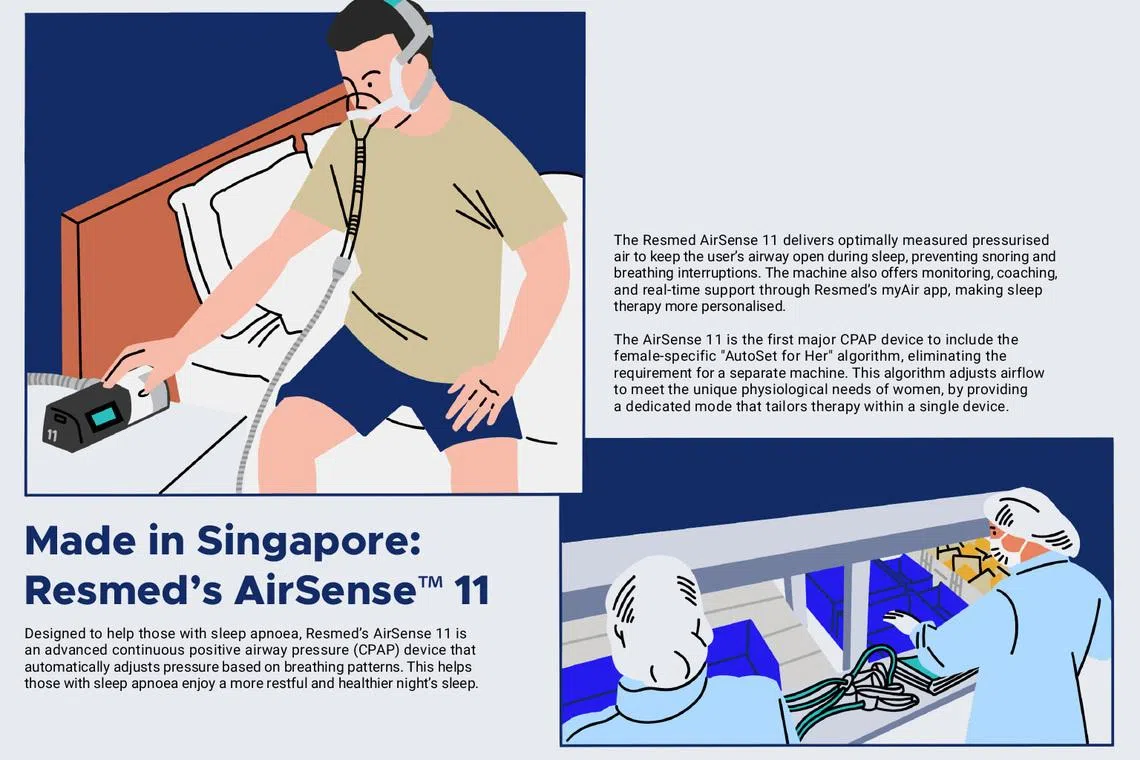
Resmed’s AirSense 11 automatically adjusts pressure based on breathing patterns to keep airways open for better sleep.
ILLUSTRATION: SINGAPORE ECONOMIC DEVELOPMENT BOARD
For those dealing with sleep apnoea, better sleep can start with the right technology.
Resmed’s AirSense 11 features technology that automatically detects and optimises pressure levels based on your breathing patterns3. It utilises continuous positive airway pressure (CPAP) to keep airways open, offering a more restful and healthier night’s sleep.
The AirSense 11 was developed through a global design collaboration, with expertise contributed from Resmed’s Product Development Laboratory in Singapore’s One-North district. With its advanced features, the AirSense 11 CPAP machine has won the Good Design Award in the Medical and Scientific Product Development category.
Australia-founded and US-headquartered Resmed has had a steady presence in Singapore for nearly three decades, with its regional headquarters, R&D and manufacturing functions all anchored here. The company’s state-of-the-art Advanced Manufacturing Centre in Tuas, measuring 270,000 sqft, is its largest global manufacturing site and primary production hub for AirSense 11 devices.
This facility is equipped to scale production of Resmed’s devices and mask systems, and also pioneers advanced manufacturing processes and new technologies that are adopted across the company’s global sites. Resmed’s Singapore operations, supported by more than 1,300 staff – including over 150 researchers, scientists and engineers at its Product Development Laboratory – have driven the company’s global growth.
As part of its long-term strategy, Resmed continues to invest and deepen its presence in Singapore. This includes expanding production capacity, driving advanced manufacturing process innovation, and supporting the growth of its Digital Science and AI Lab (DSAIL), to use AI and machine learning technologies to enhance patient and physician experiences.
Resmed is also benefiting from cross-border opportunities offered by the Johor-Singapore Special Economic Zone (JS-SEZ). The company is expanding its manufacturing operations in Johor Bahru (JB), Malaysia while anchoring key regional headquarters functions in Singapore, allowing it to optimise its supply chain and balance cost efficiency with resilience.
Strong cross-border connectivity allows Resmed to streamline staffing, and leverage the talent and expertise between its Singapore and JB teams. This boosts competitiveness and productivity, enabling Resmed to scale more effectively across the region.
What makes Singapore a leading innovation hub? Explore its vibrant research and development and startup ecosystems and discover other local product innovations.
1 Gifford KL, Richdale K, Kang P, Aller TA, Lam CS, Liu YM, Michaud L, Mulder J, Orr JB, Rose KA, Saunders KJ. IMI–clinical management guidelines report. Investigative ophthalmology & visual science. 2019;60(3):M184-203.
2 Compared to single vision lenses worn 12 hours per day for two consecutive years. Results from a prospective, randomised, double-masked, multicentre US clinical trial in myopic children aged 6 to 12 years at initiation of treatment.
3The AirSense 11 self-adjusting system is indicated for the treatment of obstructive sleep apnoea (OSA) in patients weighing more than 30 kg (66 lbs). The AirSense 11 self-adjusting system is intended for home and hospital use. myAir is a patient engagement software platform for use by patients who are prescribed a compatible Resmed device for the purpose of self-tracking therapy usage data and receiving coaching (educational videos and tips) in a personal home setting. The Personal Therapy Assistant (PTA) feature of myAir is intended for patients who are prescribed a compatible Resmed Air11 platform device to remotely simulate therapy prior to using their device with their prescribed settings. myAir is an optional software accessory to allow patients to acclimate to their therapy device.