


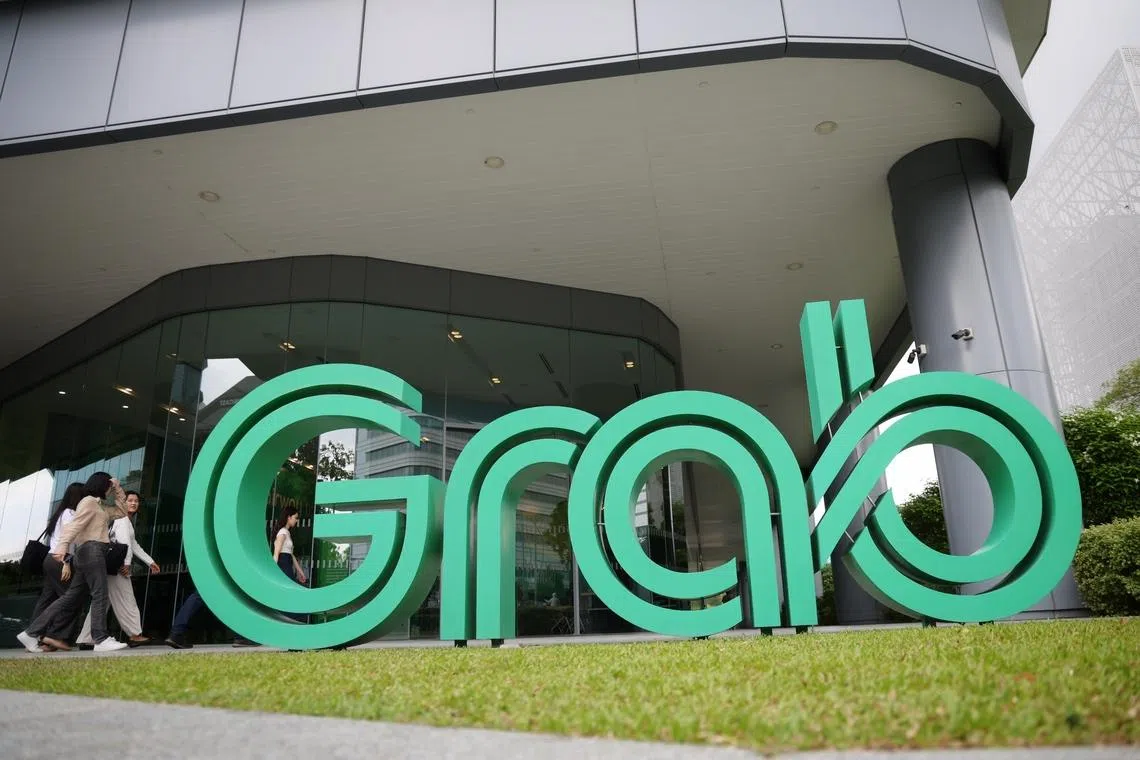
SINGAPORE – As Grab Holdings logs how more than 50 million users shop, pay and commute, it is using advanced technology to nudge users to spend more often and build daily habits around its services, making the app less easy to switch away from.
These efforts are bearing fruit as its latest quarterly results show. For January to March, revenue across Grab’s platform, including rides and deliveries, rose 24 per cent year on year to US$955 million. Adjusted earnings rose 46 per cent to US$154 million over the same period – making for 17 straight quarters of profit growth.
Speaking at Grab’s results briefing on May 5 Singapore time, chief executive and co-founder Anthony Tan said the firm’s strong growth across its core businesses reflects a strategy of using technology to improve how the platform works.
“As our platform deepens with users transacting more frequently across more services than before, the data advantages we have built over the last 14 years translate directly into better products, more reliable supply, and stronger earnings for our partners,” Mr Tan said.
“Each quarter, that flywheel strengthens, and the first quarter of 2026 is evidence of that dynamic.”
The number of people using the Grab app monthly climbed to 52 million in the first quarter – a 24 per cent year-on-year growth.
Said Mr Tan: “We capture highly localised, real-time data on how over 50 million users and partners interact across eight markets. Over the years, this has enabled Grab to build a rich and valuable dataset of over 20 billion transactions, including everything from real time map routes to in-store payments.”
Grab feeds this data into its AI systems to make the platform run more efficiently – from matching riders and drivers faster, to finding quicker delivery routes and adjusting prices based on demand. And because it also has a large network of drivers and merchants, Grab can act on these insights immediately, Mr Tan said.
He noted that drivers using Grab’s AI-powered tools earn 23 per cent more per hour and spend less time waiting for jobs, while users benefit from faster and more reliable services.
Grab is also preparing for a shift in how users search for services, betting that more will turn to its own AI tools instead of traditional apps. To capture this demand, it has introduced web-based features for dining and food that are designed to be surfaced by its AI search functions and converted into bookings or orders on its platform.
These efforts are already showing results. Grab’s AI assistant for merchants has been adopted by about half of its active sellers since 2024, helping those businesses boost sales by around 15 per cent.
Earlier in 2026, the company introduced 13 new AI-powered features, including tools designed to influence how users discover food and get around cities. These include a personalised food discovery feed based on community reviews and a mapping system built for South-east Asian conditions, aimed at surfacing more relevant options and improving navigation.
For most users, Grab’s AI push might make deliveries faster or food suggestions seem more customised or relevant, while regular tasks like reordering groceries or booking rides could take fewer steps.
But as the app becomes more useful across different parts of daily life, Grab is betting that users will come to rely on it more often and for more needs, making it a habit.
Grab president and chief operating officer Alex Hungate said AI is playing a central role in improving how its platform runs by making services more affordable, reliable and engaging, which, in turn, encourages users to spend more and return more often.
This is reflected in stronger user activity, with more people transacting regularly and spending more each time, he said.
As Grab improves and expands its services, more across the region are expected to use it as a single platform for their daily needs, which will generate even more data to refine the platform further.
Mr Hungate said new AI tools are encouraging repeat use in Grab’s deliveries business. For example, Grab’s grocery feature helps users quickly reorder weekly essentials, making everyday purchases more seamless and pushing the platform further into regular, routine spending.
Still, Grab continues to lean on pricing and affordability to drive growth, as it balances innovation with the need to keep everyday services within reach for users.
Mr Hungate noted that budget features and group orders are attracting more price-sensitive users, while subscription users tend to order more often and stay longer on the platform. At the same time, premium options like priority delivery are gaining traction, with users spending more per order and showing stronger loyalty.
In the mobility business, Mr Hungate said Grab has rolled out measures to help its drivers cope with rising fuel costs, adding that the number of active drivers has continued to grow, reaching a record high despite economic uncertainty.
The company is also opening up new routes to boost earnings, including recently launching cross-border taxi services between Singapore and Malaysia, which improves convenience for passengers while reducing empty return trips for drivers, he said.
Grab chief financial officer Peter Oey added that Grab said it is maintaining its full-year outlook, with revenue expected to grow to between US$4.04 billion and US$4.10 billion in 2026, and profits rising at a faster pace as the platform becomes more efficient.
“Our first quarter results provide a solid foundation for the rest of the year,” Mr Oey said.
US-listed Grab shares closed on May 5 at US$3.68, up 1.7 per cent.

