


SINGAPORE – People who work in the Central Business District (CBD) can look forward to more lunch options and green spaces amid tight competition in Singapore’s premium office scene.
Office landlords and experts told The Straits Times that employees increasingly look for higher-quality building features such as smart lifts, as well as more food & beverage (F&B) options and amenities including medical clinics.
Some of these features will be reflected in upcoming renovations and new offices that are being built, they added.
This comes amid a rising demand for premium offices, termed as ‘Grade A’ offices, with both rental prices and occupancy for such spaces rising in the first quarter of 2026.
Office rents for Grade A office spaces in Singapore’s CBD averaged $11.36 per sq foot a month for the first quarter of 2026, a steady increase for the past three years and almost a dollar more than three years ago, according to data by real estate company Cushman & Wakefield released on April 16.
More companies are willing to pay a pretty penny for these spaces too, with office vacancy for Grade A spaces dropping to 4.1 per cent for the first quarter of 2026 compared to 4.4 per cent the previous quarter, the data showed.
The grade of an office building is determined by meeting a list of conditions that is generally agreed upon by those in the real estate market, which in turn shapes its rental price.
Grade A buildings are those that have excelled in all of these conditions: in a prime location and access to public transportation, age of building and quality of materials and construction, amenities offered; and structural quality and design of office spaces, which takes into account how large an open-plan office space is, as well as floor to ceiling windows and height.
While the CBD property landlords upgrade the physical aspects of the building to remain attractive with the use of premium materials, design, and technology, it is the attention to detail that makes it an easier sell to get the workforce into the office five days a week.
For example, having smart lifts that brings you straight to your office level without touching any buttons. Carefully curated amenities that includes childcare centres, health clinics or fitness clubs in addition to a wide selection of food and beverage outlets that people would travel into the CBD for.
In 2024, CapitaLand Integrated Commercial Trust (CICT) opened Sushisamba, which serves a fusion of Japanese, Brazilian, and Peruvian cuisine at its CapitaLand Tower on Robinson Road, while multi-concept venue C.O.T.U took up space at CapitaGreen along Market Street. Both F&B venues offer panoramic views of the Singapore landscape.
By the middle of this year, CBD workers can get their tea fix when popular Chinese tea brand Molly Tea opens its second Singapore outlet at the Singapore Land Tower in Raffles Place.
Ms Fiona Alexander, head of workplace strategy at CBRE Singapore, said: “At the end of the day, noting the amount of time we spend at work, we should expand the perspective and realise that office buildings are also competing with home and lifestyle, not just other offices.”
Apart from the building design and fit-outs, lifestyle elements are also a draw for workers.
That means having amenities such as childcare centres or fitness clubs that are easily accessible to tenants, and spaces that meet the need for larger ad-hoc meetings that do not require workers to travel offsite. Maximising convenience for workers by having direct and sheltered connectivity to the MRT is also a big draw.
Outdoor green spaces and rooftop gardens are also in high demand and are appreciated as they provide respite from dense urban settings, added a CDL spokesperson.
Mr Chua Hsien Yang, the chief executive officer of Keppel REIT management, said he has noticed “a flight-to-quality trend” by prospective and long-term tenants.
“Tenants generally prefer well-located, high-quality workplaces that support employee experience, productivity and talent retention.”
Mr Chua said Keppel REIT regularly reviews their assets “with a focus on maintaining high building quality, driving sustainability performance and curating amenity offerings” to support tenant needs and improve the use of common spaces.
The top landlords will also go above and beyond and “act more like hospitality providers”, said Ms Alexander of CBRE Singapore.
Instead of outsourcing services to management companies, some property developers/landlords, like Singapore Land, have their tenant engagement team to organise networking and community events on a regular basis, and to maintain and manage the building app for service requests and booking of amenities.
Wellness is a big focus for office workers.
In Oct 2025, CapitaLand Investment Limited (CLI) announced a three-year partnership with the Health Promotion Board (HPB) to promote and implement health and wellness programmes across CLI’s retail and workspace network in Singapore. Some of the programmes include the HPB’s Healthy Workplace Ecosystem Programme and Health Promoting Mall Programme.
Of course, the design and look of the office matters too – having an attractive arrival lobby with a concierge, alongside sharing the building with other big name tenants, makes for a good first impression.
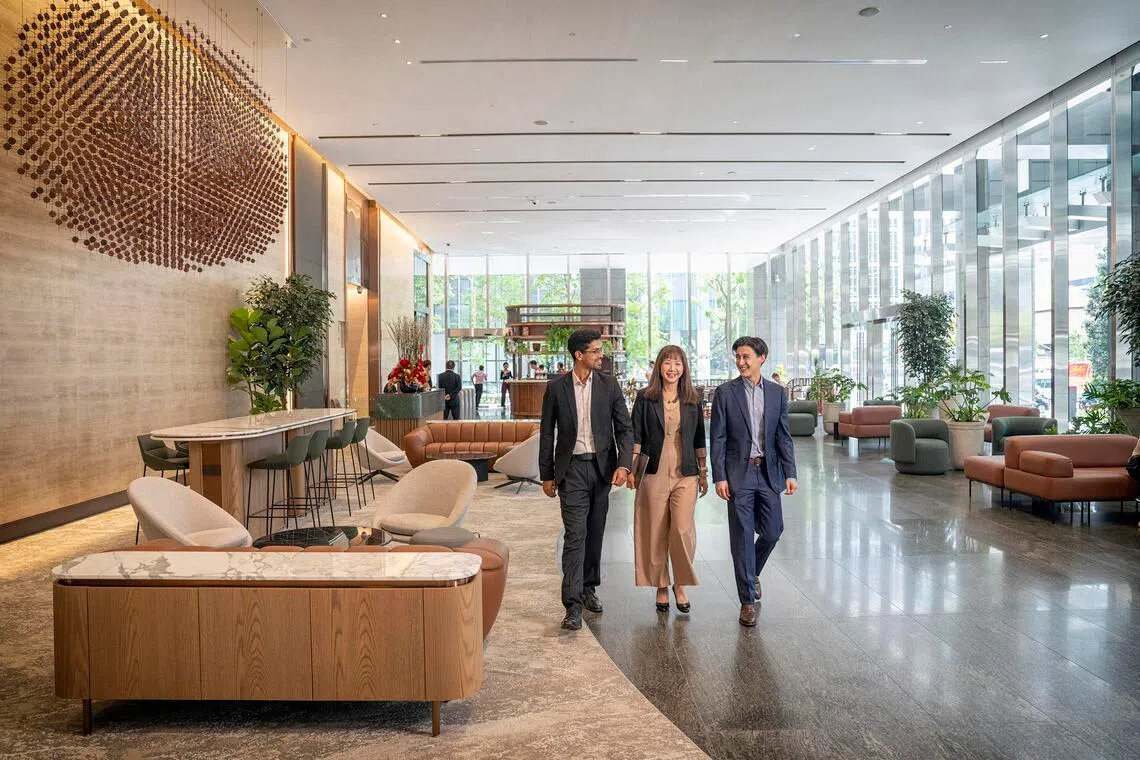
The upgraded One Raffles Quay lobby.
PHOTO: KEPPEL REIT
“At the end of the day, Tier 1 tenants care deeply about brand signalling to clients and talent and these are key considerations in their choice of location,” said CBRE’s Ms Alexander.
While tenant profiles across properties are largely shaped by prevailing market demand, each property has its own distinct positioning, said Mr Lee Yi Zhuan, CapitaLand Integrated Commercial Trust Management Limited’s head of portfolio management, in reference to the group’s portfolio of office buildings.
Mr Lee said that law firms and boutique fund managers who prefer compact office spaces and value hospitality-centric touchpoints go for the group’s Six Battery Road offices, while CapitaSpring and CapitaSky are preferred by financial services, technology and consultancy companies for the building’s large, open plan layouts.
Green buildings – which are built and operated to use energy and materials efficiently for more sustainable operations – are also be a key consideration for companies who are looking for a property that aligns with their sustainability goals.
Mr Lee added that CICT proactively fosters workplace communities by organising workshops, sports activities and themed events that promote health and wellness for tenants. The group also offers flexible workspace solutions through its partnership with The Work Project, allowing tenants the option of short or long-term office arrangements.
For real estate company JLL, which has its Asia-Pacific headquarters at the CapitaSpring development, all of that matters.
Mr Robert Macdonald, JLL’s head of corporate real estate for Asia-Pacific, said the company values CapitaLand’s collaborative approach to developing workplace solutions: “This partnership has enabled us to demonstrate a healthy, flexible and future ready workplace that enhances talent attraction, client engagement, and supports long term business growth.”
The Grade A office space supply in the CBD is currently limited, but a slew of projects slated for completion in 2027 onwards should boost supply.
City Developments Limited (CDL) has two ongoing redevelopment projects that combine Grade A office spaces with luxury residences: they are Newport Plaza, a 45-storey mixed-use building on Anson Road that is expected to be completed in 2027; and Union Square at Havelock Road, which has a 20-storey office block with 300,910 sq ft of office space, and is expected to be completed in 2029.
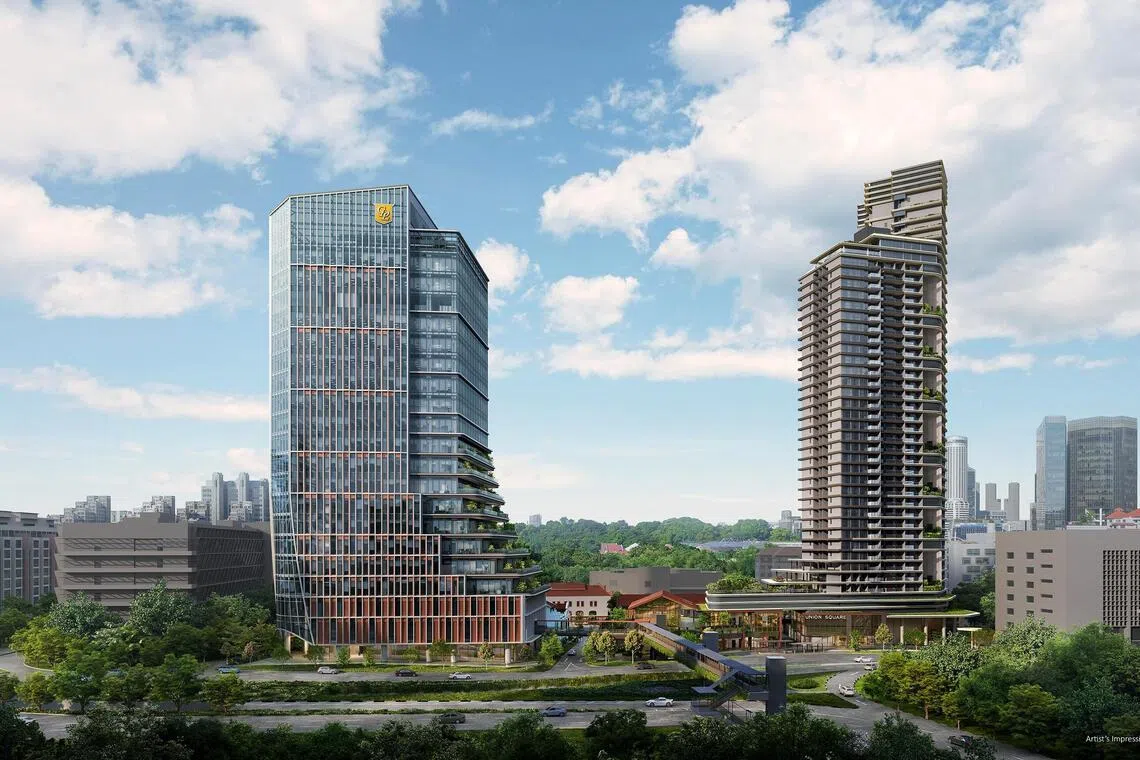
An artist’s impression of Union Square during the day. It will be within walking distance to three MRT stations, and sits along the Singapore River.
PHOTO: CITY DEVELOPMENTS LIMITED
Both buildings are within walking distance to three MRT stations each, and located near the water, adding a premium to the value of the properties. The Newport Plaza will sit on the fringe of the future Greater Southern Waterfront that is expected to fully take shape by the 2040s, while Union Square abuts the Singapore River.
A CDL spokesperson said there has been strong interest for its premium Grade A office space in both developments, particularly among professional services, financial services and flexible space operators.
The Singapore Land Group (Singland) is also expected to complete its 35-storey The Clifford at Raffles Place in 2028. Billed as a premium Grade A office tower, it will have 405,000 sq ft of leasable space, with 360,000 sq ft for office space across 21 office floors.
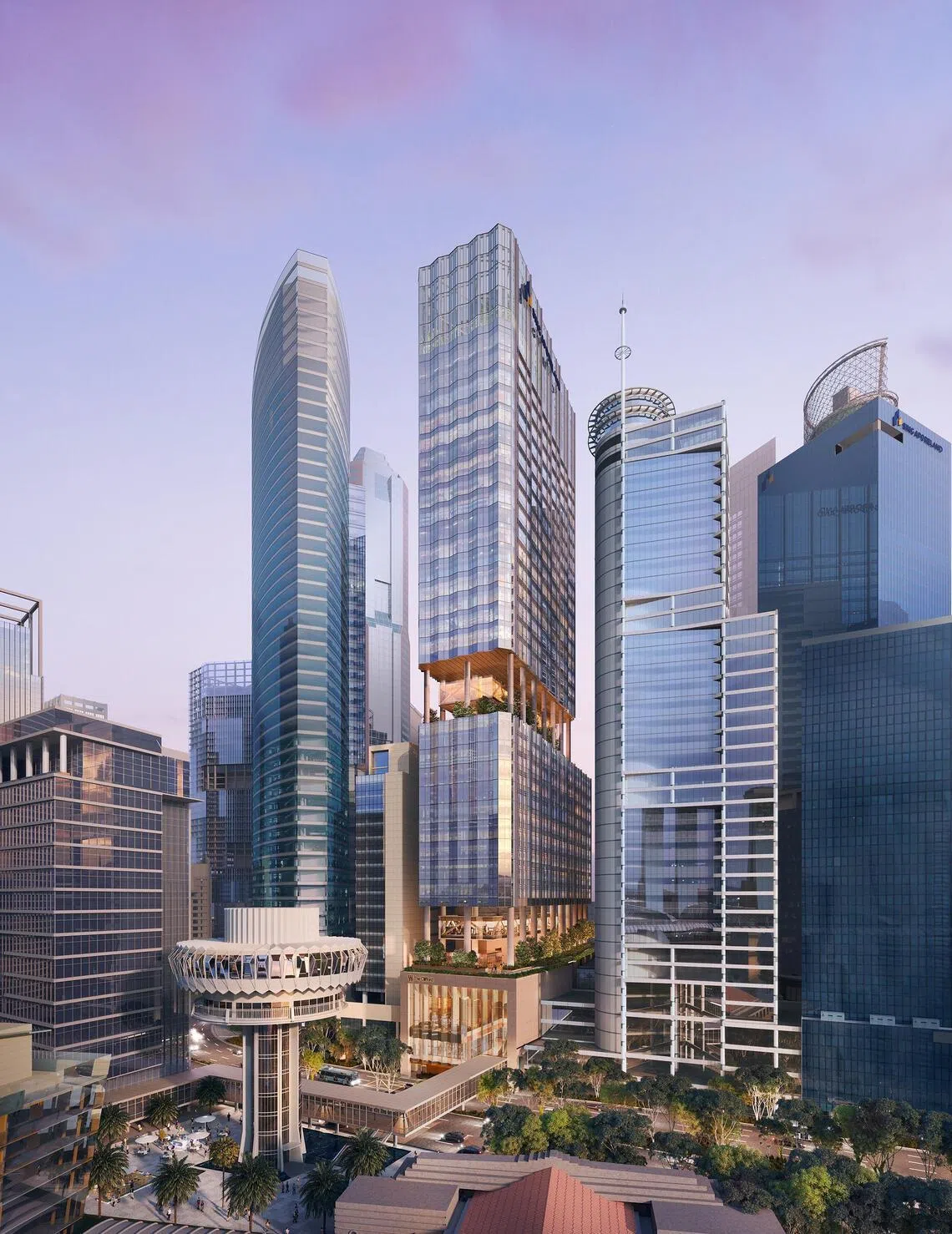
The Clifford at Raffles Place will be directly connected to the Raffles Place MRT, and to the Marina Bay Waterfront via a link bridge.
PHOTO: SINGLAND
It will also feature two landscaped sky terraces totalling about 28,000 sq ft, and a 2,000 sq ft multi-purpose hall for tenants to book for large scale meetings, conferences and events. The building will also have a designated drop-off and direct underground connection to Raffles Place MRT station, and has a bridge that will link directly to the Marina Bay waterfront.
The 23-storey City House office building, located at Robinson Road, has 157,000 sq feet of leasable space with a 100 per cent committed occupancy rate as at Dec 31, 2025. Nearby, the 66-storey Republic Plaza at Raffles Place with almost 770,000 sq ft of leasable space, had a 98.3 per cent committed occupancy rate. Both buildings are part of CDL’s office portfolio.
A committed occupancy rate measures the total lettable space that is currently leased or those legally signed with an offer for future occupancy.
Mr Marcus Chu, chief executive officer of real estate agency ERA Singapore, said there are several factors that may motivate landlords to redevelop or upgrade existing office buildings in the CBD, as these projects typically involve significant capital investment and long-term planning.
Aside from asset enhancement initiatives – major works taken to improve a building’s attractiveness, rental potential or overall valuation – another factor relates to ageing buildings and rising maintenance requirements.
“Older developments may face mounting maintenance challenges, making redevelopment into a new building with improved specifications and higher gross floor area a more viable long-term strategy,” he said.
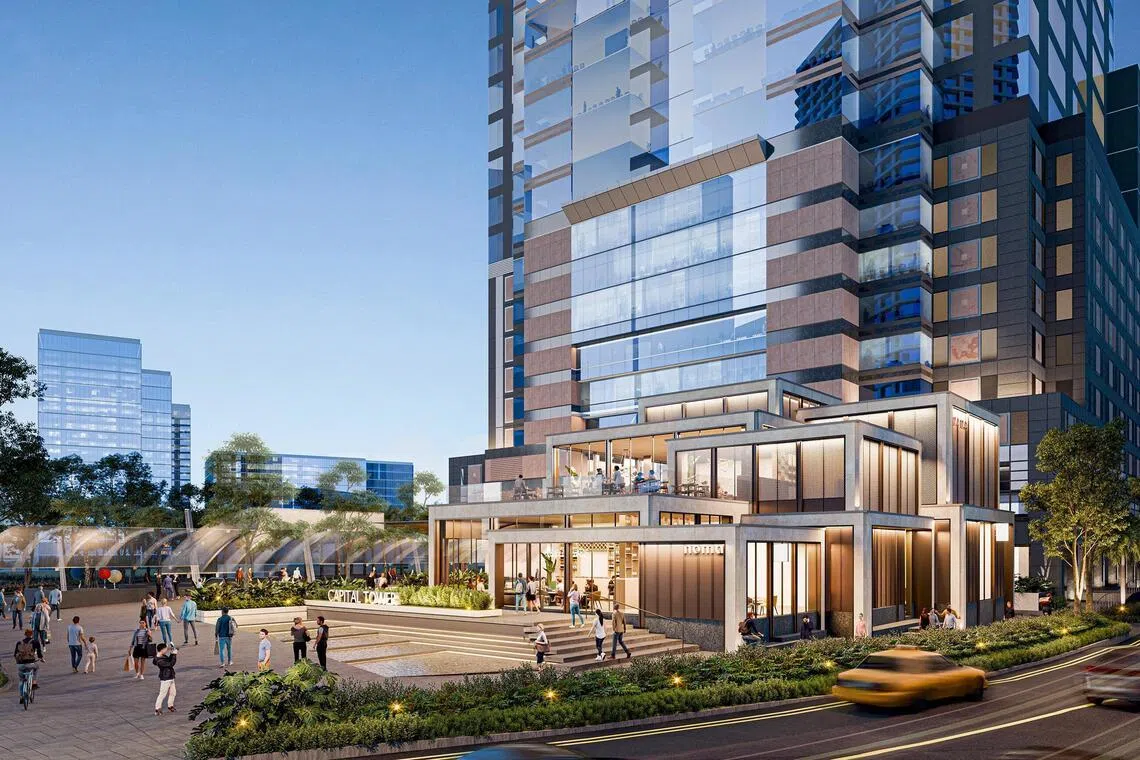
Artist’s impression of the proposed retail pavilion at Capital Tower’s Urban Plaza.
PHOTO: CAPITALAND AND INTEGRATED COMMMERCIAL TRUST
CICT will spend $25 million to upgrade the lobby at Capital Tower to include a new F&B pavilion. Refurbishment works are expected to begin in the third quarter of 2026 until the last quarter of 2027.
The group will also upgrade its Raffles City Tower at North Bridge Road to have refreshed lobbies, enhanced wayfinding and dedicated bicycle parking, lockers and changing rooms.
Keppel REIT recently completed upgrade works in 2025 at its One Raffles Quay development – it refurbished the drop-off point, upgraded the connecting bridge between the development’s two buildings to bring in more greenery, and introduced three new food and beverage offerings – Spanish tapas and wine bar Vino Tinto, specialty coffee and tea Volks cafe, and Mediterranean dining outlet Vios by Blu Kouzina.
Ms Ho Kaixin, a communications professional in her 30s whose office is near Raffles Place MRT, said that while “work is still work”, she appreciates that the CBD has “some gems”.
“My colleagues and I try different Pilates studios, my personal trainer is nearby and there’s an abundance of food options of different price ranges to try,” said Ms Ho, who has been working in the CBD for the past six years.
“Sometimes if the weather is good, I take a walk to the river to get some steps in. In contrast, when I work from home, my steps are a real struggle. But most of all I would say it’s the people that make work bearable – the pizzazz is just that.”
A change of scenery for lunch is good enough, too. Ms April Lim, 30, said her office building near Downtown MRT has an open area that is “kind of like a communal living room” with lots of benches for people to “chill and eat at”.
“It’s nice to dabao (takeaway) my lunch and eat there. It’s a good break from working from home or being in the office,” she said.

