


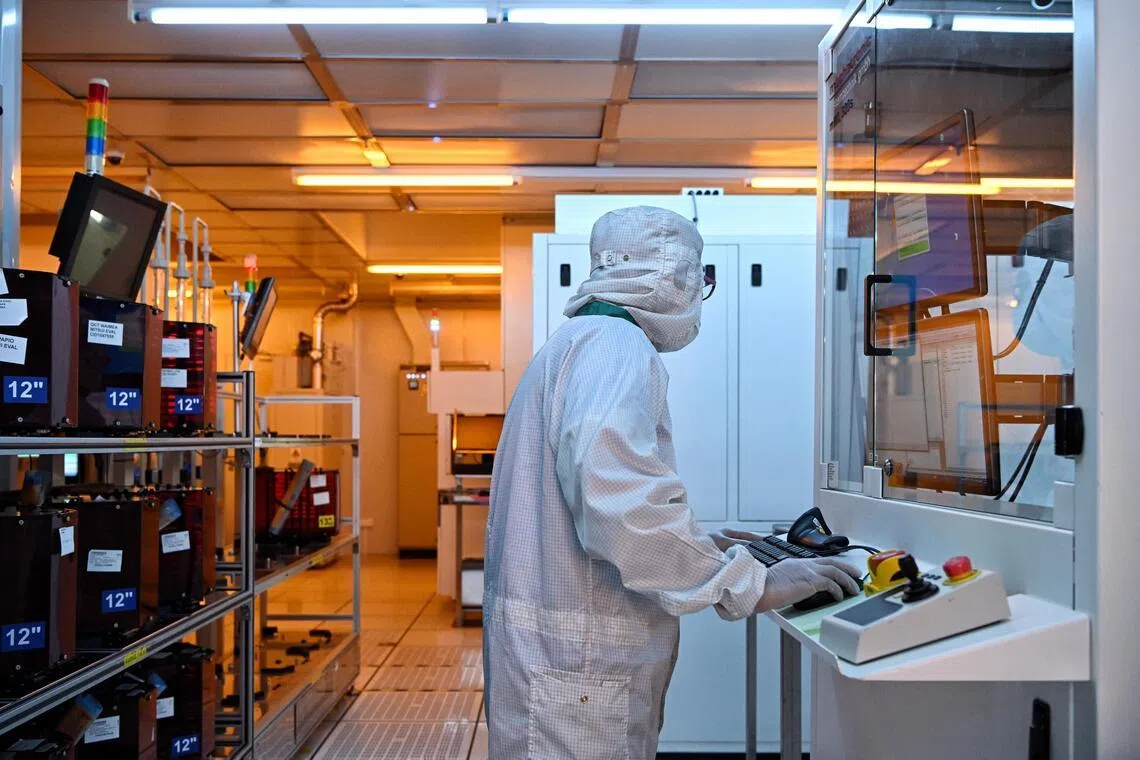
SINGAPORE – Singapore’s factory activity expanded for a ninth straight month in April, its resilience buoyed by global demand for artificial intelligence products and applications.
But manufacturers here are continuing to feel the impact of severe supply chain constraints from the ongoing Middle East conflict. The Strait of Hormuz, used to transport about one-fifth of the world’s oil and gas, remains effectively closed, driving up energy costs and impeding the supply of vital industrial materials.
Singapore’s purchasing managers’ index (PMI) – a barometer of the industry’s overall health – rose to 50.7 points in April, from 50.5 points in March. This was its highest reading since February 2025.
A PMI reading above 50 indicates growth, while one below that signals contraction.
The key electronics sector, which accounts for 40 per cent of Singapore’s manufacturing output, recorded a PMI of 51.7 points, in its eleventh consecutive month of expansion.
“The latest PMI readings reflect the positive impact of the global AI super-cycle, within the electronics and semiconductor segment, with additional support from the sectors of precision engineering and transport engineering,” said Mr Stephen Poh, executive director at the Singapore Institute of Purchasing and Materials Management, which compiles the monthly survey.
“However, severe supply chain constraints, arising from the Middle East maritime blockades and helium shortages, continue to inflate costs and prolong delivery lead times,” he noted.
Helium is indispensable for making advanced semiconductors or chips, including those that power AI. Semiconductors account for about 20 per cent of Singapore’s manufacturing output. In March, Iranian missile strikes on Qatar’s Ras Laffan Industrial City caused a major disruption to helium supply, cutting roughly 30 per cent of global production.
Apart from helium, the Hormuz blockade has affected the supply of other industrial materials like petrochemicals and plastics, aluminium and sulphur.
DBS senior economist Chua Han Teng expects factory activity to be uneven in the months ahead, although the latest reading points to a positive near-term outlook.
“Global AI-related tailwinds, driven by robust capital expenditure intentions, are supporting external demand for memory chips and server-related products, which we expect to sustain the near-term outperformance of Singapore’s electronics cluster,” he said.
But he cautioned that as the Iran war drags on, its inflationary effects and longer delivery lead times will start to weigh.
Singapore’s petrochemicals industry, for instance, is expected to remain under pressure because of the constrained supply of feedstock or raw materials, with no clarity on when the Strait of Hormuz will reopen, Mr Chua said.
OCBC Bank chief economist Selena Ling said: “Overall manufacturing and electronics demand conditions appear robust, as reflected in the stronger expansion of the new orders and new export orders gauges.”
She also said the Middle East conflict was “likely taking a toll” on manufacturers in the form of supply chain disruptions and increased business costs, including energy and petrochemical-related costs.
The PMI’s supplier deliveries sub-index contracted at a faster pace for a fourth straight month, reflecting longer lead times. This came as the order backlog index expanded and input prices increased.
Ms Ling said the data, taken together with the increase in the input purchases and imports sub-indices, suggests that manufacturers have taken pre-emptive measures to guard against worse disruptions from the war.
She noted that the future business sub-index remained in expansion for a sixth consecutive month, even as the Iran war persists. This showed that manufacturers “remain generally upbeat and bullish about business growth prospects”, she said.
However, Ms Ling added: “It is plausible that the manufacturing sector may not be able to fully immunise against higher energy prices and the widening effects of supply chain disruptions in the third quarter, if there is no resolution to the Iran war, since Singapore’s oil refining and petrochemical cluster is not insignificant.”
Hints that the Iran war is starting to affect Asia’s manufacturing powerhouses showed up in their PMI reports earlier this week.
China’s factory activity expanded for a second straight month in April, but much of it was credited to stockpiling by buyers worried that the Iran war would further inflate costs. Growth in new orders slowed, signalling that higher energy prices could deter fresh orders once stockpiling fades. In Japan, factory activity grew at its strongest pace in more than four years in April, with companies saying concerns over future supply chain delays and price increases prompted customers to place orders.

