


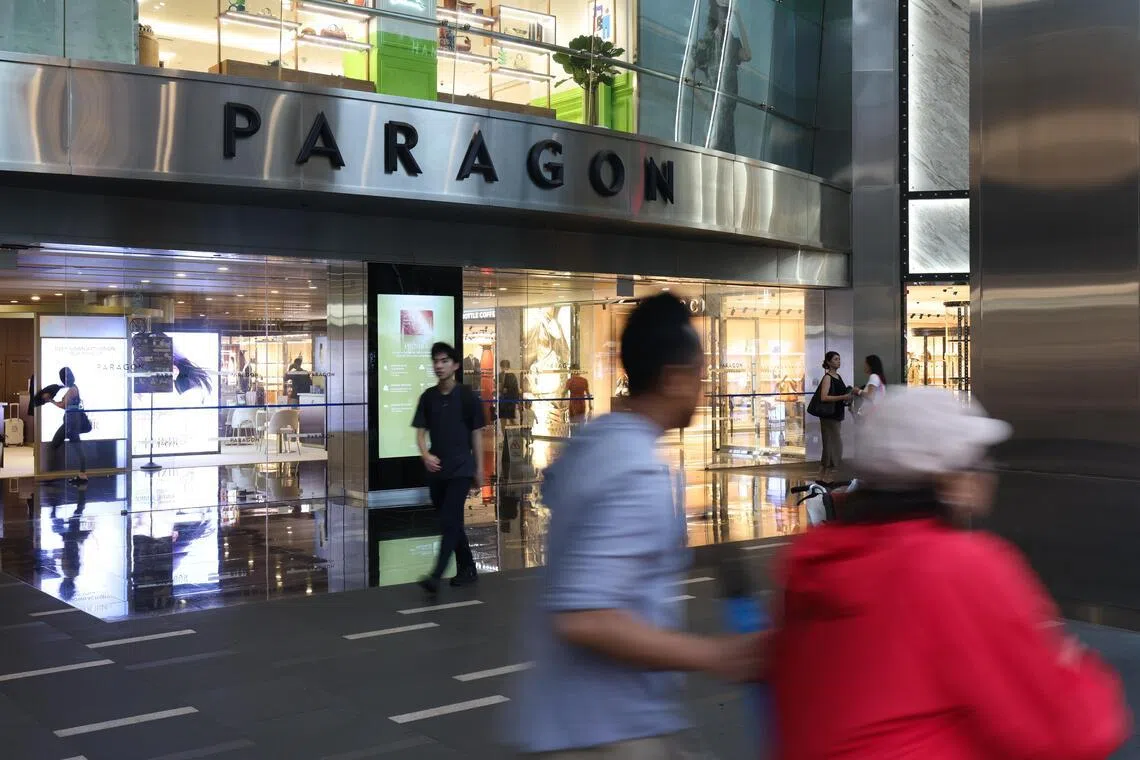
SINGAPORE – Malls in Singapore seem to be hot property recently, with i12 Katong and Paragon getting new owners, Plaza Singapura getting a $160 million upgrade, and news of White Sands up for sale.
This is despite geopolitical issues arising from the Iran war that could curb people’s spending, and lead to slower economic growth globally.
Key drivers for the recent activity involving Singapore malls are low interest rates, as well as a resilient property sector, according to experts.
While some malls are seeing foreign investor interest, this may not be a bad thing, as it may lead to new retail experiences and more diverse offerings for shoppers.
More deals on the horizon for local malls are also likely, according to experts.
Mr Desmond Sim, group chief executive of Realion (OrangeTee & ETC) Group, said that over the past few years, interest rates’ movements have swung investment in Singapore commercial assets to be in the positive spread region.
This is different from a few years ago, when local bank rates were heavily influenced by the US dollar, with high interest rates resulting in a negative yield spread.
Mr Sim added: “Your borrowing cost could be at 5 per cent but your returns at 3 per cent. It’s not a good investment when your income is less than your interest payment.”
A positive yield spread is when the income is higher than the borrowing cost, which translates to higher returns on an investment.
Yield spread for retail malls currently average around 4 per cent. This yield spread is primarily compared against the Singapore Overnight Rate Average, or SORA.
The three-month compounded SORA is Singapore’s key benchmark interest rate. It is around 1.04 per cent to 1.1 per cent as at April 2026, having dropped from as high as 3.6 per cent in April 2024.
“Malls are bought for recurring income and investors will look at the returns. The trading yield for the malls we have now is 4 to 5 per cent. Paragon was in that region,” said Mr Sim.
It was reported that Paragon mall has a yield of 3.9 per cent.
The second reason driving investor activity is that malls in Singapore have proven to be a resilient property sector, having come out of the Covid-19 pandemic performing relatively well.
Retail sales, for instance, performed better in 2025 than the year before – growing 2.8 per cent compared with 1.4 per cent in 2024.
The retail sector has also remained relatively stable so far for the first two months of 2026, growing 3.5 per cent year on year during the period.
People buy or invest in malls for two reasons, according to Mr Sim.
“You either buy a not-so-good mall thinking you can do asset enhancement, manage it and drive the occupancy up, or you buy something like Paragon that is 100 per cent occupied, very stable, and that is your stable cash cow. That is the reason retail malls have been in the limelight, it’s been proven they are resilient.”
The current geopolitical climate of the US-Iran war, which could affect consumers’ discretionary spending at malls, is a consideration but not a major one that weighs on investors when buying a mall.
What mall investors are more concerned about is stable rental income, occupancy rate and the management of the mall.
Elegant Group, which has links to Guangzhou-based Grantral Group, snapped up The Clementi Mall for around $809 million from Cuscaden Peak in December 2025, adding to its portfolio of Singapore malls which include Grantral Mall @ Clementi, Grantral Mall @ MacPherson, Changi City Point and Kinex.
In September 2025, it was reported that property developer UOL sold the Kinex mall in Paya Lebar to Xiaohong Property Management and Kinex Times Square. Xiaohong Property Management is understood to be the holding company of Elegant Group, and both share the same registered address at 601 MacPherson Road in Singapore.
On April 22, it was reported that i12 Katong would be sold by Keppel to Altallo Holdings for $372 million.
Altallo Holdings is connected to Singapore-registered fund management company Altallo Asset Management, which was incorporated in June 2025. One of the backers of Altallo Holdings is Indonesian Andre Tanoto, whose father Sukanto Tanoto owns the resource-based industrial group Royal Golden Eagle.
In December 2025, Altallo Holdings bought four HDB retail units located at Bukit Merah Central and near Toa Payoh, Ang Mo Kio and Clementi MRT stations.
In March 2026, it was reported that the group would acquire 11 retail properties from NTUC Enterprise unit Mercatus for $281 million. Properties in this portfolio include a mix of freehold and leasehold properties in locations such as Bukit Timah Plaza, Coronation Shopping Plaza and Tanjong Pagar Plaza.
While local businesses and shoppers at The Clementi Mall have raised concerns over higher rents and shifting tenant mix after its acquisition by China-linked Elegant Group, analysts say growing foreign ownership of suburban malls in Singapore is not necessarily a bad thing.
Rental hikes are expected as new owners seek to boost returns on investment, but such increases could ultimately benefit shoppers if paired with stronger promotions, a balanced tenant mix and enhancements to the retail experience that drive footfall and spending, said Mr Leonard Tay, head of research at Knight Frank Singapore.
He said: “Singapore malls have in the past been characterised as ‘cookie cutter’, where the tenant mix comprises the usual suspects, and where one mall basically looks the same as the other.
“With more foreign owners and investors, greater diversity in retail and food and beverage offerings can be curated across varied cultures and geographies.”
The introduction of new ideas, variety in products, cuisines and experiences can create a more differentiated and diverse retail arena in Singapore as well, Mr Tay added.
Mr Nicholas Mak, chief research officer at Mogul.sg, said suburban malls are a “good investment” for foreign companies. He noted that their main alternatives in Singapore are typically in the hospitality and industrial sectors.
But hotels are tricky and difficult to manage, and the risks of investing in industrial real estate can be even higher than for retail property.
“You can buy one big factory and rent it out to a company, (but) if that company one day decides to relocate to another country and not renew the lease, then you are in trouble,” he said.
Purpose-built industrial spaces can be hard to re-lease, as a facility tailored for a pharmaceutical company may not meet the needs of an aerospace tenant, for example.
Entering the office property sector is also difficult for foreign companies, as this would require significant capital to amass a large enough portfolio to become a significant player, especially in a sector where the prominent buildings in the Central Business District are mostly held by major real estate investment trusts or banks, Mr Mak said.
“So that leaves the retail mall. If they buy the whole mall, they can have full control over things like renovation, making changes to the layout or tenant mix.”
Mr Mak expects to see more malls changing owners, particularly commercial spaces that take up the first floor of a residential building, and which tend to be located near an MRT station.
Such developments are typically in land parcel zones marked out for a residential building with commercial spaces on the first floor, and there are more such land parcels sold with that classification to maximise land use.
“Other than what is existing in Orchard Road or whether it’s purely just malls, in the suburban or city fringe, it’s always mixed development that’s being sold. Going forward, this will be the new normal.”
Mr Mak estimated that excluding land parcel sales for executive condominiums, three out of 17 land parcels sold in 2024 were licensed for residential with commercial on the first floor. In 2025, it was four out of 14.
It would also make more sense for foreign companies to invest money overseas if competition in their home country is driving down their rate of returns, said Mr Mak, who added that China’s retail scene is highly competitive.
“They are coming here because Singapore is considered more low risk and attractive than their home country.”
Dr Chua Yang Liang, head of research and consultancy for South-east Asia at real estate company JLL, said the recent acquisitions with foreign capital also reflect continued confidence in the stability and long-term prospects of Singapore’s retail sector.
“Singapore’s status as a safe haven for capital continues to attract both local and foreign investment, particularly amid rising global geopolitical and economic uncertainties,” said Dr Chua.
“Ownership changes are a normal part of capital market activity, and what ultimately matters to consumers is how asset owners invest in and manage their properties, whether through tenant mix curation, customer experience enhancements, or asset repositioning.”
Realion Group’s Mr Sim said the strong Singapore dollar compared with other currencies in Asia can also be a draw for foreign investors.
“At this point, they want to collect rent in Singapore dollars because the Singdollar is powerful now. What’s the point of buying a cheap mall in Ho Chi Minh City but your rent is in Vietnamese dong, which is not performing well?”

