


SINGAPORE – Singapore must ensure its workers are well-equipped to thrive in an increasingly AI-pervasive economy, Manpower Minister Tan See Leng said, stressing that no worker should be left behind as artificial intelligence reshapes jobs and industries.
In his May Day message on April 30, Dr Tan said the country’s investment in lifelong learning for over a decade has laid a strong foundation.
“Today, as AI reshapes the nature of work, that long-term investment is bearing fruit. It will be a deep source of resilience and strength for our workers and businesses.
“It will be a strong foundation they can stand on to grow, adapt faster and take the next leap with confidence,” he said.
He added that the newly formed Tripartite Jobs Council, which brings together the Government, the National Trades Union Congress (NTUC) and the Singapore National Employers Federation (SNEF), will coordinate efforts in strengthening the “AI readiness of our workers and enterprises”.
Dr Tan’s May Day message came against a backdrop of rising geopolitical tensions and economic uncertainty, with the ongoing Middle East conflict driving up energy prices, affecting supply chain and weighing on investor confidence.
At the same time, Singapore is becoming a super-aged society, which reshapes workforce dynamics as workers live longer and career goals become more diverse.
Despite these challenges, he pointed to the tripartite model – Singapore’s “not-so-secret weapon” as a key strength.
“When unions, employers and the Government pull in the same direction with shared determination, our small nation can travel remarkably far,” he said.
Dr Tan also highlighted improvements in workers’ livelihoods, as real incomes for the median worker grew by 1.6 per cent per year over the past five years, while lower-wage workers saw a faster growth at 2.8 per cent.
On workplace safety, he noted that the Republic had a record low workplace fatal injury rate of 0.96 per 100,000 workers in 2025, which makes the country’s workplaces “among the safest in the world”.
He also outlined existing measures supporting workers at different life stages, from young graduates to mid-career workers and seniors hoping to stay employed longer. The CPF system was also strengthened to ensure retirement security for workers.
Dr Tan added that the ministry is also reviewing the Employment Act and other tripartite rules to make sure employment standards “keep pace with the changing nature of work and evolving aspirations of our workers”.
In a separate May Day message, NTUC president K. Thanaletchimi and secretary-general Ng Chee Meng reaffirmed the labour movement’s commitment to help workers progress at every stage of life, particularly as AI transforms industries.
“The evolving nature of work highlights our need to support one another, and standing together is more crucial than ever,” they said.
The labour leaders highlighted the NTUC AI-Ready SG initiative launched in February, where the labour movement supports national efforts in AI adoption to ensure a fair transition.
NTUC has been supporting union members with AI-related training, and also helps offset the cost of selected AI tool subscriptions.
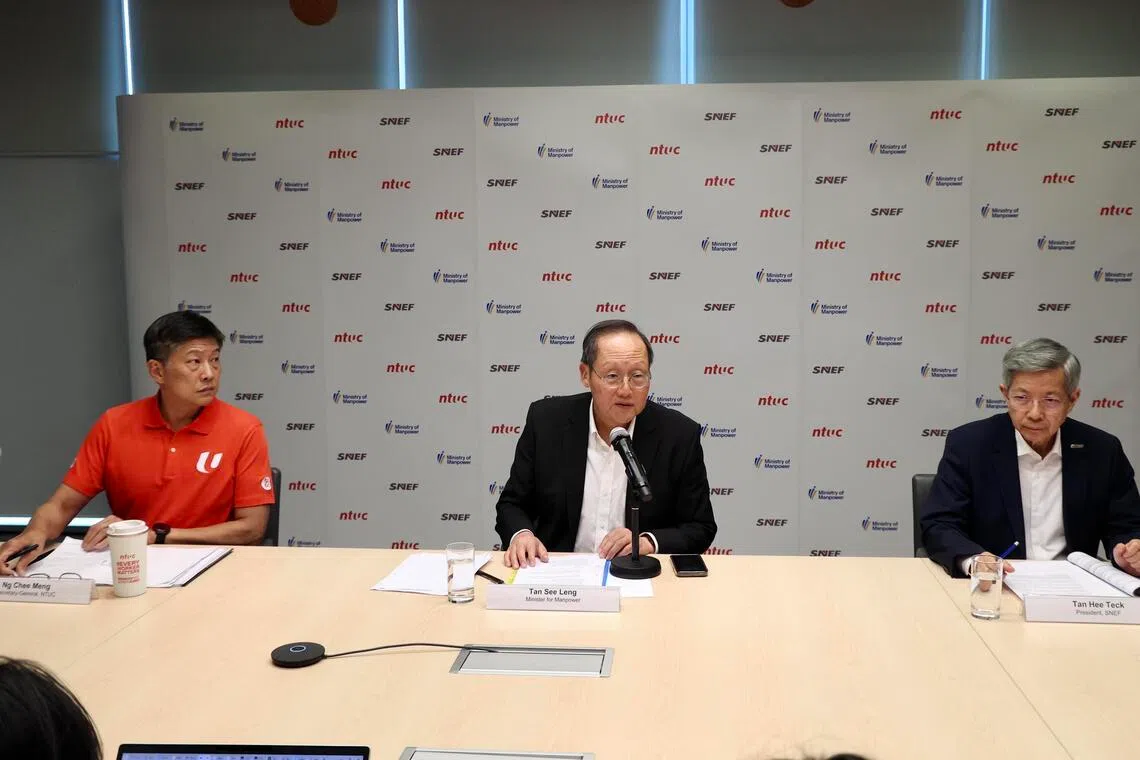
(From left) NTUC secretary-general Ng Chee Meng, Manpower Minister Tan See Leng and SNEF president Tan Hee Teck will co-chair the new Tripartite Jobs Council.
PHOTO: LIANHE ZAOBAO
In addition, it uses AI to secure better jobs for workers, help them build relevant skills, and support companies in re-designing jobs responsibly.
“Change will continue, but workers will not face it alone,” they said.
Other support measures cited include the Company Training Committee (CTC) initiative, where NTUC partners with companies to help workers upskill and progress.
“Through the CTC Grant, more than 14,000 workers will benefit from wage increases, structured career pathways and skills allowances, across more than 900 projects that raised business and workforce productivity,” they said, adding that the grant also supports AI transformation projects.
The labour leaders also vowed to “listen closely and take action for workers, especially when anxieties run high”.
The Singapore National Employers Federation (SNEF) president Tan Hee Teck said both employers and workers have had to navigate an increasingly uncertain global environment, and they have “demonstrated remarkable resilience and adaptability”.
In 2025, Singapore’s economy grew by 5 per cent. Total employment rose by 55,500, exceeding the gains in 2024.
“We recognise the invaluable contributions of workers across all sectors who have kept Singapore’s economy strong,” Mr Tan said in his May Day message.
But geopolitical conflicts are creating new stress points for the global economy, with businesses facing rising cost pressures and workers grappling with cost-of-living concerns, he said.
“Yet, amid these challenges, new opportunities for innovation and growth are emerging,” Mr Tan said, adding that it is critical for tripartite partners to support businesses and workers in seizing opportunities and adapting to change.
On AI, Mr Tan said the technology has raised job security concerns, but it also presents an opportunity to raise productivity and create better jobs if managed well.
“By driving responsible and scalable AI adoption across firms, tripartite partners can ensure that both employers and workers benefit from an AI-driven economic transformation,” he said.
He added that SNEF will continue to encourage employers to invest in AI and equip their workers with the skills to harness AI effectively.
Mr Tan also stressed the federation’s commitment in protecting the interests of businesses, while supporting progressive employment practices.

