


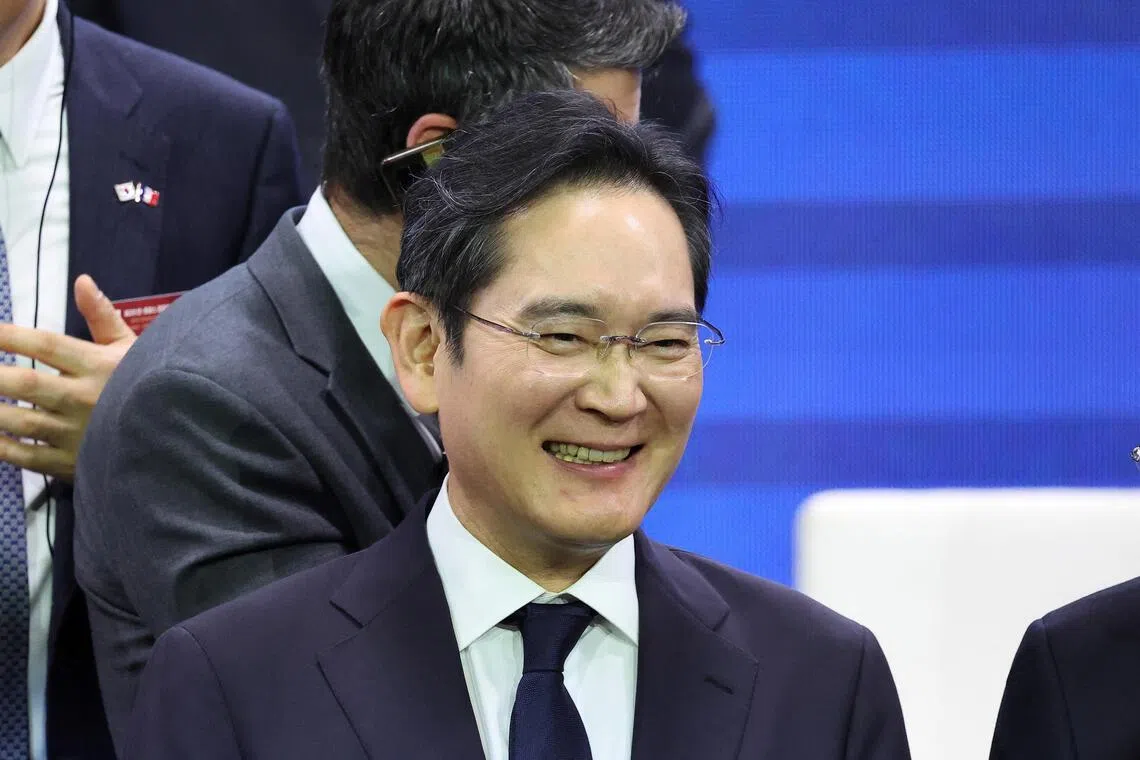
SEOUL – When Lee Kun-hee, the patriarch behind Samsung Electronics died in 2020, his dynasty soon dealt with a crisis on two fronts: first, a multi-billion-dollar inheritance tax. The following year, his son Jay Y. Lee was jailed after being convicted of bribing South Korea’s former President Park Geun-hye to win support for his succession.
At the time, some observers speculated that the sheer scale of one of the world’s largest death levies could threaten the family’s control over the conglomerate.
Instead, more than five years later, an AI-driven upswing in semiconductor valuations has helped the family cement its grip and grow richer than ever. The Lees’ combined wealth climbed to about US$45.5 billion (S$58 billion) as of March, from roughly US$20.1 billion a year earlier, according to the Bloomberg Billionaires Index.
They are now Asia’s third-richest family, up from 10th in 2025. The heirs are set to complete the final installment of their 12 trillion won (S$10.4 billion) inheritance tax due in April, wrapping up about five years of payments.
Samsung’s economic influence has continued to grow alongside a powerful market rally. The combined revenue of seven key Samsung affiliates – including Samsung Electronics – was equivalent to 19.3 per cent of South Korea’s gross domestic product in 2025, up from 15.1 per cent a decade earlier, according to Bloomberg calculations.
Samsung Electronics – which accounts for roughly a quarter of the nation’s benchmark Kospi Index – surged 126 per cent in 2025, its best annual performance in more than two decades.
Investment in AI infrastructure is driving an unprecedented semiconductor supercycle and demand for AI memory chips is expected to keep rising in 2026, Samsung Electronics co-chief executive Jun Young-hyun said at March’s annual general meeting.
Samsung is the biggest of South Korea’s family-run conglomerates known as chaebol, alongside SK Group and Hyundai Motor.
Its chairman, Jay Y. Lee, secured a presidential pardon from graft charges in 2022, allowing him to formally take the helm of the conglomerate that his grandfather created in 1938. Last week, he appeared in a selfie with the nation’s President Lee Jae Myung and India’s Prime Minister Narendra Modi during a visit to New Delhi. Over the past year, he joined presidential trips to India, Vietnam, China, the United Arab Emirates and the United States.
In October, photos of him having beer and fried chicken with another of the world’s richest tech barons, Nvidia chief executive officer Jensen Huang, went viral.
The family’s financial comeback highlights a broader disconnect in South Korea’s market rally. President Lee has made narrowing the “Korea Discount” and improving transparency among chaebol part of his election campaign. Expectations of reform to help minority investors have helped Seoul’s stock market become the world’s best performing over the past year. Still, critics say deeper changes are needed close the gap to global peers.
At the the heart of President Lee’s reform is a fundamental shift from controlling family interests to shareholder-centric governance. The parliament approved the final changes to the Commercial Act in February, which require companies to cancel treasury shares that have long been used by chaebol to entrench control.
But many chaebol are yet to deliver change, said Lee Chang Hwan, chief executive officer of activist investor Align Partners Capital Management in Seoul.
“What really needs to happen is that management and the board of these companies proactively work towards improving or optimising for shareholder value,” he added.
Samsung is seen as “behind the curve” versus other large local large groups when it comes to bringing value-up plans to investors, Morgan Stanley analysts wrote in a March 17 report.
“At least for the near future, I don’t believe the controlling family, the Lee family, has any incentive,” to do more about improving corporate governance, said Park Sangin, a professor at Seoul National University’s Graduate School of Public Administration.
“The stock price went up so much and the shareholders are so happy,” Mr Park said. In the long run, that means Korea may lose a good opportunity for substantial changes in corporate governance, according to the academic.
The company will report earnings for the March quarter on April 30, after pointing to record preliminary operating profit as customers led by cloud service providers ramp up orders for high-bandwidth memory and other chips used in data centres.
All of this has helped the Lee family to avoid selling even more shares to pay back inheritance taxes. Jay Y.’s personal wealth has risen sharply to US$26.9 billion over the past year, according to the Bloomberg Billionaires Index. He eclipsed finance tycoon Cho Jung-ho to become South Korea’s richest person, a title he lost in 2025. BLOOMBERG

