


SINGAPORE – Once teeming with clothing and accessory stores popular with bargain hunters and tourists, visitors to the second floor of Bugis Street these days will find that most of the units are now shuttered.
When The Straits Times visited the shopping complex on April 19, only about 20 out of about 100 shops on the second level were open, most of which are located some distance away from escalators and staircases.
Business was as usual on the first and third levels, which mostly feature clothing, food and beauty salons that drew a steady stream of tourists and locals.
Most tenancies on Bugis Street’s second floor have ended on March 31, a Bugis Street spokesperson confirmed in response to ST queries.
The space will be used for a new youth-focused concept, she said, adding: “We are taking the opportunity to refresh and revitalise this consolidated space into a more social and community-oriented destination.”
The rejuvenated zone will have a new youth-focused retail experience that focuses on experiential concepts, she added, alongside independent businesses.
Bugis Street is managed on a fixed rate master lease from the Singapore Land Authority (SLA), which entails a bulk renewal exercise every three years.
“We recently concluded this exercise – occupancies at level one remained strong given the footfall and visibility. Second floor units face different dynamics from first floor units,” said the spokesperson.
“Notwithstanding this, the tenant retention rate of more than 80 per cent was healthy for this bulk renewal exercise,” she added without providing exact figures.
A shop owner on the second floor of Bugis Street told ST that business has been suffering for a long while.
“I used to sell my clothes for $30 a piece, but now it’s hard to make sales even when they’ve been discounted to $10 a piece. Now that our clothes are so cheap, even selling 20 pieces a day isn’t enough to cover the day’s rental costs,” said the shop owner, who declined to be named.
“The other shops probably closed down as they can’t afford the rental,” said the owner, who shared that she has yet to decide if she will continue setting up shop in Bugis Street after the lease ends. Those interviewed declined to comment on whether rental costs have increased.
A domestic helper who was spotted browsing clothes with friends said she was surprised that so many shops have closed on the second floor.
The 23-year-old, who wanted to be known as Sam, recalled that the Bugis Street usually sees plenty of tourists and locals.
“I sometimes come to Bugis Street on my off days with friends to buy cheap clothes, but nowadays the prices are getting more expensive, so I don’t come as often,” she said.
“The closures don’t affect me much as there are other places I can get cheap clothes as well like Lucky Plaza,” she said.
Bugis Street, the pedestrian shopping street located opposite Bugis Junction – was recreated in the late 1980s following the demolition of the original site, which was known as a nightlife spot, according to Singapore Infopedia, a electronic encyclopedia by the National Library Board. The original site was replaced with Bugis Junction.
The shopping street’s floor area spans about 200,000 sq ft, housing more than 600 stores, mostly selling clothes, accessories and souvenirs.
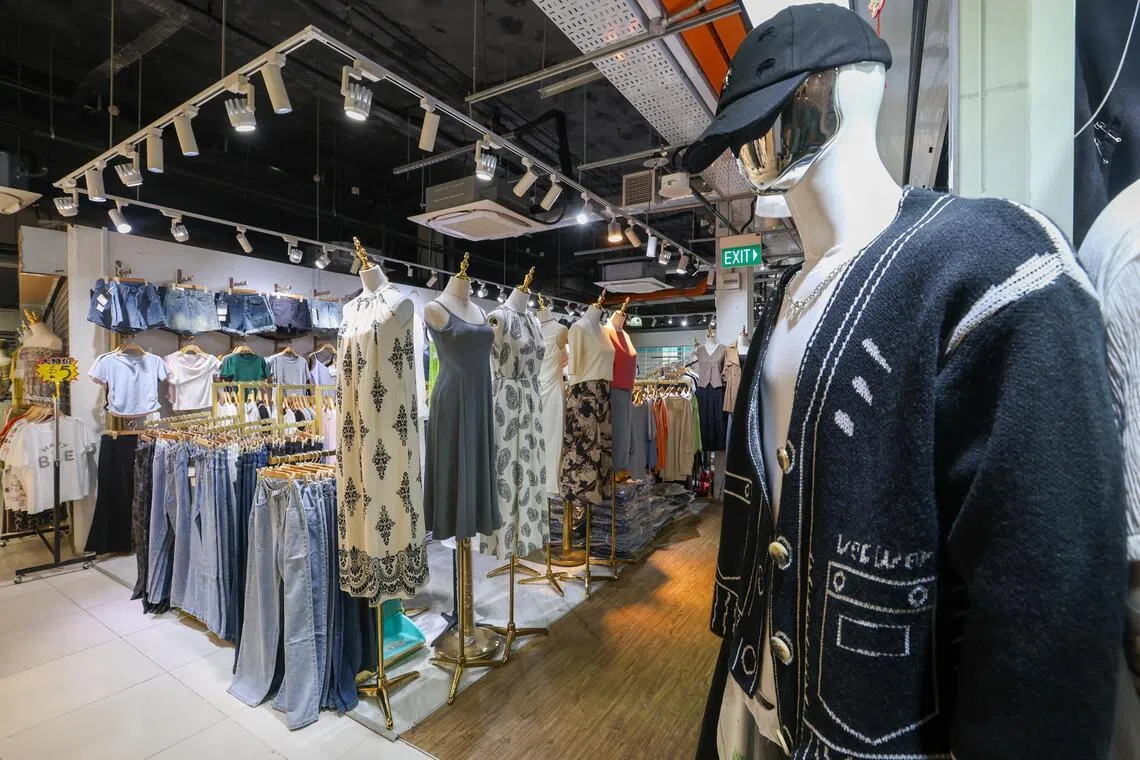
The remaining shops on Bugis Street’s second level see lower footfall.
ST PHOTO: JASEL POH
It is also a tourist hot spot, with buses often seen ferrying tour groups there.
In 2020, mall developer CapitaLand won the joint tender by the SLA, Singapore Tourism Board (STB) and Urban Redevelopment Authority (URA) to appoint a single operator for the integrated management of Bugis Village and Bugis Street.
Ms Cherie Lee, STB’s director for lifestyle and attractions, said: “We recognise that retail spaces naturally evolve to meet changing consumer preferences and market dynamics.
“CapitaLand’s vision to spotlight experiential concepts alongside independent businesses and emerging creators aligns with our broader strategy to develop differentiated lifestyle experiences across key tourism precincts.”
While the shop closures do not indicate an overall decline in demand for physical stores, consumers have become more selective about when they choose to visit brick-and-mortar outlets, said Mr Melvyn Suan, director for Nanyang Polytechnic’s Singapore Institute of Retail Studies.
When shopping is purely driven by convenience or price, many will choose to go online, especially with liveselling becoming more popular these days and delivery systems being more efficient, he explained.
“Physical retail remains important, but consumer expectations have shifted significantly. People now seek additional value when they visit a store – whether that’s an engaging experience, product discovery, or simply a compelling reason to spend time there.
“It is less about the decrease in demand, but more about the need for stores to evolve. There is genuine value in being able to view a wide variety of products in one location and finding something unexpected,” he added.
The Bugis Street spokesperson noted that “periodic tenancy adjustments are common as operators and tenants reassess space requirements, rental terms and business strategies during renewal exercises”.
“Even though it is a bulk renewal exercise, we take a customised approach with our tenants,” she said. “Renewal discussions are handled thoughtfully, with consideration for individual circumstances.”
The tenants’ retention rate and upcoming plans to refresh the space reflect a continued confidence in the location, she said, adding: “We also continue to remain in constant engagement with tenants to offer support they require.”

