


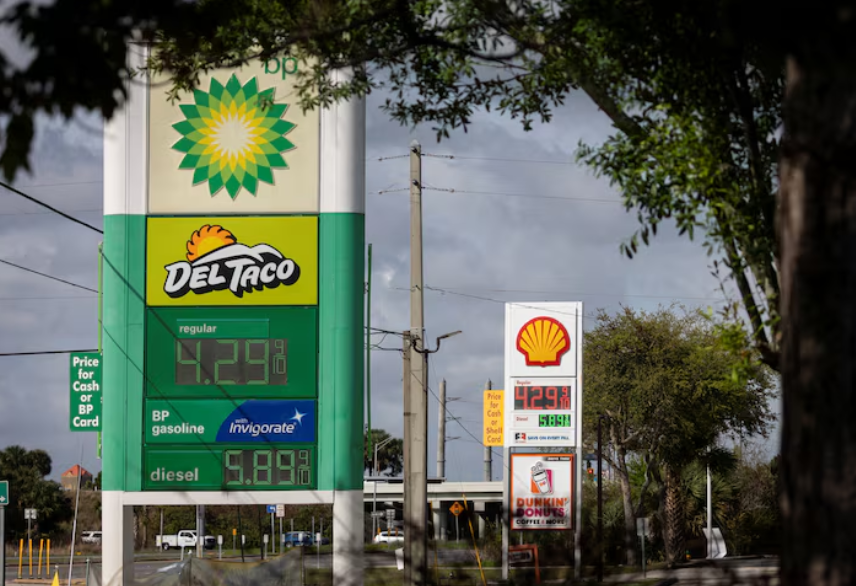
In the northeastern United States, average gasoline sales per gas station fell 4.3% month-on-month in March this year, according to data from popular cashback app provider Upside.
This is in contrast to the 0.6% month-on-month increase in average gasoline sales per gas station in March last year.
Upside tracks consumer spending at more than 23,000 gas stations across the United States.
Kevin Book, executive director of Clearview Energy, an energy market analyst, explained that it was expected that oil consumption would fall due to a surge in oil prices in the northeastern United States, where many commuters commute to work in large cities such as New York, Boston, and Philadelphia.
This is because office workers must commute to and from work, but there is an alternative to public transportation, and the fuel tax is also high.
Analysts see this as an early sign of the “destruction of demand” caused by the war in Iran.
According to the American Automobile Association (AAA), retail gasoline prices sold at U.S. gas stations have soared 28% since the blockade of the Strait of Hormuz following the Iranian war, with the national average at around $4 a gallon.
Americans are adjusting their lifestyle by not filling up their fuel tanks, carpooling, and refraining from unnecessary driving.
Signs of demand destruction are detected not only in the northeastern United States, which has relatively well-equipped public transport infrastructure, but also in areas that are not so dependent on automobiles.
Sales in the Rockies, including Arizona, Colorado and Utah, have reversed from a 3% increase last year to a 0.3% decline this year.
Sales growth in south-central states such as Tennessee, Kentucky and Alabama plunged to 3.6% this year from 7.2% last year.
The FT explained that despite the fact that the U.S. has a large land area and insufficient public transportation, it is difficult to destroy demand, consumers are feeling pressure to reduce oil use amid a widespread cost of living crisis.
He also analyzed that public sentiment due to rising gasoline prices is expected to be a big political burden on President Donald Trump ahead of the November midterm elections.
During the 2024 presidential campaign, President Trump pledged to lower oil prices to $2 a gallon.
“When oil prices rise, drivers are bound to blame the incumbent (president) unconditionally,” executive director Kim said, pointing out that there are few economic indicators that voters immediately feel like oil prices.
Those who cannot avoid driving choose low-grade fuel or refuel in small quantities.
Sales of high-end and intermediate-grade gasoline, which have higher octane values and better engine protection than regular gasoline, fell 7% and 3.6%, respectively.
Since the outbreak of the war, the number of refuels has increased by 10.7%, but overall sales by volume have only increased by 2.2%, making it clear that drivers tend to refuel frequently in small amounts without filling up their fuel tanks at once.
Samantha Lott, who lives in northern Texas and has mental health counseling while traveling by car, told FT that she refrained from meeting friends and even started selling food delivery part-time jobs and plasma to save on fuel costs.
“I only pump $10 to $15 at a time, hoping that I won’t run out of gas until more money comes in,” he said. “Delivery and plasma sales have become jobs to pay for gas.”
Fuel-saving apps and carpool apps have been showing explosive growth since the outbreak of the Iran War.
In March this year, the number of downloads for Gasbuddy, Mudflap, and Upside increased 453%, 95%, and 81%, respectively, compared to the previous month.
Carpool app BlaBlaCar grew 15% in the same period.
BloombergNEF estimated that for every month of the blockade of the Strait of Hormuz, there will be about 2 million barrels per day of demand destruction worldwide.
However, the amount of fuel supplied by refiners to retailers fell by 358,000 barrels in the week ended April 17 compared with a year earlier, according to official data from the U.S. Energy Information Administration (EIA).
However, this is not a significant decrease compared to previous years, and signs of demand destruction appear to be weak in U.S. national data.
David Doherty, head of BloombergNEF’s Natural Resources Research Team, said that because gasoline demand in the U.S. is inelastic, the drop in fuel supply nationwide is not significant.
JENNIFER KIM
US ASIA JOURNAL