


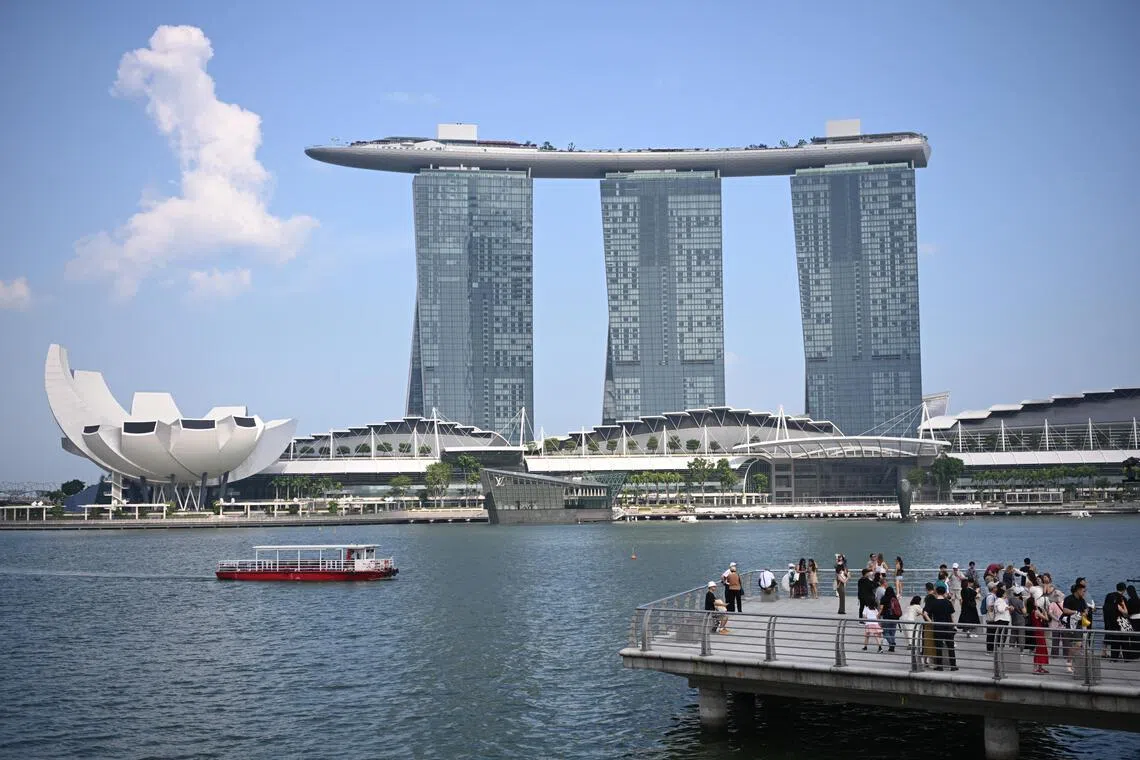
SINGAPORE – High-rollers flocking to Singapore helped propel Marina Bay Sands (MBS) to another jump in earnings, with strong casino activity driving a sharp rise in business in the first quarter of 2026.
“Singapore is an ideal market for high-value tourism spending,” said Mr Patrick Dumont, president and CEO of MBS parent company Las Vegas Sands, in an April 22 earnings call.
He added that MBS’ outstanding financial and operating results reflect the impact of the company’s investment in a market-leading product, world-class service and growth in high-value tourism.
Still, the operator could have done even better if luck at the tables had been more on its side.
Revenue growth was driven by a 16 per cent increase in mass gaming takings to US$902 million (S$1.15 billion), while rolling play – bets placed by premium players – surged, with volume more than doubling to US$18 billion.
Adjusted property earnings before interest, tax, depreciation and amortisation (Ebitda) rose 30.2 per cent year on year to US$788 million for the three months ended March 31, supported by strong demand from both mass-market visitors and high rollers.
But MBS’ earnings could have been about US$6 million higher if win rates at its high-stakes baccarat tables had come in at expected levels.
The win rate, or rolling hold rate in industry lingo, is the percentage of wagers the casino retains as revenue.
In the first quarter, MBS recorded a win rate of 3.56 per cent, which was slightly below its expected level of 3.6 per cent, resulting in the modest drag on earnings.
In recent quarters, the gap between actual and expected win rate has become more closely tracked following the rollout of smart table technology across MBS’ baccarat operations.
The system, which uses radio-frequency identification and AI-powered cameras, captures detailed data on player bets, allowing the casino to track changes in betting behaviour and calculate a more precise expected win rate for each period.
Smart table technology has been in place across all rolling baccarat tables at MBS for over 18 months, enabling the company to track and calculate its expected win rate compared with actual betting patterns.
Unlike in the past, when casinos relied on a standard benchmark, win rates are now measured based on this method and vary from quarter to quarter depending on how players bet.
These changes have helped lift expected win rates over time. At MBS, the expected hold rate has climbed from about 3.5 per cent in the third quarter of 2024 to as high as 4.2 per cent in 2025, before moderating to 3.6 per cent in the latest quarter as betting patterns shifted.
Higher expected win rates point to stronger underlying profitability, reflecting a higher house edge – a casino’s built-in advantage – even if short-term results fluctuate with luck.
Nevertheless, MBS’ results show a clear acceleration from a year earlier, reinforcing the Singapore integrated resort’s role as the group’s largest contributor to earnings.
Beyond gaming, Marina Bay Sands’ hotel occupancy was broadly unchanged even as rates climbed to more than US$1,000 a night on average from US$925 a year earlier. Revenue from retail, dining and conventions also increased.

