


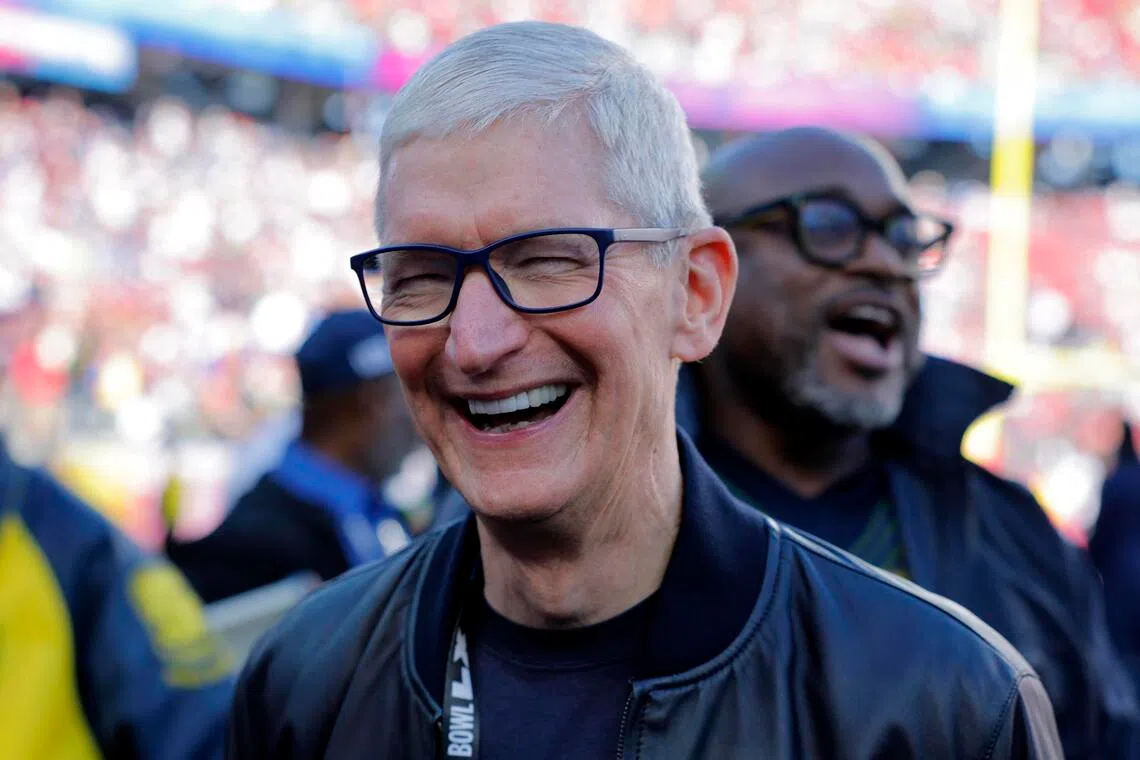
HONG KONG – Now that Tim Cook is shedding the yoke of running Apple, he can devote more time to an increasingly crucial role: acting as the company’s global ambassador.
In announcing his new job as executive chairman, Apple said that Mr Cook’s work will include engaging policymakers around the world, a task that holds new importance for the iPhone maker against a backdrop of US-China trade friction and rising geopolitical tensions from the Iran war.
While newly anointed chief executive officer John Ternus works to further Mr Cook’s work and embed AI into Apple’s devices, Mr Cook will tread a thin line between Washington and Beijing as the world’s two largest economies vie for supremacy. His new assignment extends the corporate diplomacy that defined his 15 years leading the iPhone maker.
As CEO, Mr Cook built the China-based manufacturing juggernaut that propelled Apple to tech’s upper echelon, where it ranked for years as the world’s most valuable company. He also took an early gamble nearly a decade ago in forging a close relationship with Donald Trump, making him one of the few tech industry leaders at the time to engage with the US president during his first term.
“Tim Cook moving to the executive chairman role makes strategic sense, and it is probably where he can continue to create real value for Apple,” said Francisco Jeronimo, vice president of client devices at IDC. “Freeing him from day-to-day operational responsibilities may make him more effective at what he has always done best: navigating complex geopolitical environments where personal relationships and institutional trust matter as much as any commercial argument.”
Thanks in part to Mr Cook, Apple had long enjoyed stable relations with Beijing. But that dynamic has in recent years been tested as tensions with Washington escalate and local firms such as Tencent Holdings and Huawei Technologies chip away at its business.
Apple has enjoyed by far the most success in China among its Silicon Valley peers – and arguably of any major US company in recent years. Mr Cook helped establish the vast iPhone City operation in Zhengzhou at a time most people associated the country with cheap knockoffs and low-margin goods. That early bet endeared Apple to Beijing decades ago.
Those moves were instrumental in making China the nexus of a global supply chain that today spans hundreds of companies, and Mr Cook’s regular visits to Apple stores and carefully managed social media posts have helped him win a loyal following. China remains Apple’s biggest single country market after the United States. Apple owes at least some of its success to the fact that – unlike, say, Alphabet’s Google – it scrupulously complies with Chinese content regulations.
As one of China’s biggest private employers through its vast ecosystem of local suppliers, Apple now must balance Trump administration threats to use tariffs to redirect flows of everything from memory chips to artificial intelligence processors. That’s as Beijing tries to mould a coterie of local players into global leaders in hardware and components.
Mr Cook’s next challenge will be to sustain Apple’s China presence while Washington and Beijing butt heads on everything from trade to the Middle East, creating a fraught environment for American enterprise. Government relations in China are far more critical to business success than in many other markets – and it’s where Apple is now struggling with weak consumer spending and the encroachment of powerful national champions such as Huawei and Xiaomi.
The economics of the business itself are changing as those same tensions snarl supply chains. Apple’s move to mitigate that risk by shifting the assembly of US-bound iPhones, for instance, has upset Beijing. Elsewhere, its market dominance has riled regional players with equally strong connections, such as Tencent and ByteDance. This year, Apple agreed to lower its App Store fees, in part to resolve those tensions and fend off accusations it wields too much clout in the local market.
A fresh test of Mr Cook’s diplomatic skills is taking shape in India, a potentially massive yet underdeveloped and complex market for the iPhone. Its fast-growing yet still-embryonic tech ecosystem remains a far cry from the scale and volumes of an iPhone City – the sort of critical mass that Apple demands to sustain its bottom line.
Tensions between New Delhi and Beijing are in some ways as complex as the friction between the US and China – it was only a few years ago that the Indian and Chinese militaries clashed in the Himalayas.
Exacerbating matters, India has made little secret of its intention to become a manufacturing powerhouse, at China’s expense if needed. But Mr Cook has less experience there, or connections with local manufacturing leaders such as Tata Steel or Reliance Industries, in an industry largely controlled by ambitious billionaires and their extended families.
Last year, Apple increased iPhone production in India by about 53 per cent, and it now makes a quarter of its marquee devices there, reflecting the US company’s efforts to avoid tariffs on China. In India, Mr Cook “was prepared to take a bold bet on domestic manufacturing at a time when few global majors were willing to do so,” said Aruna Sundararajan, a retired civil servant who served as the top bureaucrat in the tech and telecom ministries.
“What Apple has gone on to do in India will go down in history,” Mr Sundararajan said.
Mr Cook will also need to convince suppliers that Apple remains their best partner in the age of AI – and that includes its network of key manufacturers and enablers, from Taiwan Semiconductor Manufacturing Co. and Foxconn to Samsung Electronics and SK Hynix in South Korea.
For years, Apple has enjoyed unparalleled clout with its web of producers, because of its sheer volumes and reputation for quality, which in turn conferred credibility on its suppliers. But now Nvidia has become a larger source of revenue for TSMC, while Samsung and Hynix are focused on gaining the AI chip titan’s certification for memory. Even Foxconn – one of the linchpins of the iPhone’s global success – is growing revenue from servers far faster than from mobile devices.
Even as Mr Cook plays ambassador in other markets, he’ll have to keep a watchful eye on what’s happening in Washington – and maintain that relationship with Mr Trump, who once famously referred to him during a White House event as “Tim Apple.”
Mr Cook’s bond with Mr Trump has helped spare Apple from billions of dollars in US tariffs on goods from China and other countries, and their relationship will continue to prove essential as the administration weighs new rounds of levies against trading partners.
Back in 2017, Mr Cook’s outreach to Mr Trump made him an outlier for tech industry executives, but his example has since been followed by other Silicon Valley CEOs who now engage the president directly. Nvidia’s Jensen Huang and Meta Platforms’ Mark Zuckerberg have emerged as visible allies for Mr Trump – who in turn has endorsed their vision of large-scale AI adoption as part of his economic agenda.
In remarks to an all-hands meeting with employees on April 21, Mr Cook indicated he plans to build on his years of diplomacy on Apple’s behalf.
“This is an area where we’ve built relationships over multiple years and a decade-plus, and I think I can help with that,” he said. BLOOMBERG

