


BEIJING – At the world’s largest trade show, it’s not just the clientele that had a different look this year.
Despite the near absence of buyers wearing a traditional Arab headdress and robe at the Canton Fair, a vast showcase that started last week in China’s southern metropolis of Guangzhou, a brash new generation of tech companies stood out just as much. Few wanted to dwell on the war.
True, costs are on the rise, supply chains are creaking and delivery times are growing longer and more unpredictable. But the world’s factory floor is increasingly getting retrofitted for a new era of artificial intelligence and robotics, churning out technological innovation the world craves – and can afford – in war and peacetime.
Consider X-Human, a Guangdong-based manufacturer of cleaning robots for skyscrapers that still counts the Middle East as its biggest market. While it’s far from immune to the upheaval, global demand for its glass-clinging crawlers has been more than enough so far as orders continue to pour in from South-east Asia, putting the company on track for a 300 per cent surge in overseas revenue in 2026 after two straight years of 40 per cent gains, said Kelvin Ye, the company’s head of marketing.
“Mideast clients are taking a wait-and-see approach because of the logistical disruptions,” Mr Ye said. “We will spend more energy on developing other markets like Europe, the US and Asia. We’re not worried.”
Trade flows snarled by the war in Iran are adding a new obstacle course to navigate for tech-savvy firms like X-Human, which had its first deal with a US customer suspended in 2025 after tariffs imposed by President Donald Trump.
Now, the risk of a disruption is also high, with the Middle East and North Africa accounting for 7 per cent of China’s exports. In March alone, Chinese shipments to the region plummeted 43 per cent as Tehran all but closed the vital Strait of Hormuz in retaliation for US and Israeli strikes.
But after having to scour the globe for new markets during the trade standoff with the US, China’s latest crop of entrepreneurs is wielding technologies that make ever more of their shipments war-proof.
In the first quarter of 2026, high-tech exports surged nearly 30 per cent from a year ago, almost double the pace of overall sales abroad. The divergence between them and non-tech sales overseas follows a pattern that also emerged for other Asian countries since last year, based on research from S&P Global Ratings.
A harsher environment still awaits traditional labour-intensive sectors – ranging from makers of furniture and textiles to stationery – which will be showcased at the Canton Fair later this month and in May.
Those industries have suffered from increasing overseas competition and weak domestic demand in recent years. China’s exports of toys alone fell 15 per cent in the first quarter.
But the buzz over shiny new tech was evident at the Canton Fair, as the crowds thronged an area larger than 200 soccer fields, which organisers said drew some 167,000 overseas buyers as of April 17 – nearly 6 per cent more than in the previous year.
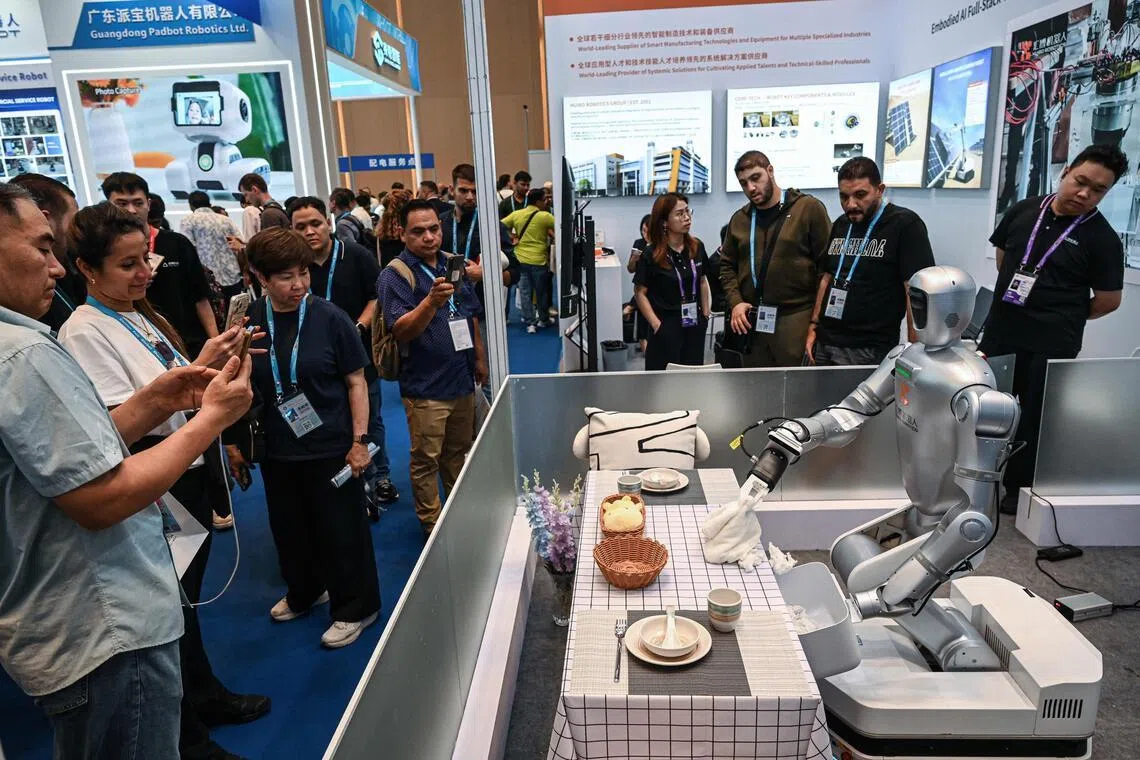
Some of the wares on offer seemed straight out of sci-fi: dozens queued to try on metallic exoskeleton suits, while others surrounded ball-shaped robots inspired by space travel that promise movement in extreme terrain and on the battlefield. Robots were everywhere, from AI toy dogs to humanoids.
The extraordinary surge in AI investment – with worldwide spending forecast at over US$2.5 trillion (S$3.2 trillion) so far for 2026 alone – is acting as a key propellant for tech exports. Already in 2025, China was the world’s largest supplier of AI-related goods, which Standard Chartered estimates netted over US$700 billion in sales and comprised almost a fifth of its total exports.
Apart from AI, innovative, high value-added products from industrial machinery to electric vehicles will likely keep China’s export momentum strong in the coming months.
Ivan Duan, vice general manager at Rotunbot – the maker of the amphibious spherical robots that could be used for police patrols or inspections at nuclear power plants – said orders for the first half of the 2026 have doubled from a year ago.
Mideast clients – Rotunbot’s main customer base – are still making inquiries online, but no one knows when actual shipments could go through. The goods may need to be rerouted through other regions, where they may face additional fees, Mr Duan said.
The cost to ship a container to the Middle East has surged to as high as US$4,000 now, roughly double the level before the war, according to Jason Ling, logistics business manager at OBD Supply Chain Management.
For Navy Liu, general manager of THRAY Design, higher oil prices are one of the big uncertainties hanging over overseas demand.
But orders for his company, which designs home appliances, are still projected to increase 50 per cent in 2026, driven by AI-enabled gadgets including pet monitors, according to Mr Liu. “Demand for such new products is pretty strong in Europe and the US,” he said.
Adding to a monthslong rally in metal prices, the oil spike pushed up costs for inputs ranging from plastics to fibres. At the same time, Chinese factories are finding their overseas clients generally more tolerant of price increases compared with domestic customers, limiting the squeeze on manufacturers’ profit margin.
Aleksandra Janowska, a buyer of garden machinery from Poland, said customers there have absorbed the 5 per cent price increase from Chinese suppliers in 2026. “Compared with similar products from South-east Asia, we are more inclined to source goods from China because the quality is better and they have a good price,” she said.
For China, however, the risk is that the export-driven boom could fail to feed through to the labour market because the manufacture of high-tech products requires far fewer human workers. Wages and employment deteriorated in the first quarter from already-weak levels.
For now, lucrative deals abroad make many businesses tick. And the prospect of post-war reconstruction is already drawing plenty of attention.
Lawrence Law, a sales manager from Jiangsu Province, said the Middle East’s eventual recovery could unlock a new source of demand for his company’s refrigeration equipment and copper tubing.
Already last year, rebuilding efforts in countries like Iraq and Syria made those countries among the largest markets by sales for a Zhejiang producer of valves, plumbing fittings and fasteners.
“Even in countries at war, ordinary people still have to live their lives,” said the factory’s sales manager, Leo Lin. “After the war is over, these countries will need additional supplies to rebuild their homes.” BLOOMBERG