


Follow our live coverage here.
SINGAPORE – I was meant to be dining at Flat Iron, a steak restaurant in London, with my family in March. I made the reservation the moment the slots opened, and we were looking forward to a holiday together.
But when it came to it, I sat alone at the table, devouring my steak portion for one.
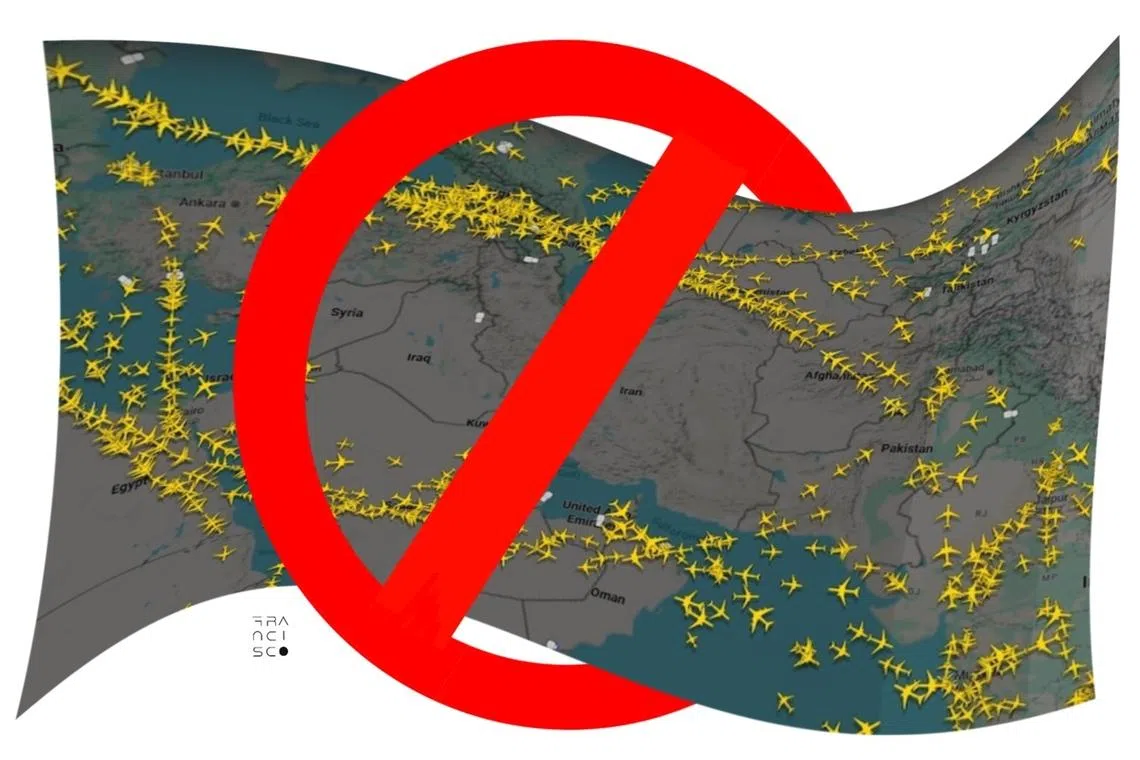
How did the family-of-four trip become a solo one? My family’s flight tickets on Emirates were cancelled due to closed airspace over Dubai when the Iran war broke out in end-February. I was flying direct on Qantas – having booked tickets earlier in 2025 – and so I simply went on my own.
Wartime is certainly not the right time to travel, but some already have tickets booked and face disruption in times of uncertainty, with no promises of easy refunds.
Even though Emirates offered my family a refund, there were so many other things to contend with – our accommodations, which were on a strict no-refund policy; train tickets to other cities; and many other little bookings.
The stress also multiplied because of heightened emotions. My mother had already packed her suitcase and was frantically searching for a replacement flight that did not have a layover in the Middle East.
But with just one week to go to our trip, there were few direct flights left that were under $3,000 a ticket, about three times more than what my family had originally paid for.
In the end, I went to London, ate my steak and cancelled the rest of our shared restaurant bookings. Instead, I ate sausage rolls in parks and little bowls of pasta at markets, and ambled along the river on my own.
My parents and sibling had paid around $4,000 in total for their hotel accommodations, while I stayed separately in another hotel as I was going to be in London for a longer period.
We also paid a few hundred dollars for train tickets for two day trips we had scheduled as a family.
Thankfully, not all is lost, as we are still in the process of claiming insurance for these losses, and the hotel is helping to waive some of them outside their policy.
In hindsight, although no one could have predicted a war would break out at the exact time it did, and in the way it did, we could have taken precautions, especially since the last few years have been some with heightened geopolitical uncertainty.
And while it is too late to do anything differently now, I will be more careful with future trips, especially those that are across the world and beyond the immediate Asian region.
Here are three things I will do next time:
My family went with Emirates because the airfares were cheaper, and sometimes, my parents prefer a break in between, rather than flying for 14 hours straight.
However, during periods of geopolitical turmoil, a direct flight might save the stress of having a layover disrupted due to tensions in the region.
This was not the first time it has happened. In June 2025, my parents’ Emirates flight from Europe to Singapore was nearly cancelled when a 12-day war broke out between Israel and Iran.
They would have been stranded in Austria if not for the fact that the war ended swiftly and flight routes reopened.
They do say “once bitten, twice shy”. In this case, we made the same decisions two years in a row – and I am determined that we will not make them thrice.
Of course, there are reasons people choose to have layovers. In an ideal war-free world where things are running smoothly, a layover is indeed a great reason to typically pay a lower rate and get the chance to stretch the muscles a little, before getting back into a cramped airline seat.
But while the world remains an unpredictable and scary place, direct flights might be the way to go, where possible.
I have a tendency to buy my flight tickets six months in advance, or whenever there is a sale. This means that I purchased my own tickets some time in October 2025 for a trip in March 2026.
But I typically think of buying travel insurance only a month before the actual trip, sometimes even just a few weeks before. It is often the last thing I think about after I have already purchased all my tickets, including those for trains, theatre shows and accommodations.
However, this means that any number of events out of my control could happen between the time I buy my first travel tickets and the time I buy insurance, which could mean the insurance no longer covers that event.
In this case, my family lucked out by buying insurance just before the end of February – the date the war began.
Indeed, the Singlife website recommends buying insurance once the trip is confirmed. It says “the unexpected can happen at any time no matter where you go, and buying your insurance only when issues happen will affect your coverage”.
Insurer FWD states clearly on its home page that the US-Israel-Iran conflict is now “considered a known event”, and any insurance bought after the war first broke out on Feb 28 at 2.38pm will not cover issues involving the Middle East and North African region.
It is also notable that some insurers do not cover war at all.
Media reports in the wake of the conflict reported that dismayed travellers found their travel insurance policies did not cover claims arising directly or indirectly from acts of war or armed conflict.
This was a big issue, especially since Middle Eastern transport hubs like Dubai, Doha and Abu Dhabi are key stopover hubs for flights connecting Asia and Europe. Travellers realised their flights, like my parents’, were cancelled, or they made the deliberate choice to cancel them for safety reasons.
A General Insurance Association of Singapore spokeperson said in March that the scale and unpredictability of armed conflict create risks that are difficult for insurers to price.
Hence, some insurers exclude war-related claims to keep premiums affordable for standard travel risks.
In this case, the important thing would be to read the fine print of insurance policies carefully before buying them.
It can be easy to just click on the cheapest policy, but reading the exclusions, especially during uncertain times, is a good idea.
For now, I am awaiting our insurance claims for my family’s accommodations and other tickets. Hopefully, doing our due diligence paid off.
We booked non-refundable hotel rooms because they were the cheapest option. But when the war broke out and my family had to cancel their trip, it meant we would be losing thousands of dollars.
In hindsight, we regretted taking the cheapest option that technically did not even allow postponing the trip or changing the dates.
It is a good reminder that in times of turbulence, it is best to book refundable tickets and accommodations as far as possible.
Even if it is not refundable, booking something that allows a change of dates is useful in case you want to postpone the trip to a later time when things are more stable, instead of cancelling it outright.
It was a difficult choice, especially since hotels in central London do not come cheap, and my instinct was to pick the most affordable option, which was non-refundable.
But perhaps paying that $200 more might be worth it just for peace of mind, especially at a time fraught with so much uncertainty.

