


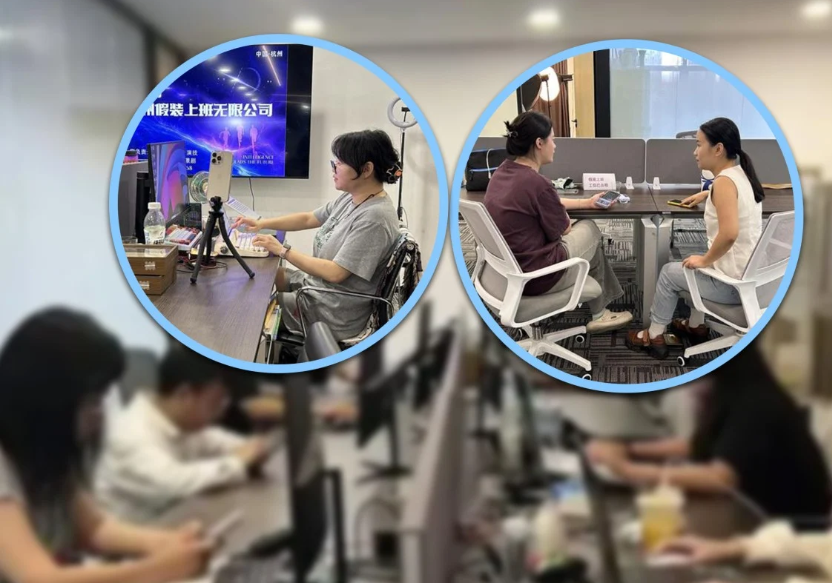
They come to work but don’t get paid. Rather, applicants flock to work even though they have to pay. According to the Chinese daily Jimu Shimbun, a fake work experience service that appeared in China has become a hot topic of conversation. It started as a simple joke, but it is interpreted as a new form of urban survival as demand explodes.
An office building in Binjiang, Hangzhou. On the surface, it looks like an ordinary office. Some people wear headsets and participate in meetings, while others look at the monitor and move their mouse. But most of them are not employees of this company. They pay to “experience going to work.”
The usage method is simple. The daily fee is 30 yuan, the weekly fee is 99.9 yuan, and the monthly fee is 300 to 400 yuan. There is also a 100 yuan discount program for prospective college graduates. After a certain period of time, there is even a “work overtime fee,” which is almost no difference from the actual work life.
This business item started with a joke. This company was originally an online shopping mall company, and there were many empty seats in the office. When the child of an acquaintance said that he wanted to experience the company life in advance, the light words led to a real business.
Since then, more-than-expected responses have been received when online applicants were posted. It spread quickly after being introduced on various social media sites in the summer of 2025, and inquiries continued as it became a hot topic again in March this year.
It’s not just those who want to spend time visiting this place. Various people, including content creators, teleworkers, and early start-up members, are using it to borrow work environments. In fact, most of the time in the office are doing their own work. The name is ‘fake work’, but it’s not a completely resting place.
The advantage is that the cost is low and the work efficiency is increased because it can work in an atmosphere similar to the actual working environment.
However, there has also been an unexpected problem. The CEO is most concerned about the situation in which “fake work” is misunderstood as an actual employment relationship. Some users said their family members got a job or requested the issuance of four major insurances or internship certificates, but the company rejected all of them. The company says it does not provide controversial services.
There are various reactions online, such as “Young generation is ingenious,” “It seems much cheaper and better than regular study cafes,” “Is it like another form of shared office?” and “There are too many fakes in this society,” and “It’s insane.”
On the outside, it looks like a “job game,” but behind it, the difficulty of finding a job, isolation from working from home, and the desire of the younger generation to belong somewhere overlap, leaving a bitterness.
JENNIFER KIM
US ASIA JOURNAL