


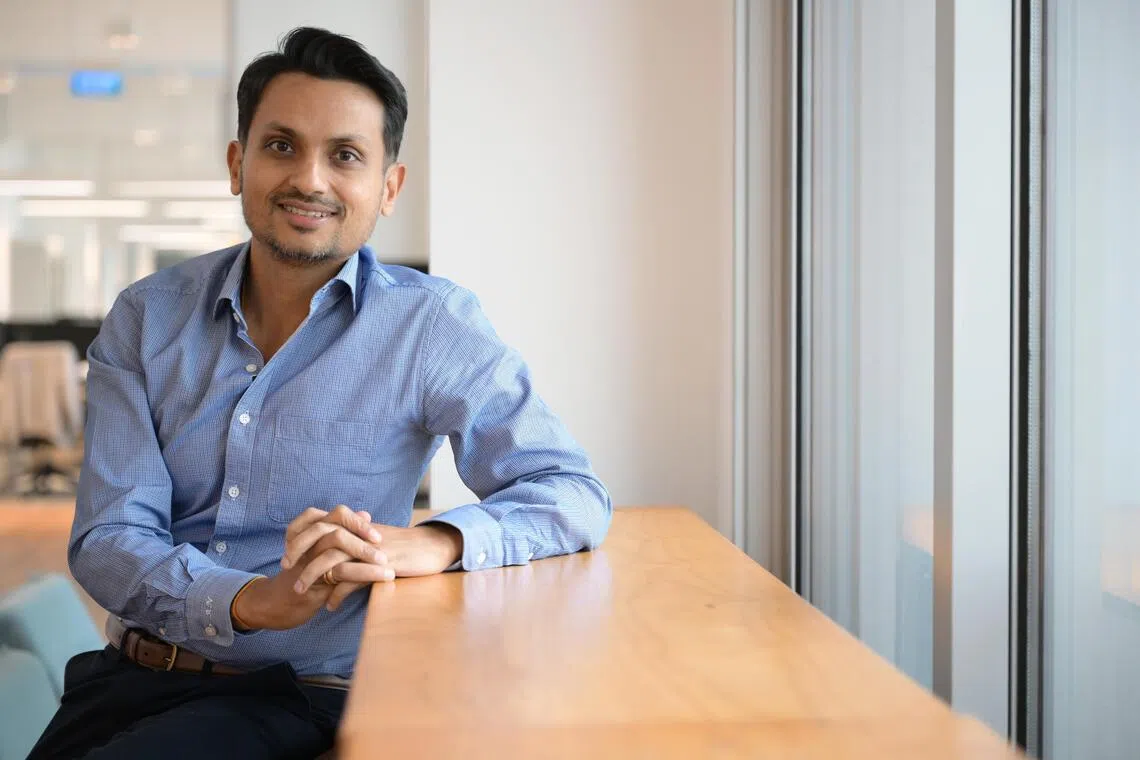
SINGAPORE – Mr Ayush Goyal grew up on Indian tea plantations, where his parents and grandparents worked as managers.
“My family’s cash in hand wasn’t much, but there were some perks that came with their jobs, like being given a house and a car,” said Mr Ayush, a Singapore permanent resident.
“It taught me that people can be happy and enjoy life even without a high disposable income… Ironically, despite growing up seeing it brewed every day, I don’t like drinking tea,” he said.
Mr Ayush is the Singapore country manager at Nasdaq-listed MoneyHero Group, which owns financial comparison platform SingSaver, personal finance community Seedly and affiliate marketing platform Creatory.
SingSaver lets users compare and sign up for credit cards, often with rewards, while Seedly hosts discussions on financial products and personal finance.
Mr Ayush takes a more relaxed approach to his own finances.
“I start with the best intentions to optimise every dollar, but I often end up using just a single credit card because I don’t really track my day-to-day spending,” he said.
“So, while I want to be a maximiser, in practice I’m not.”
Mr Ayush, 41, is married with two children.
A: My portfolio is diversified to balance growth, stability and long-term wealth creation.
About 20 per cent is in equities for long-term capital appreciation, while 30 per cent is invested via systematic investment plans, primarily into mid-cap equity and equity-debt funds.
Property accounts for 25 per cent, while 10 per cent is allocated to angel investments.
I also have about 10 per cent set aside for insurance, while the remaining 5 per cent is invested in new digital assets to explore emerging opportunities.
A: My most valuable asset is a house I bought in Gurgaon, India, in 2023. The property has appreciated by 30 per cent over the years.
A: I believe in disciplined, long-term financial planning. I automate savings while taking calculated risks, keep costs low and let compounding do the work.
A: I don’t currently invest in tangible or collectible assets such as art or trading cards. They can be interesting markets, but they require deep expertise to do well.
A: I collected stamps. It was fun hunting for rare ones and trading with friends. Definitely not an investment, but a hobby that taught me patience.
A: I started investing from the day I drew my first salary, which was during my university studies. I was selling co-branded credit cards at a mall. That was a three-month stint, and I put whatever I earned into a fixed deposit instrument.
A: I wish I had developed the habit of disciplined and regular investing when I was younger. My money would have grown much more due to the power of compounding.
A: I grew up in a middle-class family where we always had enough, but luxuries were rare. We couldn’t buy the latest gadgets, designer clothes, or take lavish holidays on a whim. Every expense had to be purposeful.
My parents invested in my future by sending me to one of India’s best boarding schools. There, I met students from all walks of life and truly understood the value of money – not just as a resource, but as a gateway to opportunity.
A: I wanted to be a sports manager or agent when I was growing up. I loved the idea of managing athletes and being part of the action.
I was a sales manager selling life insurance and managing a fleet of financial planning advisers.
A: I worked for a bank selling their co-branded cards.
A: As a child, I saved for small personal goals like toys, a cricket bat, a tennis racket or a Walkman.
I’ve carried that habit into adulthood. My savings are structured through systematic investment plans, stocks and property, always with a purpose and long-term focus.
That said, unlike my growing-up days, there is now an abundance of information readily available across social channels, websites like SingSaver and other platforms.
This wealth of accessible knowledge has made it easier to make informed decisions, understand different investment options and plan more effectively for the future.
A: My first real lesson about money came at boarding school when I was 13. I saw how it shaped opportunities – some students could afford international trips or the latest Wilson tennis rackets, while others could not.
I remember a friend whose dad went to the US for an executive course and brought back Pop-Tarts, then a total novelty. He hoarded them until the last day of term, and all 30 boys queued for a small piece.
Moments like these taught me that money isn’t just about comfort: it’s about freedom, choice and the ability to create opportunities for yourself.
A: Take control of your money, and don’t wait until you earn more to start saving, investing and making thoughtful decisions.
A: I rent a condo in the east of Singapore.
A: I drive an MG HS.
A: I just bought a golf club membership in Johor; I consider it a “guilty pleasure”.
A: I don’t define work-life balance by the number of hours in a day.
A traditional 9 to 6 doesn’t really exist any more. We’re all constantly connected, thinking about work even when we’re not actively working.
Balance is about being 100 per cent present wherever I am. I have two small kids, and, like most parents, I often feel I don’t get as much time with them as I’d like. So I focus on making the time we do have together meaningful.
A: I’ve never been an indulgent or impulsive spender, but when I first started earning, my spending wasn’t very thoughtful. I’d make more frivolous purchases like travelling or going out with friends.
Over time, especially after starting a family, my approach became much more intentional. I prioritise saving, investing and spending on things that truly add value to my life and my family’s.
A: My perfect day starts with an early morning reset followed by focused work on key priorities. I have brunch with family, recharge in the afternoon, play tennis in the evening, and finish the day by having dinner with friends.
A: I would first ensure my family’s financial security and create a strong foundation for long-term wealth through diversified investments – stocks, exchange-traded funds, property and start-ups.
I would probably buy a house in Singapore immediately. I would also focus on purposeful spending such as supporting causes I care about and investing in opportunities that create meaningful impact.
A: I would focus on buying food and basic necessities.
-
Check out The Straits Times InvestMe microsite for exclusive content and courses to boost your financial literacy.

